15 Iconic ’90s Snacks Every Kid Loved and Still Craves
The ’90s snack aisle was not a food category. It was a fluorescent psychological event. Every lunchbox came with sugar, plastic, cartoon mascots, foil wrappers, mild nutritional neglect, and the quiet belief that blue raspberry was a naturally occurring flavour.
There was a time when childhood tasted like red dye, fake cheese dust, frosting in a plastic compartment, and fruit snacks that contained very little fruit but a surprising amount of authority.
If you were a ’90s kid, snacks were not just snacks. They were currency. They were social ranking systems. They were lunchroom politics wrapped in crinkly packaging. One kid had Dunkaroos and suddenly became the mayor of third period. Another had plain apple slices and was forced to learn resilience before fractions.
The ’90s snack era was chaotic, chemically joyful, and completely unbothered by modern wellness language. Nobody was asking whether the blue pouch supported gut health. Nobody was wondering if the pizza cracker stack was ultra-processed. Nobody was making a TikTok about seed oils while holding a Capri Sun like a tiny liquid briefcase.
We were children. We wanted sugar, novelty, and packaging that looked like it had been designed by a committee of cartoon raccoons.
And honestly? The snacks delivered.
LUNCHBOX HISTORICAL NOTICE
This article is nostalgia, snack anthropology, and one adult staring into the fluorescent pantry of her childhood. It is not nutritional advice. If you are looking for a balanced meal plan, please exit through the vegetable aisle and take your dignity with you.
We are here for 90s snacks, nostalgic snacks, childhood snacks, discontinued snacks, and the emotional damage of remembering how good frosting tasted when it came with cookies shaped like a kangaroo’s marketing department.
COMMON SIDE EFFECTS OF REVISITING ’90S SNACKS
- Sudden craving for foods you have not trusted since 1998
- Remembering lunchroom trades as a legitimate economy
- Realizing your childhood palate was mostly corn syrup and branding
- Defending Gushers with the emotional force of a Supreme Court argument
- Wondering why everything tasted better when it came in foil
- Accepting that nostalgia is just memory with preservatives
The ’90s lunchbox was not packed. It was curated by chaos.
Capri Sun, crackers, and childhood diplomacy
Why ’90s Snacks Hit So Hard
The reason 90s snacks still have a chokehold on grown adults is not because they were objectively better. Some of them were barely food. Some were engineered sugar architecture. Some tasted like a dare from a focus group wearing windbreakers.
But they were fun.
Modern snacks often want to improve you. They promise protein, fibre, clean ingredients, adaptogens, electrolytes, collagen, gut support, focus, calm, glow, immunity, productivity, and the vague possibility that your life might become less embarrassing if you buy a $6 bar made of dates and moral superiority.
’90s snacks wanted nothing from you except your attention span and possibly your dental enamel.
They were bright. Weird. Playful. Unashamed. Fruit snacks had shapes. Yogurt came in tubes. Cookies came with frosting. Drinks came in metallic pouches that required weaponized straws. Pizza was somehow a cracker, a roll, a bagel, and a lunch concept.
It was less “wellness” and more “what if childhood had a flavour lab and no adult supervision?”
That is why they still work as nostalgia. They do not remind us of nutrition. They remind us of recess, book fairs, sleepovers, school cafeterias, and the tiny thrill of opening a lunchbox and realizing someone had packed you something with enough sugar to briefly become interesting.
If this is your kind of cultural spiral, you may also enjoy our deep dive into 90s and 2000s food trends, which was apparently a period when society looked at neon yogurt and said, yes, civilization is going well.
The Fruit Snack Industrial Complex
Fruit snacks were the backbone of the ’90s lunchbox. They suggested fruit in the same way a scented candle suggests an orchard. Technically related. Emotionally persuasive. Nutritionally, let us not involve the courts.
1. Gushers
The tiny fruit grenade with a liquid centre
Gushers were not just a snack. They were an event. You bit down and suddenly your mouth was dealing with a sticky internal surprise, like a candy lawsuit. General Mills’ own fruit snack history notes that Gushers arrived in 1992, which makes sense because the early ’90s were exactly the kind of time that would look at fruit snacks and ask, “But what if they bled?”
They were strange, dramatic, and slightly unsafe in spirit. Perfect lunchbox material.
2. Fruit Roll-Ups
Edible plastic, but make it fashion
Fruit Roll-Ups gave kids permission to play with food in a way that felt legally sanctioned. The peel-outs. The tongue tattoos. The weird stretchy faces. The feeling that you were eating a laminated document from a fruit-themed court case.
They were less snack than activity. A child could turn one Fruit Roll-Up into a ten-minute production involving tearing, folding, sticking it to fingers, and finally eating it in a way that made adults quietly question the future.
3. Fruit by the Foot
A measuring tape for children with no plans
Fruit by the Foot joined the General Mills fruit snack lineup in 1991, which is probably the most ’90s sentence available without mentioning slap bracelets. It was long, sugary, and completely impractical. Naturally, children loved it.
There was no elegant way to eat Fruit by the Foot. You either folded it into a wad like a goblin or unrolled the whole thing with the seriousness of a town crier. Either way, dignity was not invited.
4. Shark Bites
Aquatic fruit snacks with lunchroom mythology
Shark Bites had lore. The white shark was treated like treasure, currency, and prophecy. A kid who opened a pack with multiple white sharks became briefly important, which is childhood’s version of being invited to Davos.
They tasted like every other fruit snack and yet somehow felt more dangerous because they involved sharks. Marketing, unfortunately, works.
Fruit snacks were the original lesson in branding. The shape mattered. The wrapper mattered. The mascot mattered. The fact that adults called them “fruit” mattered most of all, because children understood loopholes before they understood taxes.
Fruit snacks taught us that food could be shaped like marine life and still count as lunch-adjacent.
The FDA looked away, spiritually
The Lunchbox Power Snacks
Not all childhood snacks were equal. Some were simple. Some were elite. Some changed the social weather of an entire cafeteria.
5. Dunkaroos
Cookies, frosting, and schoolyard status
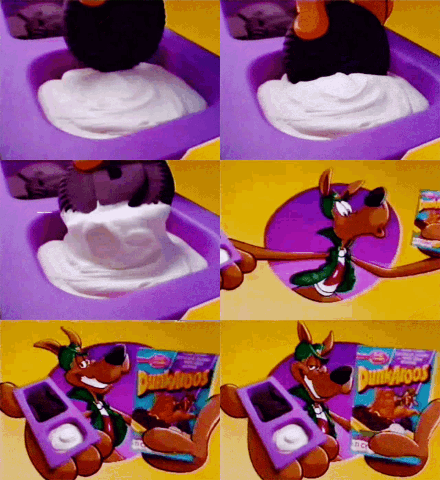
Dunkaroos were the snack equivalent of arriving in a limo. Cookies on one side, frosting on the other, and absolutely no adult pretending this was anything other than dessert in disguise.
General Mills says Dunkaroos were a fan favourite from 1990 and returned to shelves in 2020. That return was not just a product relaunch. It was a millennial group therapy session with sprinkles.
The genius of Dunkaroos was the illusion of control. You decided how much frosting each cookie received. You became your own snack architect. Naturally, everyone ran out of cookies before frosting and then faced the moral question of whether to eat the rest with a finger. The answer was yes. Childhood had no HR department.
6. Lunchables
A charcuterie board for children with Capri Sun breath
Lunchables made kids feel like tiny adults assembling an unpaid catering platter. Crackers. Meat circles. Cheese squares. Maybe a miniature pizza situation if your parent was feeling generous or had simply given up.
The real magic was assembly. You were not eating lunch. You were constructing lunch. This gave children the illusion of agency while still consuming a meal whose emotional centre was processed cheese.
Modern adults can debate sodium, processing, school lunches, and nutrition policy. Fair. But the kid version of you did not care. The kid version of you saw a Lunchable and thought, finally, architecture.
7. Kid Cuisine
A frozen dinner with a penguin and no shame
Kid Cuisine was what happened when dinner became a TV commercial with compartments. The brownie had its own territory. The corn existed mostly as a witness. The entrée was whatever the freezer decided would technically qualify as food that day.
It was not gourmet. It was not subtle. It was not concerned with plating. It came in a tray and looked like a children’s hospital cafeteria got funding from a cartoon penguin.
And still, if you were a kid, it felt like luxury.
8. Bagel Bites
Pizza, but tiny enough to justify eating eleven
Bagel Bites were built on one perfect lie: if pizza is small, it is somehow less serious.
They came out of the oven hot enough to damage your bloodline, then cooled into a chewy little saucer of sauce and cheese. Every bite was either frozen in the middle or molten enough to file charges. There was no middle ground. Only childhood.
9. Totino’s Pizza Rolls
Lava pockets for reckless children
Pizza Rolls taught patience by punishing those without it. You either waited or accepted that the inside of your mouth would be redesigned by molten tomato paste.
They were dangerous, delicious, and weirdly communal. A plate of Pizza Rolls in the middle of a sleepover had the emotional importance of a campfire. Everyone gathered. Everyone burned themselves. Nobody learned.
This is why 90s kid nostalgia hits so sharply. It is not only the snacks. It is the entire ritual around them: lunchboxes, sleepovers, microwaves, cafeterias, snack trades, and eating something objectively suspicious while watching cartoons like society had achieved balance.
The Candy That Built Character, Mostly Through Dental Risk
90s candy had range. It could be sweet, sour, sticky, chalky, explosive, powdered, tubular, or dispensed from a plastic baby bottle because the decade was apparently unsupervised.
10. Ring Pops
Jewelry you could lick in public
Ring Pops were glamour for children with no access to actual jewellery and no understanding of germs. You wore candy on your finger and occasionally remembered to eat it. Elegant. Sticky. Deeply impractical.
They made kids feel fancy in the most chaotic possible way, like a sugar heiress at recess.
11. Push Pops
A lollipop with storage issues
Push Pops were designed around the promise that you could save candy for later. This was disgusting in theory and magnificent in practice.
You would push it up, lick it, push it back down, and place it somewhere horrifying like a backpack pocket. Somehow we survived. Medical science remains too quiet about this.
12. Warheads
Sour candy as a personality test
Warheads were less candy than a dare wrapped in cellophane. The whole point was pain, which children accepted because childhood social status often requires unnecessary suffering.
You did not eat Warheads for pleasure. You ate them to prove you could. This explains a lot about adulthood, unfortunately.
13. Baby Bottle Pop
Candy, but make it weirdly infantile
Baby Bottle Pop was a lollipop dipped into sugar powder from a tiny plastic bottle. Conceptually upsetting. Commercially brilliant. Musically unforgettable if the jingle ever lodged itself into your developing brain.
The ’90s looked at candy and asked, what if we made this stranger? Then it did. Repeatedly.
These were not snacks in the modern sense. They were sensory events. You ate them loudly, visibly, and with consequences. Much like the clean girl aesthetic later proved, culture always swings between controlled polish and complete chaos. The ’90s snack aisle chose chaos and added sour powder.
The Discontinued Snacks We Still Talk About Like Lost Lovers
Nothing gives a snack emotional power like disappearance. The minute something becomes one of those discontinued snacks, it stops being a food and becomes a wound.
14. Kudos Bars
A candy bar pretending to have after-school values
Kudos Bars occupied a strange category. They looked like granola bars. They behaved like candy bars. They allowed adults to pretend something productive had happened.
The chocolate drizzle was doing a lot of narrative work. It whispered “treat” while the oats whispered “responsible.” This is exactly the kind of identity crisis that made the ’90s snack aisle great.
15. Squeezits
A drink bottle shaped like bad judgment
Squeezits were drinks, technically, but they belonged in this conversation because they had the emotional energy of a snack. The bottle had a face. The liquid was aggressively colourful. The cap required child-level commitment. Everything about it suggested that hydration had gone through a toy factory and lost its innocence.
Were they good? Maybe. Were they memorable? Absolutely. Were they part of the same universe as neon yogurt, cartoon mascots, and lunchroom trades? Without question.
The funny thing about nostalgic snacks is that half the craving is not really for the food. It is for the version of yourself who ate it without checking ingredients, reading discourse, or wondering whether a drink through a straw would later become part of your acid reflux storyline.
Childhood snacks were simple because childhood was not simple, exactly, but because adults kept the complications out of frame. You did not know about grocery budgets, food marketing, school nutrition debates, or whether your mother bought the name-brand snacks because she loved you or because they were on sale.
You only knew that opening your lunchbox and finding Dunkaroos meant the day had improved.
THE REAL REASON WE MISS THEM
We do not only miss the snacks. We miss the era when a lunchbox could fix the mood. When a fruit snack shaped like a shark felt meaningful. When a tiny pizza bagel counted as joy. When nobody was asking whether our childhood cravings were “optimized.” They were not. That was the point.
Why Nostalgia Food Keeps Coming Back
Brands understand nostalgia because nostalgia is profitable. It softens people. It makes grown adults buy cereal because the box resembles a childhood cartoon and their nervous system briefly forgets rent exists.
That is why retro snacks keep returning, either as relaunches, limited editions, novelty flavours, or TikTok-fuelled rediscoveries. Dunkaroos came back. Old candies resurface. Grocery stores suddenly stock products that feel like they were summoned from a Blockbuster parking lot.
The pitch is never just taste. It is time travel.
Buy this and remember being small. Buy this and remember Saturday morning. Buy this and remember school lunches, sleepovers, field trips, book fairs, pencil cases, Lisa Frank folders, and the deep emotional drama of someone else getting the snack you wanted.
Nostalgia food works because it is not honest. It edits. It removes the awkwardness, the stress, the bad haircuts, the school anxiety, the weird family dinners, the adults fighting in other rooms. It leaves the snack.
And sometimes, honestly, that is enough.
We do the same thing with culture in general. The internet gets nostalgic for eras like 2016 internet nostalgia, pretending a messy year was simpler because the filters looked better and the stakes felt smaller in hindsight. Snacks are just the edible version of that. Less discourse, more frosting.
Nostalgia is not memory. It is memory after the preservatives kick in.
Still delicious, unfortunately
Were ’90s Snacks Better, or Were We Just Smaller?
This is the question nobody wants answered too directly.
Were ’90s snacks actually better? Some, yes. Some were probably carried by marketing, novelty, and the fact that our taste buds had not yet developed standards. There is a real chance half these snacks would disappoint us now if eaten under adult lighting while checking email.
That is the danger of revisiting childhood food. The memory is often better than the product. The packaging was brighter. The stakes were lower. Your metabolism had not yet become political. Nobody was tracking protein. Nobody was explaining gut health. Nobody had yet been personally victimized by a Stanley Cup and gut health spiral.
You were just a kid with a snack.
And maybe that is why these foods still hit. Not because they were gourmet. They were not. Nobody needs to pretend a Push Pop was artisanal. But they belonged to a time when joy could be small, wrapped, and traded across a cafeteria table.
That kind of joy is hard to scale. Brands try. Algorithms try. Nostalgia listicles try. This one is, admittedly, also trying. We all have bills and childhood wounds.
But the real thing was simpler.
You opened the package. You ate the snack. For six minutes, life improved.
This article is for you if…
You searched 90s snacks and wanted more than a lazy list.
You still remember the social power of Dunkaroos.
You believe Gushers were a legitimate childhood event.
You enjoy nostalgia with jokes, sources, and mild food-related grief.
Skip it if you…
Want nutrition advice. Truly, wrong building.
Think Lunchables were emotionally neutral.
Do not understand why the white Shark Bite mattered.
Need childhood to remain tasteful. It was not.
The Final Bite
The best ’90s snacks were not subtle, refined, clean, natural, or sensible. They were loud. They were strange. They were sweet enough to make a dentist stare into the middle distance.
They were also fun.
And fun is underrated now. Everything has to justify itself. Snacks have to be functional. Hobbies have to become brands. Rest has to become recovery. Water has to become an identity. Even nostalgia has to be optimized for engagement, which is grim but here we are.
Maybe that is why these snacks still matter. They remind us of a time before everything had to improve us.
Sometimes a snack was just a snack.
Sometimes it was frosting and cookies in a plastic tray.
Sometimes it was a fruit snack shaped like a shark.
Sometimes it was a tiny pizza that burned your mouth and still felt worth it.
That is not health. That is not wellness. That is not progress.
It is memory, dyed blue, wrapped in foil, and somehow still stuck to the roof of your mouth.
The ’90s snack aisle raised us badly, but with commitment.
And honestly, we respect the vision
90s Snacks
Nostalgic Snacks
Childhood Snacks
Discontinued Snacks
90s Candy
Retro Snacks
School Lunch Snacks
Nostalgia Food
More culture essays with artificial flavouring.
Browse Culture, where nostalgia gets interrogated first.
Browse Culture →