The Internet Is Nostalgic for 2016 Again
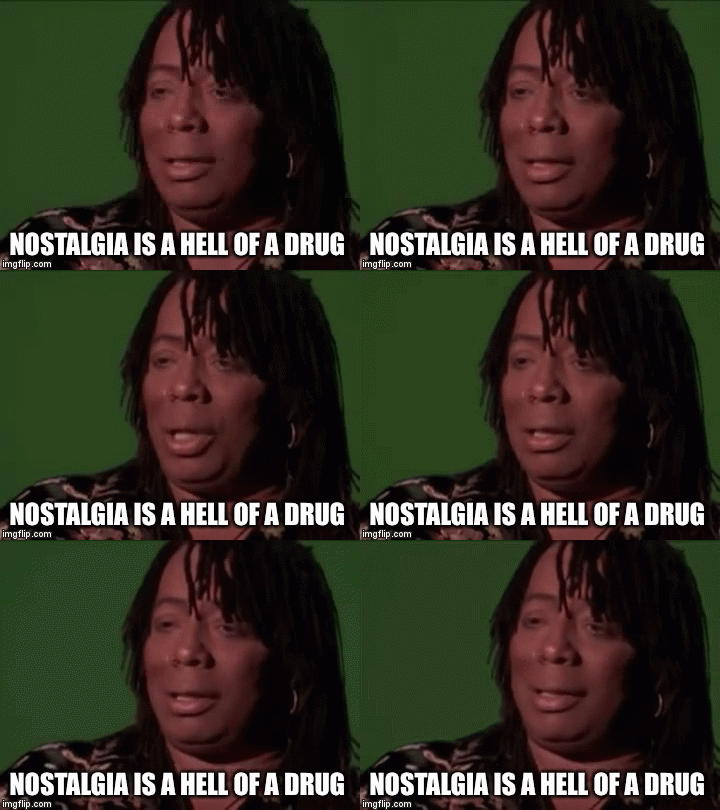
We Are Romanticizing 2016 Now.
Not the 90s. Not Y2K. Not even peak Tumblr. The internet has chosen its newest nostalgia target — and it's weirder than you think.
Something Strange Has Been Happening
Spend ten minutes on TikTok, Instagram, or Reddit and you'll start noticing the pattern. Old memes resurfacing. Instagram photos looking aggressively saturated again. Flower-crown filters making cameo appearances like they were never properly buried in 2018.
The internet has decided to romanticize 2016. Not the 1990s — which had its nostalgia era, peaked, and got turned into a Halloween costume. Not the early 2000s, which has been thoroughly mined for aesthetic content. Not even the Tumblr-heavy early 2010s, which arguably deserved more appreciation than it received.
Specifically, 2016. A year that most people, at the time, were desperate to escape. And yet here we are, ten years later, collectively deciding it was actually kind of great.
The Atlantic and other major outlets have started noticing the same pattern: nostalgia cycles online are accelerating rapidly. Cultural aesthetics that once took decades to return now reappear within just a few years. The internet now treats its own history the way people treat leftovers. Everything eventually gets reheated.
When the Internet Was Slightly Less Engineered
To understand the appeal of 2016, it helps to remember how different the internet actually felt back then. Instagram was chronological. If someone posted a photo, you saw it — in order — instead of waiting for an algorithm to decide whether your brain deserved to see it.
TikTok didn't exist yet. Vine was still producing chaotic six-second videos filmed by people who looked like they'd just discovered caffeine and a phone camera simultaneously. Twitter was messy, but still oddly organic. Memes appeared randomly. Tumblr posts spread because people liked them, not because someone had A/B tested the thumbnail.
The internet felt slightly less engineered. And that feeling — that sense of stumbling across things rather than being fed them — is what people are actually nostalgic for. Not the flower crowns. The serendipity.
The Algorithm Took the Wheel
The biggest difference between 2016 and today can be summarized in one word: algorithms. Modern social platforms are built around recommendation systems designed to keep people scrolling for as long as possible. Feeds now prioritize engagement above almost everything else — above recency, above quality, above what you actually said you wanted.
Content isn't simply shown. It's curated, ranked, optimized, and carefully delivered. Creators learn quickly what performs well. Certain editing styles spread. Certain storytelling formulas dominate. Eventually the entire internet begins to look like a house where every room was decorated by the same interior designer — competent, inoffensive, and completely interchangeable.
Which may explain why older internet aesthetics suddenly look refreshing. Even the questionable ones. Even the ones involving ring lights, aggressive Valencia filters, and fonts that had no business being on a motivation poster.
How We Got Here
But Let's Be Honest: It Was Probably the 90s
Here's where things get interesting. If the internet is nostalgic for 2016, the next question practically asks itself: why stop there?
Because if people are really craving simpler times, the real nostalgia target might be the 1990s. Before smartphones lived in pockets. Before social media turned everyone into a broadcaster. Before every moment of life had the potential — or the pressure — to become content.
The internet now lives in your bloodstream. It's ambient. It's always-on. And the human brain, which evolved for neither infinite scroll nor algorithmic dopamine loops, is registering the dissonance in the form of nostalgia for any era when things moved slower. 2016 is the nearest exit. The 90s is the actual destination.
Nothing Truly Disappears Online. It Just Waits.
Here's what the nostalgia cycle is actually telling us: the internet is aware of itself now. It knows it's changed. It knows the early version of it — chaotic, chronological, slightly unhinged — was something people could live inside differently than the current one. And it's processing that awareness the way humans have always processed loss: by romanticizing the thing that's gone.
2016 wasn't actually better. It had plenty of its own disasters, algorithmic or otherwise. But it was the last year before the optimization fully arrived, before the feed became truly curated, before every creator had to understand engagement metrics just to reach the audience they already had.
At the Brewtiful Living desk, we'll keep watching the nostalgia cycle unfold. Because if the internet has taught us anything, it's this: nothing truly disappears online. It just waits a few years, comes back pretending it was always iconic, and gets a Pinterest board dedicated to it.
Stranger things have happened. Online, they usually happen twice.