Why Freida McFadden Feels Like a Drug You Can Read
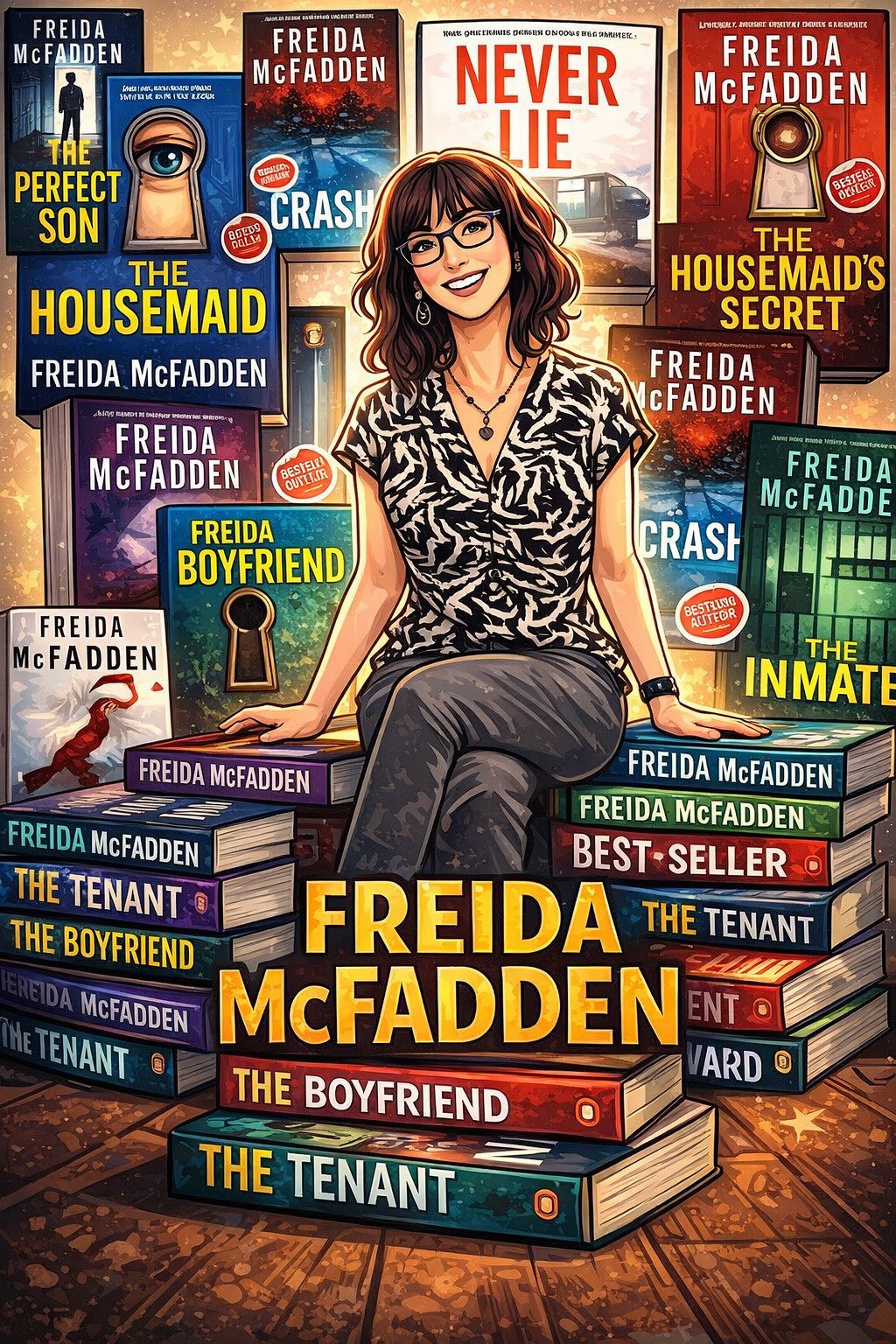
There’s a particular kind of reading experience that doesn’t feel like “literature” so much as it feels like chewing through a door to see what’s on the other side. Freida McFadden specializes in that.
You came here for the primal answer, not the polite one. So here it is: her books are built to hijack your threat detection system. They press on the same internal buttons as a whispered rumor, a locked room, a text you should not open, and a smile that lasts half a second too long.
And the wild part is that this isn’t accidental. McFadden’s whole public story is basically a case study in controlled contradiction: a practicing physician (often reported as working with brain injury) who writes under a pseudonym, keeps a low profile, and still pumps out compulsive thrillers that travel by word of mouth like a virus.
Let’s get into what makes the books so juicy on a deep human level, using the kind of logic your brain pretends it doesn’t run on.
1) She writes in the language of suspicion
A lot of thrillers want you to admire the plot. McFadden wants you to distrust the room you’re standing in.
Her setups are clean, familiar, and socially loaded. A couple. A house. A job. A neighbor. A relationship that looks normal from the sidewalk. Then she starts introducing micro-threats: small inconsistencies, missing context, awkward timing, a detail that doesn’t match the vibe.
That’s the oldest human alarm system there is. “Something’s off.” Not “someone is evil,” not “there’s a murderer.” Just off. Your brain doesn’t like “off.” Your brain wants to resolve it. So you keep reading to restore order.
This is the same reason people can’t stop listening when someone says, “Don’t tell anyone, but…” It’s not the content. It’s the pattern.
2) Her pacing is engineered, not vibes-based
You know how some books feel like they wander until the author decides to start the story?
McFadden does the opposite. The scene-to-scene momentum is aggressively functional. Chapters end like the book is physically grabbing your sleeve. This is why people describe her work as “unputdownable” in reviews, even when they’re not trying to be poetic about it.
That “just one more chapter” effect isn’t magic. It’s reward scheduling, the same behavioral loop that makes you refresh your feed. You get a partial answer, then a new question, then a sharper threat, then a new angle. The payoff is always close enough to chase.
3) The domestic setting is the trap
McFadden’s most effective move is also the simplest: she puts danger where people expect comfort.
Homes, relationships, caretaking roles, marriages, tenants, employers. These are not neutral spaces. They’re emotionally expensive spaces. They come with power dynamics and unspoken rules. And that’s where the “primal” thing kicks in.
Because the home is supposed to be where you drop your guard. So when a story poisons that setting, it hits harder. Your brain treats it like a violation of a survival contract.
That’s why the Housemaid premise exploded so hard culturally that it didn’t just become a popular book, it became a full mainstream adaptation pipeline. The film adaptation of The Housemaid has been treated as a big commercial event, with reporting on its box office performance and franchise plans.
Even if you never see the movie, the existence of the movie matters. It tells readers: this isn’t just your niche little obsession. This is the kind of story structure that scales.
4) She weaponizes “normal” people
A lot of thrillers rely on exceptional characters: geniuses, detectives, trained killers, glamorous liars.
McFadden’s characters are often closer to “a person you would recognize,” which is why the threat feels intimate. The fear isn’t “what if I’m hunted by a mastermind.” It’s “what if I misread someone I live with.”
That lands because it’s realistic enough to be portable. You can finish a McFadden book and immediately project it onto your life without meaning to. The neighbor. The employer. The person who is a little too nice. The friend who asks oddly specific questions.
It’s not that her books convince you the world is unsafe. They convince you that your certainty is unsafe.
5) The twist isn’t the point. The reversal of meaning is.
People talk about McFadden like she’s a twist machine. Sure. But the deeper pleasure is what the twist does.
A good McFadden reveal doesn’t just add information, it forces you to reinterpret what you already read. That’s the dopamine hit: your brain gets to solve the same puzzle twice, and the second solution is nastier.
It’s also why her books are bingeable. You’re not just reading forward. You’re constantly revising backward in your head, re-ranking the evidence like your mind is running its own internal investigation.
That loop is addictive because it makes you feel both manipulated and smart. You hate it. You love it. You keep going.
6) Her anonymity makes the work feel… hungrier
This is going to sound dramatic, but it’s true: McFadden’s public distance amplifies the intensity of the books.
She’s widely described as avoiding the typical author-celebrity circuit, writing under a pen name, and keeping her day-life separate. There’s a mystique there that accidentally flatters the reading experience. No parasocial “bestie author” vibes. No constant branding voice telling you how to feel.
Just the work showing up, doing its job, and leaving you slightly feral at 1 a.m.
In a market where authors are expected to be content creators, a low-profile presence reads like confidence. Or like someone who doesn’t need your approval because the machine is already running.
7) The books scratch modern anxieties without preaching
McFadden doesn’t need long social commentary monologues. She just picks situations that already contain pressure:
money and class
the vulnerability of needing housing
being trapped by optics
the way women are judged in domestic roles
the terror of not being believed
the idea that love can be a cover story
You don’t need to agree with a “message” to feel the tension. The stakes are social, not just physical. And social stakes are the ones that keep people awake because they’re messy and plausible.
That’s why these stories spread. They feel like they’re about something without stopping to announce what.
8) She’s prolific, and that changes the reader relationship
Prolific authors create a particular kind of loyalty: not just fandom, but dependence. You finish one book and you’re not left wandering the desert. There’s another fix waiting.
Interviews and profiles regularly point out the sheer volume of her output and how her career scaled from self-publishing into major bestseller momentum.
That pace trains readers to trust the experience. You’re not gambling on whether the next book will hit. You’re stepping into a system designed to hit.
9) The adaptation news is proof of “cultural stickiness”
When publishers and studios chase an author, it’s not just because the books are popular. It’s because the premise is reusable.
Recent entertainment reporting has focused on multiple McFadden projects moving toward the screen, including further Housemaid installments and other properties like The Surrogate Mother landing film rights.
That tells you something important about the “deep human” appeal: these stories plug into broad fears that don’t require a niche taste profile. You don’t have to be a thriller snob. You just have to be a human with a front door and a pulse.
So what is it about her, really?
It’s this:
Freida McFadden writes books that turn everyday life into evidence.
Not in an artsy, metaphorical way. In a “look again” way.
Her work is juicy because it keeps you in a state of alert curiosity, where you feel like you’re doing emotional forensics. Every interaction becomes a clue. Every kindness becomes suspicious. Every explanation feels like a cover.
That’s not just entertainment. That’s a controlled simulation of betrayal, danger, and relief, delivered in a voice that moves fast enough to keep you from thinking too hard about the fact you’re being expertly played.
And you love it because being played is the point, as long as it’s done well.