My Boss Humiliated Me and I Want Revenge
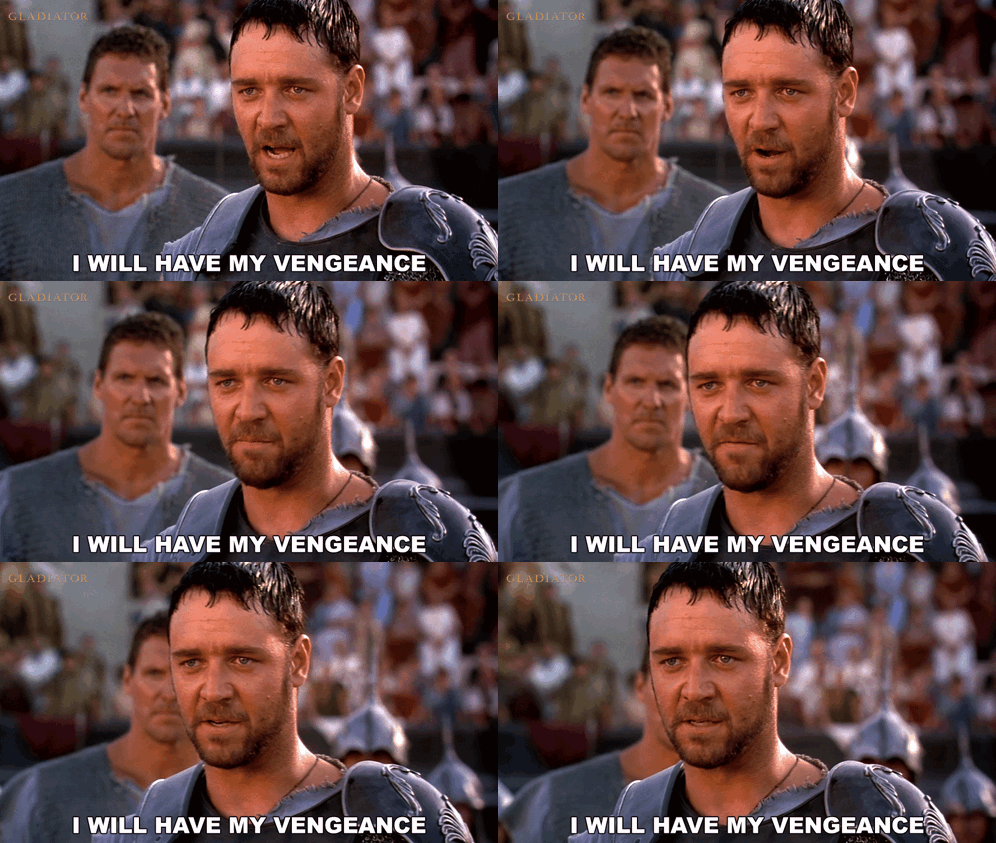
Dear Brewtiful,
Yesterday my boss yelled at me in front of people. Not “stern feedback.” Not “raised his voice.” Yelled. Like I was a malfunctioning printer and he was a man who’d just discovered consequences.
I’ve been loyal for years. I’ve carried projects that weren’t mine. I’ve smoothed over mistakes that would’ve gotten other people quietly escorted out with a cardboard box and a sad ficus. I’ve been competent, consistent, reliable. The kind of employee managers describe as “a rock” right before they throw you at someone else’s fire.
And then he humiliated me. Publicly. Loudly.
I didn’t cry. I didn’t argue. I just stood there and absorbed it like a professional. But inside, something shifted. I felt degraded. Angry. Not the dramatic kind of anger that burns out quickly, but the cold kind. The kind that sits down in your chest like it pays rent.
Now I can’t stop thinking about sending an email. A career-ending one.
The email would be factual. It would outline the hypocrisy. The low bonuses. The mismanagement. The way he takes credit when things go right and disappears when things go wrong. The way loyalty is rewarded with extra work and occasional humiliation, like some kind of corporate hazing ritual.
I know if I send it, it could destroy my job. But part of me wants that. Part of me wants to watch the whole thing catch fire.
How do I stop myself from doing something irreversible?
Or should I stop myself at all?
— Ready to Burn It Down
Dear Ready to Burn It Down,
Your boss yelled at you because he could.
Not because you deserved it. Not because you “needed to hear it.” Not because he “lost control.” He did it because he wanted the room to remember who gets to be loud and who has to stay employable.
That’s the part people miss. Yelling isn’t communication. It’s a public demonstration. Like a dog pissing on a couch. Primitive, but strangely effective.
And you, being intelligent and competent, did what smart women always do in these moments. You stood there calmly while your brain took a screenshot.
Now you’re at home fantasizing about sending an email that would detonate his reputation and salt the earth behind you.
Which makes sense. Because humiliation creates a specific kind of hunger. It doesn’t want healing. It wants symmetry.
You want him to feel what you felt. You want the room to tilt back into balance. You want your dignity returned in a neat little package with a subject line like: “Following Up on Yesterday.”
And yes, I understand the appeal.
There is something almost erotic about the idea of pressing send and watching the office descend into panic, Slack messages, whispered meetings, and sudden calendar invites titled “Quick Touch Base.”
But let’s be clear about what you’re actually holding in your hand.
That email is not justice.
That email is a suicide vest made out of Microsoft Outlook.
You already know this. That’s why you called me instead of writing it.
Here’s the thing about workplaces: they are not moral ecosystems. They are food chains with branding guidelines. The system is not designed to reward truth. It is designed to protect whatever generates revenue and whatever keeps the higher-ups from looking stupid.
If you send the email, you will not become the hero.
You will become “the problem.”
Not because you’re wrong. Because you’re inconvenient.
You’ll be framed as emotional, unstable, unprofessional. They’ll say they’re “concerned.” They’ll say you “seem stressed.” Someone will use the phrase “not like herself,” as if you’re a malfunctioning Roomba.
And your boss? Your boss will blink a few times, claim he was under pressure, and get to play the role of “leader who handled a difficult employee with grace.”
He will survive it. Men like that always do. They’re like cockroaches with dental benefits.
So yes, you should stop yourself.
Not because revenge is wrong.
Because your revenge idea is lazy.
It’s the kind of revenge that makes you feel powerful for thirty seconds and unemployed for twelve months.
You don’t need to explode. You need to extract.
You want to do something irreversible? Great.
Do something irreversible that benefits you.
Start with this: do not give him the gift of your reaction.
Your restraint is not passivity. It’s weaponized patience. It’s watching someone walk into traffic and letting them get far enough that you can’t be blamed for the impact.
You’re tempted to send the email because you want control back. Understandable. But control isn’t screaming. Control is options.
So here’s what you do instead:
Write the email. Make it vicious. Make it precise. Include every hypocrisy, every bonus insult, every strategic failure dressed up as “leadership.” Make it so accurate it feels like a crime scene report.
Save it. Title it something innocent, like “Q2 Notes” or “Client Feedback.”
Do not send it. Not yet. Let it sit. Let it rot. Let it become evidence instead of an emotional flare gun.
Start documenting everything. Dates. Witnesses. Exact wording. Keep it boring. Boring is what makes it lethal.
Update your resume. Quietly. Not in a hopeful way. In a predatory way.
Act normal. Not cheerful. Not forgiving. Just normal enough that no one can point to you and say, “See? She’s unstable.”
Because the most satisfying revenge isn’t exposure. It’s absence.
It’s leaving without warning.
It’s letting them realize too late that the person they treated like furniture was the one holding the building up.
You’re in the part of the story where the main character learns something important: loyalty is only admirable when it’s reciprocated. Otherwise it’s just unpaid labor with a personality.
And about your boss: the humiliation wasn’t a mistake. It was a test.
He wanted to see if you’d stay.
If you send the email, you confirm what he suspects: that you can be provoked into self-destruction. That you’re passionate. Reactive. Containable.
If you stay calm, he learns something much worse.
He learns you’re watching.
So don’t burn it down. Not yet.
Right now, you don’t need fire.
You need leverage.
And the beautiful part is: you already have it.
Because a woman who can stand there quietly while someone tries to degrade her is not weak. She’s dangerous. She’s the kind of person who doesn’t explode. She simply makes plans.
Let him think he won. Let him relax. Let him go back to his little kingdom of bad decisions and cheap bonuses.
And while he’s busy being loud, you’ll be busy being precise.
Then one day, when it’s convenient for you, you’ll walk out like you were never there.
And he’ll finally understand the difference between power and noise.
— Brewtiful