Mindful-ish

Holding it together. Technically.

Wellness without the performance. No perfect routines, no fake enlightenment. Just trying to feel slightly better without turning self-improvement into a full-time personality.
burnout, lightly healing, allegedly no fake serenity
Sara Alba Sara Alba

Would You Survive Jurassic Park? An Honest Assessment

Would You Survive Jurassic Park? An Honest Assessment | Brewtiful Living
Brewtiful Living · Culture · Pop Culture

Would You Survive
Jurassic Park?

An honest, affectionate, and slightly brutal assessment.

In 1993, Steven Spielberg put dinosaurs on screen and broke everyone's brain. Thirty-three years later, the original Jurassic Park remains one of the most perfectly constructed blockbusters ever made — and we have not stopped arguing about who would and wouldn't make it out alive.

Let's be honest about something: most people who watch Jurassic Park are quietly doing the math. Not on the genetics or the chaos theory or the amber extraction — on themselves. Would I have gotten into that car? Would I have climbed the fence? Would I have run toward the T-Rex or away from it? These are the questions that matter.

The film is, at its core, a masterclass in showing us exactly who people are under pressure. Dennis Nedry sells out an entire island of people for a canister of embryos. Dr. Ian Malcolm spends most of the film being right about everything while also being extremely annoying about it. Ellie Sattler runs toward danger so many times it stops being remarkable and starts being a personality trait.

We rewatched the original. We took notes. We have opinions. And we built a quiz — because the only thing better than watching characters make terrible decisions in 1993 is finding out which terrible decision you would make in their place.

The Original — Why It Still Holds Up

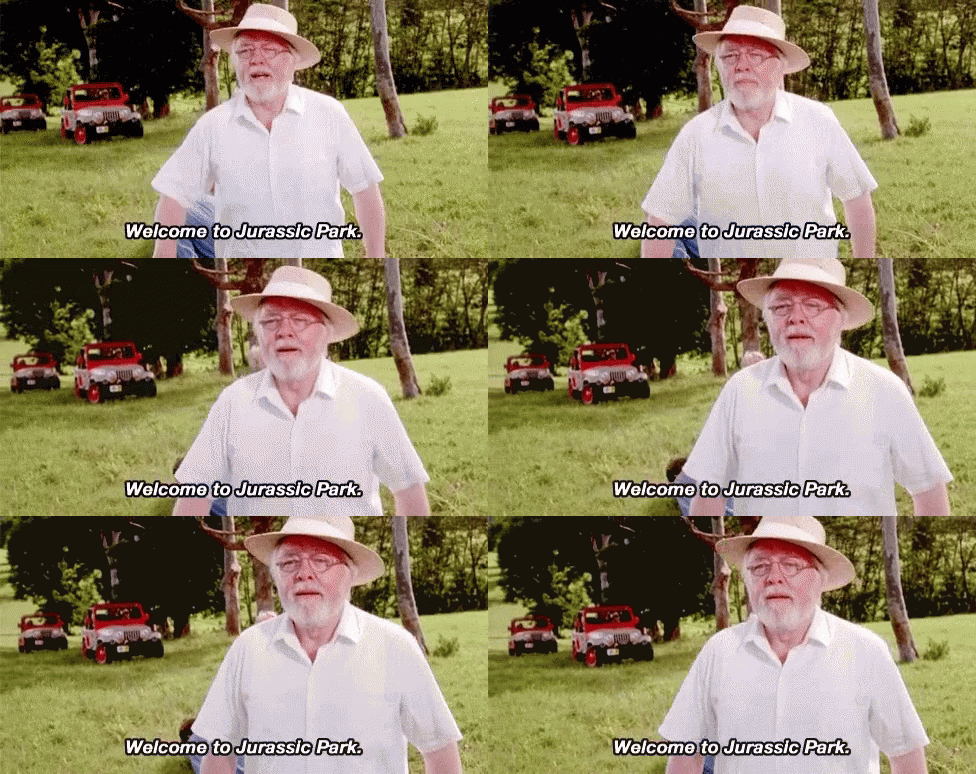
Jurassic Park works because Spielberg understood something that most blockbuster directors miss: the spectacle is only as good as the people watching it. The famous brachiosaurus reveal — John Hammond's delighted face, Alan Grant's jaw literally dropping, the John Williams score swelling — lands because we have spent twenty minutes caring about these specific humans. The dinosaurs are extraordinary. But the humans are the story.

The script, adapted from Michael Crichton's novel by Crichton and David Koepp, is extraordinarily economical. Every scene does double work. The kitchen scene where the kids hide from the raptors is terrifying not just because raptors are terrifying but because Lex and Tim are children we have already spent time with, in a kitchen that has been quietly established as a place we understand spatially. Spielberg builds the geography and then weaponises it.

And the practical effects. The combination of Stan Winston's animatronics and ILM's early CGI — used sparingly and precisely — created something that still holds up better than most fully-digital blockbusters made thirty years later. The T-Rex paddock scene in the rain. The ripple in the water glass. The moment the goat leg lands on the tour car roof. These images are burned into an entire generation's visual memory for a reason.

Things You May Have Forgotten

The Film That Changed Everything

  • The T-Rex roar was a combination of a baby elephant, an alligator, and a tiger — slowed down and layered.
  • Jeff Goldblum improvised the way Ian Malcolm says "life, uh... finds a way." The pause is real.
  • Spielberg insisted on using practical dinosaur effects as much as possible. The CGI dinosaurs appear for less than 15 minutes of the film's runtime.
  • The film earned $1 billion at the box office in 1993 — the first film ever to do so. Adjusted for inflation, it would be closer to $2.5 billion today.
  • Richard Attenborough's John Hammond was written as a villain in Crichton's novel. Spielberg made him sympathetic. It was the right call.
  • The velociraptors in the film are significantly larger than actual Velociraptor fossils. They were based on Deinonychus. Crichton just liked the name Velociraptor better.
The Survivors — A Character Audit

Not everyone makes it. More importantly, the reasons why people survive or don't survive Jurassic Park are rarely about strength or speed. They're about decision-making, ego, and whether or not you are the kind of person who electrocutes themselves trying to restart a park's power grid alone in the dark. Let's audit the cast.

Alan Grant Palaeontologist · Survivor

Competent, calm under pressure, and crucially — already an expert in the things that want to kill him. His main disadvantage is that he does not like children, which the plot immediately corrects.

Survives: Obviously
Ellie Sattler Palaeobotanist · Survivor

Runs toward danger repeatedly. Climbs into a pile of dinosaur droppings without flinching. Restores power to the entire park largely by herself. The most competent person in the film. It's not close.

Survives: Obviously
Ian Malcolm Chaotician · Barely Survivor

Predicts everything that goes wrong. Also gets mauled by a T-Rex for his trouble. Being right is apparently not enough. Being right and running faster would have helped.

Survives: Technically
John Hammond Billionaire · Survivor

Spared by the narrative because he's delightful and Richard Attenborough is Richard Attenborough. In real life, the man who built a dinosaur island and skimped on the security system does not make it out.

Survives: Narratively
Dennis Nedry Programmer · Did Not Survive

Sold out an entire island for money, got lost in the rain immediately, and was killed by a Dilophosaurus he tried to trick with a stick. His death is the most deserved in film history. We feel no way about it.

Did Not Survive
Lex & Tim Children · Survivors

Tim gets electrocuted and falls off a fence. Lex hacks the park's computer system at age 12. They are both going to need significant therapy. They survive because the film requires them to.

Survive: Barely

"Life breaks free. Life expands to new territories. Painfully, perhaps even dangerously. But life finds a way."

— Dr. Ian Malcolm, 1993. Still correct. Still insufferable about it.

The genius of the original film is that it never loses its sense of wonder even as everything goes wrong. Hammond's dream is genuinely beautiful — he wanted to give people something real, something they'd never seen. The fact that it kills several of them doesn't entirely undermine the dream, it just clarifies the price of arrogance. Crichton's novel is angrier about this. Spielberg's film is sadder, and more honest about the complicated feelings we have about the thing that breaks us.

Which brings us to the question you've been sitting with since 1993. The one everyone asks but nobody answers honestly. If you were on that island, in that situation, with those choices — what actually happens to you? Not the version of you that you'd like to believe in. The actual you. The one who sometimes can't decide what to order for dinner, who definitely doesn't have a plan for emergencies, who would absolutely want to pet the Triceratops.

We built a quiz. It will tell you the truth.

⚠ Honest Assessment · No Flattery

Would You Survive
Jurassic Park?

Six questions. One verdict. We are not going to be kind about this.
Question 1 of 6
01

The tour cars have stopped. The T-Rex paddock fence has gone dark. You hear something large moving in the trees. What do you do?

02

You're separated from the group. It's dark. There's a working jeep forty metres away across an open field. Somewhere in the park, raptors are loose. Do you go for the jeep?

03

A sick Triceratops is lying on the ground, clearly distressed. The staff says not to approach. What happens?

04

The park's power is down. The control room is accessible but the computer system is locked. You have some programming knowledge. Do you try to restore access?

05

A raptor has figured out how to open doors. It's in the building. You can hear it. What is your honest reaction?

06

The helicopter is on the way. You're almost out. There's one person who hasn't made it to the landing zone yet. Do you go back?

You Survived. Outcome: Alive · Exit: By Helicopter · Therapy: Required

You made good decisions under pressure, didn't let curiosity overrule survival instinct, and had the discipline to wait when waiting was the right call. You're an Alan Grant. You probably already knew this. The dinosaurs are going to haunt you for years but you are, technically, fine. Go home. Don't tell anyone how close it actually was.

Probably Not. Outcome: Uncertain · Cause: Your Own Decisions · Regrets: Several

You're an Ian Malcolm. Smart enough to see the problem clearly, not quite fast enough to fully outrun it. You're going to make it off the island but you will absolutely be injured and you will absolutely spend the helicopter ride explaining to everyone why you saw this coming. Which you did. But that's not actually as useful as you thought it would be when the T-Rex was right there.

You Did Not Make It. Outcome: Deceased · Cause: Several Avoidable Decisions · Dignity: Intact (Mostly)

You are a Dennis Nedry. Not because you're malicious — you probably aren't — but because you let something other than survival instinct make the decisions. Curiosity, loyalty, ego, or the completely understandable urge to touch the Triceratops. The island got you. The good news: your death will be referenced in hushed tones for years. The bad news: you are dead.

You Not Only Survived. Outcome: Thriving · Role: The One Who Saved Everyone Else · Sleep: Fine, Actually

You're an Ellie Sattler. You ran toward danger when everyone else ran away. You made calm, competent decisions under conditions that would have broken most people. You probably also climbed into something unpleasant at some point and didn't make a big deal about it. The island didn't break you. If anything, it clarified things. You leave knowing exactly who you are. Go write a paper about it.

Why We Still Come Back To It

The sequels exist. We have seen them. We choose not to discuss most of them here, except to note that the original remains categorically different from everything that followed it — not just in quality but in intent. Jurassic Park is not really about dinosaurs. It is about the gap between what we can do and what we should do, between ambition and wisdom, between the spectacle we create and the responsibility we owe to the things we create it with.

Hammond's line — "We spared no expense" — is one of cinema's great dramatic ironies. He spared every expense that mattered. The security. The oversight. The exit strategy. He hired Dennis Nedry. He brought children onto an island full of apex predators with no contingency plan. He spared no expense on the wonder and every expense on the hubris.

This is, of course, extremely funny. It is also what makes the film feel current in ways that a movie about dinosaurs probably shouldn't. The specific mechanism changes. The shape of the mistake — the powerful person who believed that wanting something badly enough was the same as being ready for it — does not.

Jurassic Park came out 33 years ago. The CGI has aged better than most things made last year. The practical effects are still extraordinary. Jeff Goldblum's shirt is still open in that scene. John Williams' score still does exactly what it's supposed to do. And the question — would you survive it? — is still the most honest personality test cinema has ever accidentally produced.

We think the answer, for most of us, is probably no. But not because we're cowards. Because we would touch the Triceratops. Because we would hesitate at exactly the wrong moment. Because we would be curious when curiosity was the last thing the situation required. Which is, in the end, what makes us human — and what makes the film about us as much as it is about the dinosaurs.

Life finds a way. Occasionally, so do we.

— Sara Alba · Brewtiful Living · Culture
Jurassic Park Pop Culture 1993 Films Steven Spielberg Interactive Quiz Culture Film

More culture. More takes. Less fluff.

Browse everything on Brewtiful Living →
Browse Culture →
Read More
Sara Alba Sara Alba

10 Red Flags That Mrs. Doubtfire Wasn’t the Perfect Nanny We All Thought She Was

10 Red Flags That Mrs. Doubtfire Wasn’t the Perfect Nanny We All Thought She Was
Childhood movie revisionism

10 Red Flags That Mrs. Doubtfire Wasn’t the Perfect Nanny We All Thought She Was

When you’re a kid, Mrs. Doubtfire feels like a warm blanket with a British accent. Robin Williams does voices, throws fruit at Pierce Brosnan, and turns divorce into something weirdly whimsical. It’s charming. It’s chaotic. It’s deeply committed to the bit.

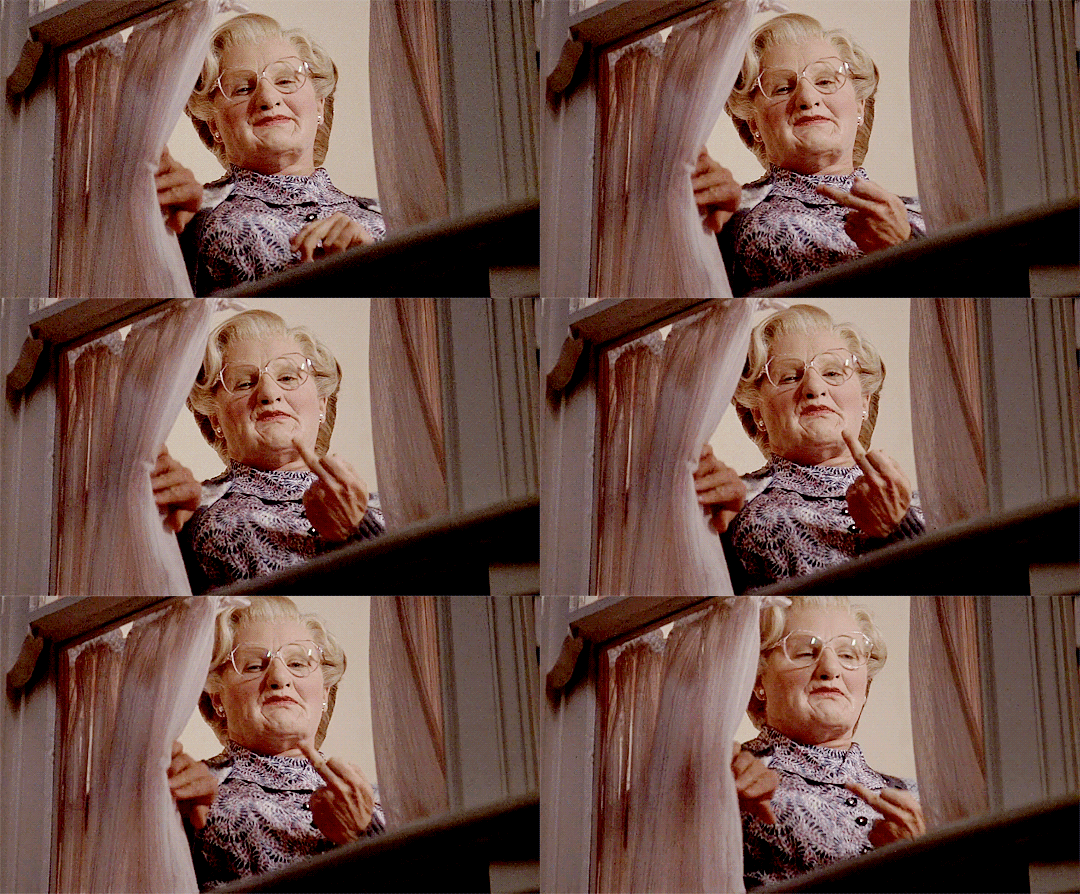
Then you grow up, pay rent, develop boundaries, and suddenly the entire movie starts looking less like “adorable dad fighting for his family” and more like a full-scale identity fraud situation with pastry-based assault.

This is not anti-Doubtfire propaganda. This is just an adult rewatch with functioning judgment. And honestly? The red flags were not subtle.

Why this movie hits different now

As kids, we were emotionally aligned with Daniel because he was fun. Fun parents always win in childhood logic. The responsible parent is just the villain standing between you and cake for dinner.

But adulthood is rude and full of context. Once you notice that Daniel lies constantly, bulldozes boundaries, weaponizes charm, and impersonates a nanny to access his ex-wife’s home, the whole thing gets less “heartwarming classic” and more “this would end in court documents.”

Which is exactly why this article exists.

The adult rewatch file

1elaborate fake identity
Severaldecisions that should have stopped immediately
0reasonable co-parenting instincts
Highcomedic value, questionable legality
Red Flag #1

He responded to divorce by launching a secret operation

Most people process divorce with grief, therapy, bad bangs, or at minimum a long walk. Daniel processed it by creating a prosthetic-heavy undercover persona and infiltrating his ex-wife’s household.

That is not coping. That is escalation with contouring.

Adult translation

“I miss my children” is sympathetic. “So I invented a fake elderly woman to bypass custody boundaries” is where sympathy packs a bag and leaves.

Red Flag #2

He lied to literally everyone with breathtaking commitment

The movie treats Daniel’s deception like a lovable hustle. In reality, he lies to his ex-wife, his kids, the court system’s spirit, potential employers, and anyone within a ten-foot radius of a wig.

A person that comfortable with deception is not “resourceful.” They are exhausting.

Somewhere between “devoted father” and “full facial appliance disguise,” we probably should have asked more questions.

Red Flag #3

Boundary issues? He practically invented new ones

Miranda says no. The court sets limits. Reality offers several very clear signs to stop. Daniel hears all of that and decides what’s really needed is more access, more interference, and more theatrical deceit.

If someone cannot respect a boundary unless they personally agree with it, that is not love. That is entitlement in a cardigan.

Red Flag #4

He sabotaged Miranda’s life and called it devotion

One of the sneakiest things about the movie is how often Daniel’s actions are framed as romance-adjacent family loyalty when they’re actually sabotage. He doesn’t just want time with his kids. He wants control over how Miranda moves on, who she sees, and how the house operates without him.

That is not noble. That is a man treating his ex-wife’s independence like a clerical error.

Red Flag #5

Pierce Brosnan’s character was not the villain, sorry

Childhood taught us to boo Stu because he was polished, handsome, and standing in the way of the main character’s chaos. Adult eyes notice that he is, in fact, mostly normal.

Meanwhile Daniel attempts emotional warfare and nearly turns dinner into a homicide-adjacent seafood incident.

Hard truth

If the “rival” is stable, kind to the kids, and trying to eat in peace, the movie may have manipulated you.

Red Flag #6

He was fun, yes. He was also wildly irresponsible

Daniel’s whole appeal is that he’s whimsical, spontaneous, and anti-boring. Which sounds magical until you remember that children also need consistency, rules, and someone who doesn’t treat adulthood like a personal insult.

The movie kind of smuggles this point in, to be fair, but it still spends a lot of time seducing you with “fun dad” energy so you almost forget why Miranda was tired in the first place.

Red Flag #7

The whole nanny arrangement was emotionally chaotic for the kids

Let’s pause for the children, who were unknowingly being cared for by their father in drag while also being manipulated into a massive secret. That is not a quirky childhood memory. That is the kind of thing you unpack later while staring at a therapist’s throw pillow.

Imagine discovering that the trusted adult helping you through your parents’ divorce was also… your dad doing accents. I’m sorry, but that would rewire something.

Red Flag #8

He confused access with entitlement

Loving your children does not automatically grant you unlimited access on your preferred terms. That is one of the least fun but most adult lessons on earth.

Daniel acts like wanting to be there should override every practical concern, every legal structure, and every ounce of Miranda’s judgment. That is not paternal devotion at its purest. That is a man refusing to accept that love does not cancel consequences.

Red Flag #9

The charm worked mostly because Robin Williams was doing it

This is maybe the biggest plot twist of all. A lot of Daniel’s behavior gets a pass because Robin Williams was so disarmingly funny, warm, and human on screen. Another actor and this becomes a psychological thriller by act two.

Which is less a criticism of the movie than a reminder that charisma has gotten many people out of accountability since the beginning of time.

Red Flag #10

The sweetest ending still doesn’t erase the original mess

Yes, the film lands on a softer note. Yes, it offers growth. Yes, it still absolutely works emotionally. But we cannot let a tidy ending convince us that the road there wasn’t paved with red flags, panic, manipulation, and one of the most committed acts of domestic deception ever marketed as family comedy.

You can still love the movie. You just have to love it honestly.

Your adult Mrs. Doubtfire reaction

Your result appears here.
Read More