Meghan Markle Took Lilibet. Then Turned It Into a Brand
MEGHAN MARKLE
TOOK LILIBET.
THEN TURNED IT INTO A BRAND.
first appeared
a baby name
adjacent to brand assets
has been addressed
There was once a time when family nicknames stayed inside families. They lived in kitchens, on handwritten birthday cards, in the kind of private jokes that only make sense to the people who were there. They were intimate precisely because they were small. Earned, not announced. Protected by the very people who knew them.
"Lilibet" was not a name created in a strategy meeting. It came from a young Elizabeth struggling to say her own name. It became precious because it was personal — the kind of tender detail that makes a public figure feel, for a moment, like a real person. It belonged to the family who knew her before she was a queen, not to the family who knew her after she became one.
Which is why people blinked when Harry and Meghan used it for their daughter. Blinked again when they were told privacy was the guiding principle. And blinked a third time, harder, when the children's identities began appearing, incrementally, in the lifestyle branding. The name that belonged to history had become, in some meaningful sense, inventory.
Belonged to History.
WHY "LILIBET" WASN'T AVAILABLE
Some names are available. Some carry weight. This one had its own security detail.Lilibet was the name young Elizabeth used for herself before she could pronounce "Elizabeth" properly — a name known only to her closest family, most famously her grandfather King George V. It became the private shorthand for one of the most public figures of the twentieth century: a woman who spent seventy years perfecting the art of revealing nothing while communicating everything.
That a couple who had spent two years loudly exiting the institution would then reach back into it for one of its most intimate details struck many observers as an unusual move. Not illegal. Not even entirely unusual in royal naming traditions, where historical echoes are common. But notable in a way that landed differently given everything that had preceded it.
It was presented as a tribute. Critics saw opportunism in a cashmere sweater. And it is worth noting the context: this was a couple with an ongoing dispute over the use of the Sussex Royal brand, in the process of being required to step back from official royal duties. The naming of Lilibet arrived against that backdrop. The timing was, to put it generously, complicated.
From Nickname to Inventory.
THE FULL TIMELINE: MEGHAN MARKLE, LILIBET, AND THE BRAND
Each step individually defensible. Collectively: a pattern.We Have Arrived Here.
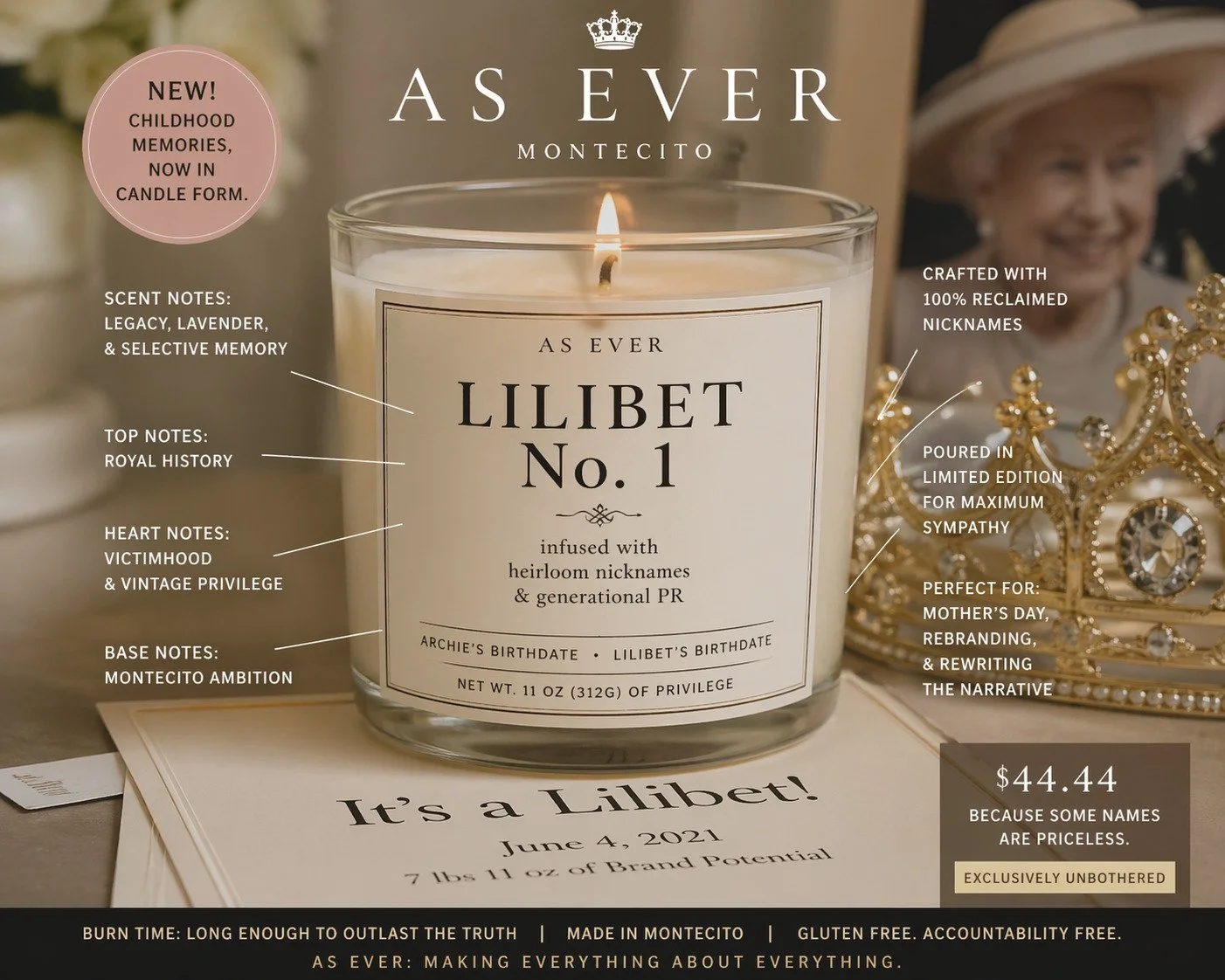
Products tied to family identity and the As Ever brand are not remarkable on their own. Lifestyle brands sell things. This is what they do. Scent is intimate, universal, and carries a marketer's dream of emotional resonance at a $42 price point.
What makes it remarkable is the name attached to it. And the name attached to the brand. And the title still deployed on the publicity materials. And the fact that all three of these things were acquired through, and remain inseparable from, the very institution whose values and practices Meghan has spent years publicly critiquing.
We are now in the phase where personal milestones become scent profiles. Childhood nicknames become packaging. Family pain becomes context. Legacy becomes inventory. The royal connection that Meghan has been leaving — loudly, documentarily, podcastingly — for six years turns out to be extremely useful for the brand she has been building simultaneously.
Somewhere, a Buckingham Palace lampshade is judging everyone involved.
- Boundaries Room Spray — notes of passive aggression and early exit
- Inherited Trauma Tea Towels — 300 thread count, limited run
- Royal Adjacent Linen Mist — smells like proximity and distance simultaneously
- Spare Change Wax Melts — hand-poured, memoir-adjacent
- Victimhood Vanilla Reserve — sold out. Back-ordered indefinitely. Much like accountability.
What Should Remain Off-Limits for Monetisation?
Results unavailable. Much like accountability.Selectively Applied.
The Sussex brand has, from the beginning, leaned heavily on the language of privacy. Privacy from tabloids. Privacy from cameras. Privacy from speculation. A desire for privacy is human and understandable. They have two young children. They left an institution that contributed to significant mental health struggles. Nobody is arguing against privacy as a concept.
But privacy, in the Sussex context, has always operated with a very particular set of terms and conditions. Whenever a launch arrives, private life tends to return — wearing linen and neutral tones, shot in warm late-afternoon light, exactly calibrated to feel intimate without being intimate. The children become narrative accessories. Family pain becomes context that validates the product. The titles become useful again. It is privacy with a marketing department.
This selective application of the privacy principle is, arguably, the central reason why the "most trolled person" claim landed so poorly. The argument that Meghan is uniquely victimised by public attention is difficult to sustain when that attention is so consistently, so professionally, so expensively courted. You do not accidentally appear on MasterChef Australia in an impeccable apron. That was a decision, and it raised questions.
There is also the matter of Thomas Markle Sr. — a man who has publicly pleaded, repeatedly, for contact from his daughter. Meghan's brand is built significantly on empathy, healing, and the language of connection and compassion. The contrast between that public identity and the sustained private silence toward her father is something critics find difficult to reconcile. The brand says empathy. The pattern says something more complicated.
THE INSTITUTION IS STILL IN THE NAME. THE NAME IS IN THE MARKETING DECK. THE MARKETING DECK SAYS PRIVACY IS A CORE VALUE. NONE OF THESE THREE THINGS ARE COMPATIBLE AND NOBODY HAS ADDRESSED IT.
Changes the Mood.
Queen Elizabeth II would have turned 100 in 2026. That number carries weight. It invites reflection on a woman whose public image was built on discipline, ritual, understatement, and an almost supernatural ability to say nothing while communicating everything. Seventy years on the throne without a memoir, a podcast, or a single documented act of passive aggression toward a family member who staged paparazzi photos.
Against that backdrop, the modern Sussex circus feels louder than usual. On one side: seventy years of duty, performed with almost mechanical consistency. On the other: lifestyle products that monetise the emotional vocabulary of the very family being publicly held accountable. The centenary is not just a birthday. It is an implicit contrast. And Meghan, of all the people in the global spotlight right now, is most exposed by it — because she is the one who claimed the name.
If irony had a scent, it would sell out within minutes and reappear on Depop for three times the price.
THE PATTERN — AND WHY IT MATTERS HERE
The Lilibet brand does not exist in isolation. It is the latest chapter.The Chartreuse Pattern, Explained
The Meghan Markle Lilibet controversy fits into a broader pattern we have been documenting since 2018 — a consistent tendency to position herself at the centre of events, rooms, and narratives that are nominally about something or someone else. The chartreuse at Carey Mulligan's party. The olive green at Prince Louis' christening. The documentary that used the family's grief as its backdrop. The memoir that used Harry's trauma as its vehicle. The brand that uses the royal title as its most potent marketing asset while simultaneously disavowing the institution that made the title possible. You do not understand the Lilibet naming if you only look at the Lilibet naming. You understand it by understanding everything that came before it.
The Contradiction Fatigue — Why Critics Are Tired
This is not about a woman making money. Women should build companies, launch products, cultivate brands, and collect every available cheque. The commerce is not the problem. The problem is contradiction fatigue. If the institution is harmful, why keep extracting status from it? If the titles are meaningless, why are they still on the press materials? If privacy is sacred, why does it keep appearing in campaign photography? If healing is the mission, why does every chapter require a product launch? That is the contradiction that exhausts people. Not the ambition. Not the commerce. The insistence on having it every possible way simultaneously — privacy and publicity, victimhood and empire, intimacy and inventory — while presenting the whole arrangement as the most natural thing in the world.
What the AI Letter Revealed About the Pattern
The AI open letter is a perfect recent example. A cause nobody opposes, signed by a couple whose lifestyle is entirely sustained by the digital attention economy, presented as an act of civic courage. It is not that the cause is wrong. It is that the messenger strains credulity in ways that are hard to ignore. When the same pattern keeps repeating — moral language deployed in the service of commercial positioning — audiences eventually stop evaluating each instance individually and start evaluating the pattern. The Lilibet name is the founding document of that pattern.
Maybe the candles smell delightful. Maybe every jar arrives in recyclable tissue paper with a handwritten note about the importance of presence. None of that changes the central issue.
Some names are bigger than brand opportunities. "Lilibet" represented a private family tenderness attached to one of the most widely recognised women in human history — a woman whose entire public identity was built on the absolute refusal to commodify the personal. It was intimate because it was protected. It was meaningful because it was never packaged.
Now it evokes marketing copy, candle wick, and public backlash. That transformation says something about the current royal moment that no press release has yet managed to fully address. Six years of the post-royal era have produced a brand that is inseparable from the institution it claims to have left. That is not a commercial failure. It is something more structurally interesting: a brand that cannot survive without the thing it spent six years leaving. That is why critics keep returning to the Lilibet name. Because the name keeps returning to them.