BEAUTY
UNFILTERED.
Honest takes on beauty — the good, the bad & the deeply unnecessary.
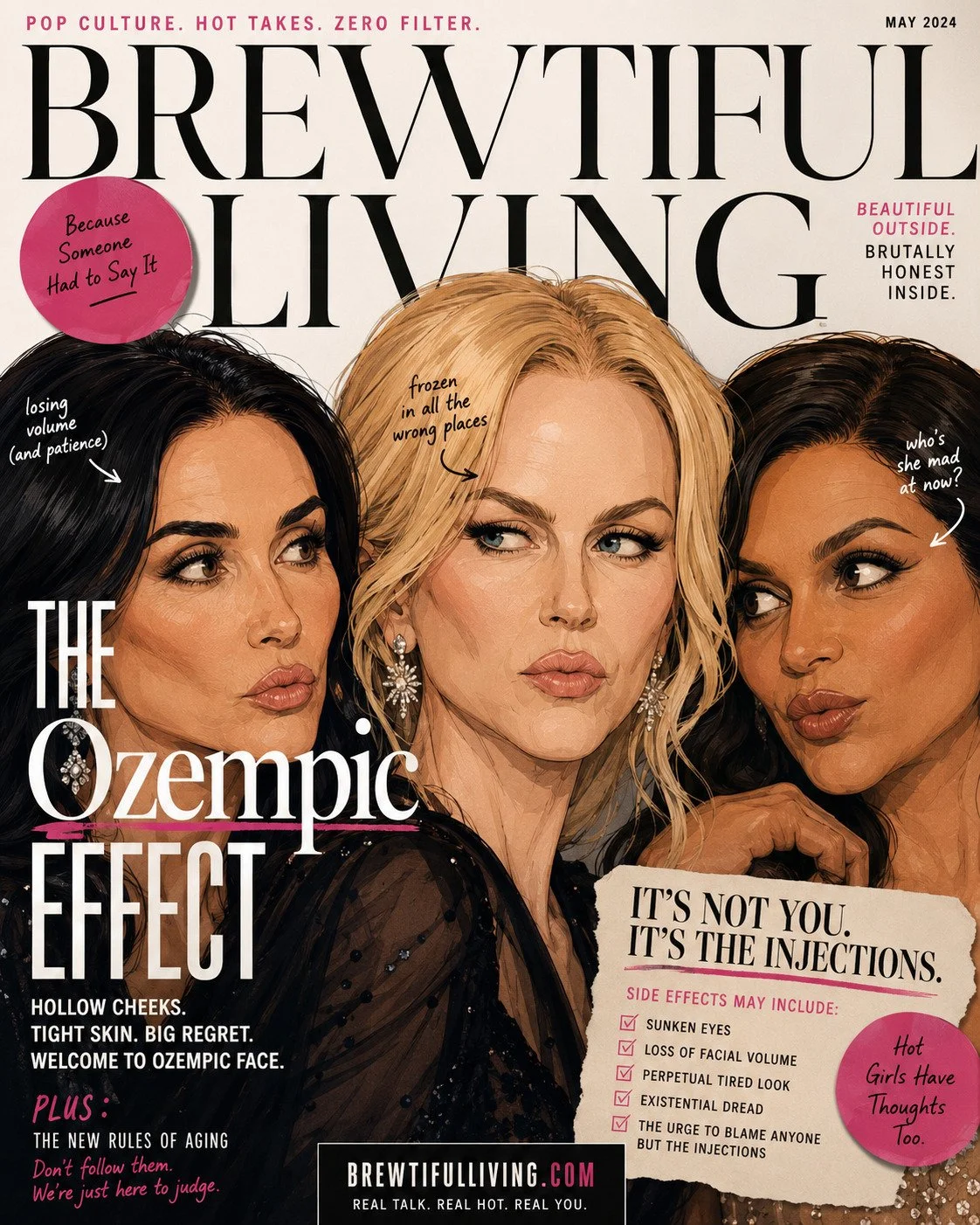
Ozempic Face Is Officially an Epidemic
By Sara Alba · Beauty Unfiltered
Let me say something that nobody in a press release is willing to say.
Ozempic face is real. It is everywhere. It is walking red carpets, accepting awards, and showing up at charity galas looking like a slightly deflated version of someone we used to recognize. And the strangest part? We are all just standing here watching it happen, nodding politely, and writing headlines like "radiant!" and "glowing!"
She is not glowing. She has lost the fat that was doing the glowing for her.
Let's talk about it. Brewtifully.
What Is Ozempic Face, Exactly?
Ozempic face is what happens when you lose weight very quickly — specifically the kind of quick, dramatic weight loss that GLP-1 medications like Ozempic and Mounjaro produce — and your face loses the volume that was keeping it looking youthful, plump and alive.
The dermatologist who literally invented the term, Dr. Paul Jarrod Frank, explained it simply: when we lose weight rapidly, we don't get to choose where we lose it from. And the face — which relies on fat pockets to maintain structure, lift and that general "I am a living person with good skin" appearance — tends to give up its volume faster than anywhere else.
What you're left with is hollowed temples. Prominent cheekbones that weren't prominent before. Sharper jawlines that read less as defined and more as depleted. Skin that has lost its padding and now sits slightly loose on a frame it no longer fits. It is — and I say this with the full weight of someone who has watched it happen in real time across multiple award seasons — not a good look. For anyone.
The 2026 Award Season Was a Horror Show
I mean this respectfully.
By early 2026, as red carpets rolled out, a new wave of noticeably leaner celebrity looks — from Kelly Osbourne to Demi Moore — pushed the conversation into overdrive. International Business Times What was once a quiet whisper about individual celebrities became a full volume conversation nobody could avoid.
Kelly Osbourne showed up to the BRIT Awards in a black sequinned dress and the internet collectively lost its mind. Photos highlighting her slimmer frame and sharper features spread almost instantly, with side-by-side comparisons picking up traction. House and Whips She denied Ozempic. She blamed lifestyle changes. The photos disagreed politely.
Sharon Osbourne — Kelly's mother, which makes this a whole family saga — has been one of the most honest celebrities about what went wrong. She admitted she went too far, dropped to under 100 pounds, and even after going off GLP-1s has struggled to regain weight, saying "I'm too gaunt and I can't put any weight on. I want to, because I feel I'm too skinny." Women A source reportedly told Radar Online that the weight loss drugs had wrecked her metabolism with no going back. She is over 70. This is not a wellness journey. This is a warning.
Ariana Grande has been dealing with "skeletal" concerns for the better part of a year. She grew emotional when asked about it, describing herself as "a specimen in a petri dish" since she was 16 or 17, saying "I have heard it all." Bored Panda Which is genuinely sad. And also — the concern is not unfounded, Ariana.
Oprah Winfrey has admitted to using Ozempic and has been photographed looking dramatically different at multiple 2026 events. The woman who once represented something warm and full and powerful now looks like she is being carefully managed by a team of people who are afraid of what happens if she eats a sandwich.
The Part Nobody Wants to Say
Here is the thing about Ozempic face that the wellness content and the glowing press coverage consistently refuses to acknowledge:
These women were beautiful before.
Not beautiful "for their size." Not beautiful "despite" anything. Just beautiful. Full faces, present and alive. The kind of beauty that reads as health because it is health. And somewhere along the way — between the Hollywood sample sizes that still run small, the red carpet scrutiny that never stops, and the sudden availability of a drug that makes dramatic weight loss feel medically sanctioned — they decided that was not enough.
Experts warn that the normalization of Ozempic face during award season and similar aesthetic markers may influence how beauty is interpreted and pursued. The concern is not only physical health, but psychological impact — particularly as social media accelerates comparison. Runway Magazine One fashion industry commentator drew the comparison plainly: the parallels to the 1990s are difficult to overlook. The "heroin chic" era similarly elevated fragility and angularity as markers of high fashion.
We did this before. We watched Kate Moss. We watched what happened after. We said never again.
And here we are.
And Then There's Meghan Markle
I already wrote about this at length — What On Earth Is Meghan Markle Doing? — but it belongs here too because it is the Beauty case study of 2026.
There was a version of Meghan Markle that was genuinely, undeniably beautiful. Healthy. Plump in the way that reads as alive. She spent years building a wellness brand on the back of that image — green juices, breathwork, the suggestion of sustained spiritual equilibrium.
And then the Ozempic face arrived. The jawline sharpened. The cheeks hollowed. The glow became something that requires considerably more lighting equipment to produce. The woman who told us wellness was a lifestyle now looks like the aesthetic casualty of the very culture she claimed to have transcended.
The irony is almost too much. Almost.
What Actually Happens to Your Skin
For the beauty side of this — because this is a beauty column and we should talk about what is actually happening physiologically:
Rapid weight loss depletes the fat compartments of the face that act as structural support. These fat pads — in the cheeks, under the eyes, along the jawline — are what give skin its lift and fullness. When they disappear quickly, skin can't retract fast enough to compensate. The result is sagging, fine lines appearing more pronounced, hollowing under the eyes, and what dermatologists are now calling "Ozempic neck" — where the loss of fullness in the lower face and neck creates visible muscle definition and loose skin in ways that read as significantly older than the person's actual age.
You can try to counteract it with fillers. Many celebrities clearly are. But fillers on a deflated face have a specific look — pillow-y in the wrong places, slightly off-balance — that is becoming its own recognisable aesthetic. You cannot simply reinflate what was lost. Biology doesn't work like that.
The cruelest part? Facial plastic surgeon Dr. Donald B. Yoo explained that a person's face might look different after taking diabetes drugs because the rapid weight loss could make the signs of facial aging more pronounced. Women You took the drug to look better. The drug made you look older. And now you are considering fillers to fix what the drug did, which may make you look stranger still.
It's a very expensive way to look worse.
The Honest Verdict
I am not here to tell anyone what to do with their body. That is not the point of this piece and it is not what Brewtiful Living is for.
But I am here to say — loudly, clearly, with my oat milk latte and zero apologies — that what is happening across Hollywood right now is not a wellness revolution. It is not empowerment. It is not "health at every size" or "body autonomy" or any of the other phrases that get deployed to shut down this conversation before it gets uncomfortable.
It is the same pressure that has always existed, now equipped with a medical delivery mechanism.
The women who are disappearing on our red carpets were not unhealthy before. They were not in need of intervention. They were full and present and visible.
And now they are not.
That is worth saying. Even if nobody in a press release will. ☕
Read More from Beauty Unfiltered
We Spent a Decade Erasing Our Noses. Now We Want Them Back
The Barbie nose is over. Revision rhinoplasty is booming. And somewhere, a whole generation of women is reckoning with the face they paid to lose.
Let's set the scene. It is approximately 2015. Your Instagram feed is a curated gallery of identical faces — poreless skin, overlined lips, and noses so small, so narrow, so surgically precise that they appear to have been selected from a dropdown menu. The tip is lifted. The bridge is straight. The nostrils are mathematically even. It is called the Barbie nose, and it is everywhere, and it is aspirational, and approximately one decade later, the people who got it are paying to have it undone.
This is where we are in 2026. And it is, genuinely, one of the more interesting places we could be.
What the Barbie Nose Actually Was (And What It Did to Everyone's Face)
The Barbie nose trend refers to a highly stylized rhinoplasty outcome characterized by a small, narrow nose with an elevated tip and pronounced curvature. This look gained popularity through social media and celebrity influence, often promoted as an idealized standard of beauty. While visually striking, the Barbie nose trend quickly became controversial due to concerns about uniformity and long-term consequences.
The uniformity is the key word. What the Barbie nose era produced, at scale, was a generation of faces that all made the same decision — noses trimmed to the same specification, tips lifted to the same angle, bridges narrowed to the same width. The individuality that lived in the architecture of a face, the specific slope or bump or breadth that made a nose belong to one particular person, was edited out. Removed. Replaced with something that looked good in photos and belonged to everyone and no one simultaneously.
Beauty trends in rhinoplasty move like a pendulum — from the shapely sculpted noses of the 60s and 70s to the fuller, more natural look of the late 90s and 2000s, and back again. The pendulum, it seems, has swung again. Cosmetics Business
And this time it is swinging toward something that sounds radical only because we forgot it was the default: keeping the nose you were born with, or something that looks convincingly close to it.
The Revision Boom Nobody Is Talking About Loudly Enough
Patient dissatisfaction with overly sculpted noses drove a corrective wave. Revision rhinoplasty rates climbed, and surgeons began advocating for anatomy-first approaches that respect each patient's unique nasal structure, skin thickness, and ethnic features. Fashionista
Let that land for a moment. People are paying, a second time, sometimes a third time, to undo what they paid the first time to achieve. The Barbie nose has a return policy, and it is expensive, and the waiting rooms are full.
Over-defined results, once popular, are now often associated with outdated techniques and unrealistic beauty ideals. Sharp edges, overly narrow bridges, and excessively lifted tips can draw attention away from the face as a whole. Many patients who pursued these results in the past now seek revision procedures to restore balance and softness.
This is the part that does not get discussed in the trend pieces because it is uncomfortable: the Barbie nose was sold as a beauty upgrade. It was presented as an improvement on what you had. The standard was narrow enough that most people's natural noses fell outside it, and the solution being marketed was surgical. Thousands of people bought the solution. And now thousands of people are in consultations explaining that the solution changed their face in ways they did not anticipate and cannot fully reverse.
We wrote about where this logic leads in our open letter to Andrea Ivanova — the woman who took the "more is more" philosophy of cosmetic enhancement to its absolute, unambiguous conclusion and became, in the process, a mirror for everything the culture has been quietly doing at a smaller scale. Andrea didn't invent the logic. She just refused to stop applying it. The Barbie nose is the same logic, applied with more restraint, by more people, with the same fundamental premise: your face as it is is not enough.
What's Actually Replacing It
Rhinoplasty trends for 2025 and 2026 reflect a major shift in aesthetic preferences. Patients are asking for results that enhance their natural facial balance rather than dramatically altering their appearance. Social media, greater access to education, and rising demand for authenticity have made natural rhinoplasty the preferred approach for both men and women. Instead of cookie-cutter results, patients want a nose that fits their face — not someone else's.
The phrase doing the most work in that sentence is "fits their face." Not a better nose in the abstract. Not a nose from a reference photo. A nose that belongs specifically and visibly to the face it is on — that works with the eyes and the jaw and the proportions that already exist, rather than against them.
"Asking for a nose similar to a celebrity's is common, but it's not usually ideal. Individualized procedures allow for a natural look that best suits your personal facial features," Wallpaper* as one board-certified plastic surgeon put it. The surgeons themselves are now pushing back on the reference photo. The reference photo, for a decade, was the entire consultation. Now it is a starting point for a conversation about why it probably should not be the goal.
Natural results maintain subtle asymmetries that make a face look human rather than manufactured. That sentence, from a 2026 rhinoplasty trend analysis, is quietly extraordinary. We have arrived at a moment in cosmetic medicine where "human rather than manufactured" is a selling point. Where the slight imprecision of a real face — the asymmetry, the individuality, the specific character of features that were never designed by committee — is being marketed as the outcome to aspire to.
This is either a genuine cultural correction or the beauty industry finding a new way to sell you back what you already had. Possibly both.
The Nose You Have Is the Trend Now, Apparently
Here is what none of the surgical trend reports will say plainly but what the data collectively implies: the nose you were born with — the one that perhaps has a bump, or a width, or a tip that does not sit at the precise angle that Instagram decided was correct circa 2016 — is, in 2026, the aesthetic goal.
Not because big noses are suddenly "in" in the way that blush placement is in, here for a season and gone by autumn. But because the entire framework of there being a single correct nose is collapsing. The philosophy now is enhancing harmony while preserving identity — ensuring that the nose belongs to the face and the face belongs to the person, rather than both belonging to a trend that will date as badly as anything else from that era.
This is, if you have read our Wabi-Sabi piece — about finding beauty in imperfection rather than erasing it — the same philosophy applied directly to your face. The bump is not a flaw requiring correction. It is the specific, irreplaceable feature that makes your nose yours and nobody else's. The asymmetry is not an error in the design. It is what makes the design look alive.
The Japanese have a word for this. Cosmetic surgeons in 2026, apparently, have a whole consultancy framework for it.
The Cultural Shift Underneath the Surgical One
What is actually happening here is bigger than noses. The emphasis is on embracing the natural look with some enhancements and simultaneously owning the fact that a change was made and being fully transparent about it — the shift is as much about honesty as it is about aesthetics. Wallpaper*
The clean girl era tried to sell effortlessness while requiring enormous effort. The Barbie nose era tried to sell naturalness while surgically removing it. Both were premised on the same sleight of hand — the idea that the goal was to look like you had always looked this way, that the best version of beauty was one where the work was invisible and the result looked inevitable.
What 2026 is doing, tentatively and imperfectly, is asking whether the work needs to be invisible at all. Whether the nose with the bump is not a before photo awaiting its after. Whether the face with its specific, inherited, culturally particular architecture is not a problem to be solved but a thing to be worked with.
This is not a revolution. Beauty standards do not have revolutions. They have slow, commercial, interest-driven evolutions that circle back on themselves and charge you for the return trip. We have been here before — the clean girl's sleaky successor is already in the room, and she too will eventually be replaced by something that claims to be more authentic.
But right now, in this specific moment, the trend is your face. The actual one. The one with the features you inherited and the proportions that are specific to you and the nose that perhaps you have spent years looking at sideways in bathroom mirrors with a specific feeling.
That nose, apparently, is now the reference photo.
Sit with that for a moment.
— BrewtifulLiving.com | Brutal truths, Brewtifully packaged.
Clean Girl Is Dead. Glitchy Glam Killed Her
A eulogy for your perfectly blended contour, your strawberry glaze lip, and the exhausting era of looking like you definitely didn't try.
She had a good run. The clean girl — with her slicked bun, her glass skin, her seven-step routine, and her devastating ability to make you feel behind before 8am — dominated your feed for the better part of three years. She was dewy. She was disciplined. She made "effortless" look like a full-time job, which, if you've ever spent forty-five minutes achieving the "no makeup" look, you know it absolutely was.
And now she's gone.
In her place: mismatched nails, two-toned lips, asymmetrical everything, and the specific energy of someone who looked in the mirror, considered the options, and said actually, no. Welcome to Glitchy Glam — 2026's loudest, most colourful answer to three years of beige, blended, barely-there beauty. It arrived right on time.
What Glitchy Glam Actually Is (And Why It's Not Just an Excuse to Look Unfinished)
Glitchy Glam is the lovechild of late-night glamour and a corrupted JPEG. Disco-ball sparkle meets digital artifact. The goal is not to look messy — it's to look intentionally deconstructed, as if a perfectly classic smokey eye or bold lip has been disrupted by a beautiful, glitching signal.
Think: VHS distortion, pixelated video calls, the nostalgic error screen of an early 2000s desktop — but filtered through sequins and red-carpet lighting. It is the beauty world finally admitting that the glitch is more interesting than the original file. Inspired by digital distortion and pixelation, Glitchy Glam celebrates the unexpected — bold, asymmetrical, intentionally "off." Makeup that looks like it skipped a frame, nails that refuse to coordinate, hair that leans into imbalance instead of correcting it.
The critical distinction — and this matters before you use this article to justify leaving the house in absolute chaos — is that Glitchy Glam is not accidental. The focus has moved away from surface precision and toward a celebration of missing the mark on purpose. Beauty is no longer about hitting a standard of symmetry. It's about the art of the intentional error. You're not running late. You're making a statement. The difference between the two is confidence and about twenty minutes of practice.
The Numbers, Because Pinterest Did the Research So We Don't Have To
This is not a small cultural moment. Searches for "eccentric makeup" rose by 100%. "Weird makeup looks" increased by 115%. Searches for "avant-garde makeup tutorial" are up by 270%. Meanwhile, "nails with different colors on each hand" spiked so hard it made the Pinterest trend report. These are not niche numbers. These are people, in large quantities, actively choosing chaos.
Which tracks — after three years of being told that less is more, the collective response has apparently been what if more is just more, actually. After years of the clean girl aesthetic and its rotating cast of strawberry glaze lips, 2025 saw the first real cracks: the 90s comeback reached fever pitch, and with it the forgotten love of indie sleaze, tumblrcore, tired girl makeup, and dark romanticism. Glitchy Glam is where all of that lands. It took the chaos, added eyeshadow in two clashing hues, and filed it under Pinterest Predicts 2026.
And per Pinterest: this year, beauty is missing the mark — on purpose. Gen Z and Millennials will rock mismatched manicures, two-toned lipstick, and bright eyeshadow in two binary hues. This is not a subculture. This is the mainstream now. Act accordingly.
What It Actually Looks Like on a Human Face
Here's the fun part. Glitchy Glam doesn't have one uniform look — it has a language, and you can speak as much or as little of it as you want.
The Eyes: Your eyelid is your canvas. Rhinestones. Dual-tone eyeshadow. Graphic liner that Picasso would respect. The specific signature move is called "binary eyes" — two bold, contrasting eyeshadow shades worn to emphasize contrast: colour against colour, structure against softness, polish against rebellion. One eye smoked out in charcoal. The other in electric blue. Both completely intentional. Neither apologising for the other.
The Lips: The two-toned lip is your easiest entry point if full eye looks feel like a commitment on a Tuesday. A deeper shade on the outer corners, a brighter one in the centre, or simply two different shades meeting somewhere in the middle. There are no rules about where they meet. The instructions end at "pick two colours." That's it. That's the tutorial.
The Nails: Start here if you want the trend with zero long-term commitment. Mismatched nails in a single colour family — five shades, zero coordination, zero apologies. Maybe stripes on one hand and a solid on the other. Maybe each nail is its own decision. If you've already been through the specific nail-salon grief of getting French tips that weren't what you ordered — and you have, we all have — then mismatched nails are the logical, chaotic, liberating evolution. There's no wrong version to request. That's the entire point.
The Hair: Electric shades from pink to platinum. Erratic dyeing patterns. Frosted purple tips on bleach blonde. Half a rainbow fringe. The point being, as it always is with Glitchy Glam: there are no rules. You don't need to commit to a full dye job to participate. An asymmetrical part, an unexpected colour at the root, a lopsided updo that you stopped correcting — any of these reads Glitchy Glam without requiring a three-hour appointment.
Why This Trend Exists (It's Not Just Aesthetics, It's a Whole Mood)
The beauty landscape is making a major shift — harking back to Gen Z and millennials' love for nostalgic grunge beauty, with messy makeup fuelled by artistic asymmetry. But the deeper reason Glitchy Glam landed when it did is this: we live in a world where AI can generate a flawless face in four seconds. When perfection is free, infinite, and algorithmically available to anyone, the most subversive thing a real human can do is show up looking deliberately, specifically, intentionally imperfect. The glitch is the humanity. The asymmetry is the proof of life.
There's also the clean girl fatigue, which was, let's be honest, a long time coming. The clean girl was — at her most honest — a performance of effortlessness. A look that required significant effort to suggest it required none. A seven-step nighttime routine dressed up as spontaneity. If you've spent time in the peculiar headspace of someone who built a skincare routine and started to feel human again, you already know how strange it is to invest that much in looking like you invested nothing. Glitchy Glam doesn't ask you to pretend. It asks you to commit — loudly, colourfully, and slightly off-centre.
The Bigger Picture: On Perfection, Performance, and Why We're Over It
Glitchy Glam is arriving at the same cultural moment as a broader reckoning with how much energy women have been spending on looking the right kind of effortless. The lash extension era is a good example — that specific zone of beauty where the result was meant to look natural, but the process involved lying still for three hours while someone glued things to your eye. The post-lash-disaster memoir practically writes itself, and the punchline is always the same: we did all of that to look like we woke up like this.
Glitchy Glam is the refusal of that particular bargain. It says: I will put effort in, but you will see the effort. The seams are visible. The choices are deliberate. The whole thing is slightly too much and entirely on purpose. It is beauty that doesn't pretend to be anything other than what it is — a decision, made by a person, in a specific mood, on a specific day.
That, frankly, is more interesting than glass skin ever was.
How to Start Without Looking Like You Lost a Bet
The rule — and it is the only rule — is intention. Glitchy Glam done well looks like you knew exactly what you were doing. Glitchy Glam done badly looks like you got ready in the dark. The line between them is not skill. It's commitment. Pick the thing, commit to the thing, don't apologise for the thing.
Start with one element. One mismatched nail. One graphic liner on one eye. One two-toned lip you do in the car before walking in somewhere. Get comfortable with the discomfort of looking uneven. Then build from there.
The clean girl had a good run. She served a purpose. She gave us glass skin and slicked buns and the vague sense that our lives could be organised and luminous at the same time. We are grateful for her service.
But she's done. The glitch is in.
Go be a little bit broken on purpose. Apparently that's the whole look.
— BrewtifulLiving.com | Brutal truths, Brewtifully packaged.
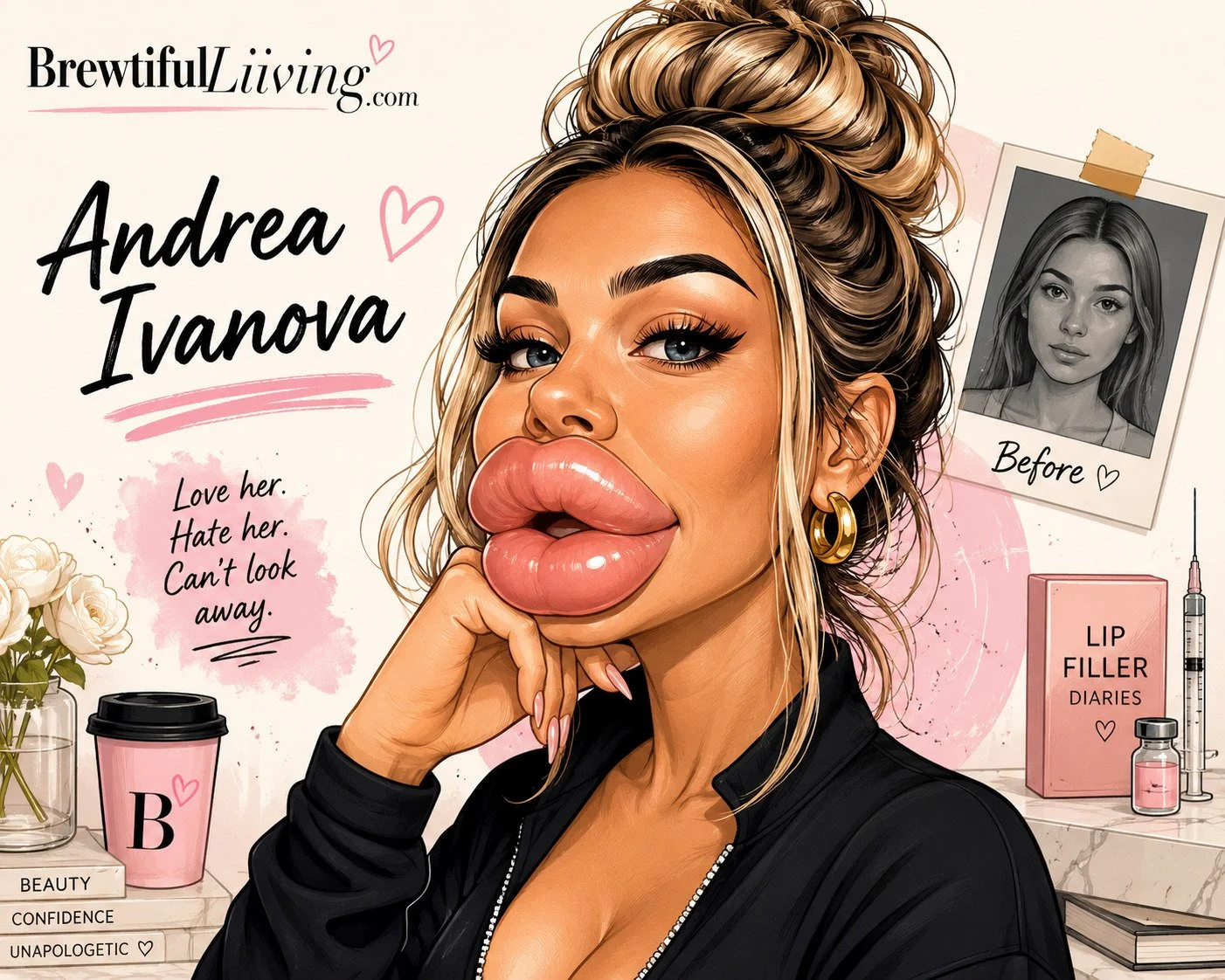
Open Letter to Andrea Ivanova — A Study in the Art of Excess
Editor’s Note: The following piece discusses extreme cosmetic procedures and body modification. It’s not medical advice, not an endorsement, and definitely not encouragement. If you’re thinking about filler, Botox, or anything that involves a syringe, talk to a doctor. Not a columnist.
LIP SERVICE: THE WOMAN WHO OUTGREW HER FACE
There are trends, there are obsessions, and then there’s Andrea Ivanova.
She’s the woman with the world’s biggest lips — a title that sounds like a Guinness category nobody asked for.
Over $26,000 spent. More than thirty injections. A new face built from old insecurities.
In her words, “natural beauty is boring.”
In ours, this is what happens when the mirror stops being a reflection and becomes a stage light.
THE ERA OF EXTREME: 1998 CALLED, IT WANTS ITS RESTRAINT BACK
Back then, beauty was minimalism. Nude lip, brown mascara, subtle confidence.
Now, confidence comes in syringes.
Andrea started small in 2018. One harmless tweak. A touch of gloss to the ego.
Then another. Then another. Somewhere between the tenth and the thirtieth, the word “temporary” lost all meaning.
What’s left is not a woman — it’s a warning label wearing lipstick.
"THE LIPS AREN’T THE STORY. THEY’RE THE SYMPTOM."
ATTENTION IS THE NEW FACE CREAM
The 90s had tabloids. Today has TikTok.
Andrea’s face is her brand. Every headline, every selfie, every shocked comment — revenue.
The math is simple:
Shock equals visibility.
Visibility equals relevance.
Relevance equals survival.
Beauty? Optional.
In the age of viral deformity, being forgettable is the only sin left.
COVER GIRL OR COVER STORY?
The Daily Mail writes about her like a circus act.
Instagram treats her like content.
The rest of us scroll, judge, share, and feel slightly better about our own reflections.
Andrea gives us what we crave most — distraction.
She’s turned her body into a mirror for our moral superiority.
THE DOCTORS WHO KEEP SAYING YES
In the 90s, cosmetic surgeons still had ethics pamphlets and quiet clinics with fake plants.
Now? It’s influencer medicine.
Ring lights. “Before and After” slideshows.
Some doctors said no. Others said, “how soon?”
Because when aesthetics become commerce, ethics become optional.
Andrea isn’t just a patient. She’s marketing material.
"SHE CALLS IT CONFIDENCE. IT LOOKS LIKE UPKEEP."
WHEN BEAUTY BECOMES A JOB TITLE
Andrea calls her look “empowering.”
But empowerment that requires monthly injections sounds less like freedom and more like freelance work.
Every refill, every “just a little more,” keeps her employed in her own mythology.
She isn’t chasing beauty. She’s maintaining visibility.
And visibility, like rent, is due every month.
THE MIRROR THAT LIED TO EVERYONE
Remember when mirrors told the truth?
Now they come with filters.
Andrea didn’t just use one — she became one.
She turned her face into the physical version of a Facetune filter that never resets.
The result is not ugly. It’s unsettling.
She’s achieved what no tech ever could: permanent digital distortion.
EDITOR’S NOTE: YES, THIS REALLY HAPPENED
Andrea says her lips still look small to her.
That she wants them “much bigger than now.”
Somewhere between delusion and determination lives the new definition of confidence.
THE ADDICTION OF THE AESTHETIC AGE
Addiction doesn’t always look like pills or powder.
Sometimes it looks like a woman scrolling through her own selfies thinking, not enough yet.
Andrea isn’t the only one. She’s just the most visible.
The filtered, the retouched, the reshaped — they all live in the same feedback loop.
The line between maintenance and mania is paper-thin.
"SHE ISN’T THE GLITCH IN THE SYSTEM. SHE’S THE SYSTEM WORKING PERFECTLY."
THE CULTURE THAT BUILT HER
We told women to love themselves — but only after fixing everything first.
We called it empowerment.
We packaged it in pink.
We sold it with free samples.
Andrea didn’t misunderstand the assignment. She completed it.
She’s not the villain. She’s the honor student of consumer capitalism.
THE BODY AS BILLBOARD
Andrea’s not alone.
The filtered teen with the AI jawline.
The influencer adjusting her face every season.
The 40-year-old pretending she’s twenty-two on camera.
They all learned the same lesson: identity is editable.
Andrea just refused to stop editing.
THE DECADE OF NEVER ENOUGH
If the 90s were about minimalism, this decade is about maxing out.
More filler, more followers, more outrage.
Andrea’s story isn’t an anomaly. It’s a prophecy.
Every “just a little tweak” brings us closer to her.
The only difference between us and Andrea is the budget and the nerve.
"POWER ISN’T DOING WHAT YOU WANT TO YOUR FACE. IT’S BEING ABLE TO STOP."
THE AFTERLIFE OF THE IMAGE
One day, Andrea will stop.
Because she’ll have to.
Because her body will tap out before her ambition does.
But her images will live on.
The Internet doesn’t dissolve like filler.
Andrea’s face will float forever — a cautionary ad for a culture that doesn’t believe in stopping.
THE LONELINESS OF BEING LOOKED AT
She’s famous. But fame is not affection.
She’s said relationships are hard. That people stare but don’t stay.
Visibility replaced intimacy.
Everyone looks, but no one sees.
It’s the kind of loneliness that used to belong to starlets and supermodels.
Now it belongs to anyone with a Wi-Fi connection and an identity crisis.
FINAL REFLECTION: THE GIRL WHO SOLD US OUR OWN DELUSION
Andrea Ivanova didn’t destroy beauty standards. She revealed them.
She’s what happens when the culture of “be your best self” forgets to define best.
Her lips are a product.
Her story is a sales pitch.
And her tragedy — if it is one — belongs to all of us.
DEAR ANDREA
You didn’t ruin your face. You just proved how ruinable it was.
You believed the same myth everyone else did: that perfection was purchasable, that attention was love, that more was better.
You’re not a monster. You’re a mirror.
I hope one day you look in it and stop seeing an audience.
Sincerely,
Someone Who Still Misses the 90s, When Faces Looked Like Faces
I Survived a Lash Disaster and I’m Never Going Back
Let me begin, as all cautionary tales should, with a lie I told myself: It’ll be fine.
It was not fine.
But that’s the thing about modern femininity—we’ve been conditioned to ignore the red flags if they come with a cute logo and an Instagram page with before-and-after shots. And so, despite the psychic ache in my gut and the physical ache in my neck (slept funny, probably a metaphor), I found myself en route to a lash appointment I didn’t want to go to. This wasn’t self-care. This was self-sabotage in a cashmere hoodie.
I miss Pat BB.
Pat BB, if you’re reading this, come back. She understood me. She understood my eyes. She gave me lashes that whispered sweet nothings. They said, I read books. I make good decisions. I don’t scream in public. But Pat BB no longer works at the lash studio. She vanished like all good things do—in silence and without warning. Probably ascended to a higher plane. Or took a job at Sephora. Same thing.
Enter: Coco.
Coco, who once gave me a pedicure so traumatic I had to Google "can you get tetanus from a nail salon." Coco, who clipped my cuticles like she was cutting into brisket. Coco, who treated my toe like it owed her money. And still, still, I went back. Because, say it with me: Maybe it’s just me.
Let’s pause here and reflect on the quiet violence of that sentence. “Maybe it’s just me” is the national anthem of every woman who’s ever tried to advocate for herself and then apologized for the tone. It is the slogan of our downfall. It should be stitched onto the flag we wave when entering battle: the battle being any appointment that requires a waiver and a ring light.
Anyway. The appointment.
It began with the usual lies.
“Just lie back and relax.”
“Tell me if anything’s uncomfortable.”
“These will last at least three weeks.”
Within the first ten minutes, my left eye began staging a revolt. Something between a migraine and a nervous breakdown took root behind my brow bone. The glue fumes were conducting a TED Talk in my sinuses. I whispered, “I think I need a tissue.” Coco handed me a linty square of toilet paper. Budget spa energy. Love that for me.
Halfway through, I had to ask for a vomit bag. A vomit bag. While she was gluing what can only be described as insect legs to my lash line, my body decided to protest—quietly, of course, because even in medical distress I am Canadian.
Coco said I was “sensitive.” As if sensitivity is a flaw and not just... my body screaming in Morse code.
Three and a half hours later—because apparently time is elastic when you’re questioning all your life choices—I looked in the mirror and nearly collapsed. My lashes were straight out of a 2010 YouTube tutorial. Full glam. Vegas stripper meets angry crow. Each lash looked like it had its own opinions.
I blinked, and the room darkened. That’s how heavy they were.
My right eyeball was bloodshot like it had just come back from war. My left eye was watering in what I can only assume was sympathy. Coco, ever the optimist, called this “normal.” I, ever the liar, said, “Oh okay, I didn’t get this with Pat BB.”
She shrugged.
A shrug. A full-body punctuation mark that said, Not my problem.
It’s now been 26 hours since the Incident. I’ve spent most of that time pacing my condo like a Victorian ghost. My cats have stopped making eye contact. Every time I pass a reflective surface, I jump. I look like a tired raccoon who tried to contour. I’ve Googled “lash extension allergic reaction” so many times I’m now being served ads for steroids and eye patches.
But somewhere between the Advil and the regret, I had a breakthrough. An awakening. A spiritual unraveling, really.
Maybe this wasn’t just about lashes. Maybe this was a divine intervention. A sacred slap. The universe, sick of my wishy-washy tendencies, finally sent in the heavy artillery: eye inflammation and aesthetic humiliation.
So here’s what we’re doing going forward:
1. No More Lash Extensions. Ever.
Not even if I’m invited to the Oscars. Not even if a hot stranger says, “You’d be perfect, if your lashes were a bit fuller.” Not even if Pat BB opens a boutique in my lobby. I am done.
2. Natural Lashes Only.
We're talking castor oil, baby. Daily brushing. A ritualistic grooming routine, Victorian governess-style. “Did you wash your face?” No. But I did comb my lashes like an old woman in mourning.
3. No Mascara. No Curling.
We’re raw now. We’re feral. We’re letting our lashes live and die on their own terms.
4. Emphasis on Earrings.
We’re pivoting the beauty narrative. Statement earrings will do the talking from now on. Lashless but loud. Think Vogue Paris meets accidental agoraphobe with decision fatigue and a Pinterest board called “elevated neutrals.”
5. Trust the Gut.
If I hesitate, it’s a no. If I flinch, it’s a no. If I have to Google the technician beforehand and find a Yelp review that says “she was fine once she got her coffee,” it’s a no.
This wasn’t a lash appointment. It was a detox. An exorcism. A forced reckoning with my inability to say no until I’m blinking through pain and fury.
Let this be a lesson.
If you feel weird about something—a booking, a person, a suspiciously cheap Groupon—cancel it. Run. Throw your phone in a lake. Bake a loaf of banana bread instead. Real self-care isn’t a $140 lash lift. It’s telling yourself the truth and acting on it before your eyeball turns into a crime scene.
In conclusion: I forgive myself. But also, never again.
See you in the next chapter. Hopefully with both eyes, and at least some dignity, intact.
Cleansed, Toned, and Barely Holding It Together
By Sara Alba, Editor-in-Chief, Brewtiful Living
TORONTO — In a world where your ex is thriving, your group chat is dead, and your brain is an anxious swirl of half-thoughts and unpaid parking tickets, one woman is finally taking control. No, she didn’t join a monastery or delete Instagram. She started... washing her face. Consistently.
“Honestly? I used to be gross,” confesses Brewtiful Living’s own Editor-in-Chief, Sara Alba, sipping her third coffee and tapping thoughtfully at her freshly moisturized cheek. “I would doomscroll through skincare TikToks and just roll my eyes. Serums? Essence? Who has time for that? I was busy watching YouTube girls wipe their perfectly winged eyeliner off with micellar water while I lay there in a shirt that smelled like regret.”
And yet—here we are. Glowy. Mentally stable adjacent. Slightly smug.
“Skincare Routine Turns Former Goblin Woman Into Functioning Human”
There’s something inherently ridiculous about spending $34 on a cream that promises “barrier repair” when you haven’t replied to your therapist in four weeks. But somehow, it works. Not just on your skin—on your entire nervous system.
“I started small,” Sara admits. “It wasn’t some expensive overhaul. It was literally just washing my face with warm water and putting Vaseline on my eyelids. But I felt... weirdly amazing? Like, am I a girl now? Am I soft?”
As it turns out, having a skincare routine isn’t just about preventing breakouts or pretending to be Hailey Bieber. It’s about rituals. Slowness. The tiniest sense of control when life feels like a Target cart with a busted wheel.
“Local Woman Applies Moisturizer, Feels Something”
“The first night I double-cleansed, I felt like I was participating in something. Like I belonged to this secret society of women who smell like rosehip oil and don’t panic when someone FaceTimes them.”
It wasn’t just about appearance—it was a shift in self-perception. People noticed.
“The compliments started trickling in. ‘You look fresh!’ ‘Did you sleep last night?’ It was like I was living in HD. And no one knew my entire skincare budget was $12.99 and a prayer.”
“Mental Health on the Rise as Women Discover Power of Routine, Slight Grease”
Experts (aka the girls in your comment section) say that touching your own face gently every night might be more healing than your last situationship. It’s not that a cleanser replaces therapy—but sometimes, it’s a start.
“I don’t feel ugly anymore,” Sara says, “even on days when my skin’s not perfect. Just putting in the effort—slapping on a bit of balm, doing a jade roller move I learned from a girl named Daniella in a claw clip—it makes me feel like I’m worth showing up for.”
Let’s be clear: Skincare won’t fix your job, your taxes, or your existential dread. But it might make you pause long enough to remember you're a person—not just a tired WiFi signal in leggings.
“Editor Says Vaseline Changed Her Life, Society Skeptical”
“I used to think beauty routines were performative. That they were for influencers with bathroom lighting sponsored by God. But now? I kind of love being that bitch who has a ‘nighttime routine.’ It feels like hope.”
And hope, dear readers, is cheaper than La Mer.
Need proof that beauty doesn’t always mean “perfect”? Yesterday I cried over a set of French tips that looked like they belonged in the clearance bin of a Claire’s circa 2004. I’m still wearing them. Why? Because sometimes beauty is messy, petty, and painfully real.
Read When French Tips Turn Trashy—a nail saga for the emotionally unstable but well-moisturized.
When French Tips Turn Trashy
Photo credit
by Sara Alba, Editor-in-Chief, Brewtiful Living
Toronto, ON — In a chic, high-end nail salon nestled in one of the city’s most expensive neighborhoods (a place with eucalyptus-scented towels, minimalist decor, and silence that costs extra) a woman walked in with hope.
She carried a dream: soft, tapered French tips. Elegant. Subtle. A whisper of wealth, not a scream. A nail that said “I book dental cleanings on time” and “I don’t follow trends—I just always look like this.”
She left with trauma. And a receipt.
I know this, because that woman was me.
Exhibit A: The Photo
It started like every classic nail appointment disaster: with a Pinterest photo.
A clean almond shape. A milky base. The kind of French tip that whispers, “I’m expensive, but you’ll never know how much.”
I presented it politely, reverently. I made eye contact with my technician. I used phrases like “subtle white,” “not too thick,” and “clean lines, please.” I even circled the tip style in the photo. I was clear. I was communicative. I was vulnerable.
What I got in return… was not that.
Exhibit B: The Nails
Imagine, if you will, an episode of Laguna Beach where the B-roll girls get ready for prom. Now imagine those nails, but somehow worse. That’s what I walked out with.
They were square-ish. The white tips were thick, like they were done with a paint roller. They had that early-2000s gap between the cuticle and color that screamed “I’m letting my mom drop me off at Hollister.”
They looked like they belonged to someone who says “literally” too much and still wears Victoria’s Secret body spray unironically.
They were not timeless.
They were not chic.
They were… offensively Y2K.
The Tip Heard Round My Bank Account
I smiled. I thanked her. I tipped.
Because this is what we do. We tip for emotional labor. We tip for effort. We tip because we’re too socially conditioned to say, “This is not what I asked for.”
And so I paid nearly $100 to walk out with ten fingers of regret.
It wasn’t just the shame of knowing I was about to walk around like this, telling people I “just felt like something different.”
It was also, very much, the price. A reminder that I paid for my own disappointment—and tipped for it, too.
4:17 PM — Post-Tip Despair
I got home. Took a long look under natural lighting.
That’s when the emotional hangover hit.
It’s the same feeling you get after sending a risky text. Or ordering clothes from a sketchy website. A mix of nausea, denial, and internal screaming.
I paced. I tried placing my hands against various backdrops—my marble counter, my sweater, my coffee cup. Nothing helped.
My hands looked like they belonged to a different person.
A stranger. Someone who watches Selling Sunset unironically.
The Quiet Humiliation of Aesthetic Regret
There’s a certain kind of sadness that comes when your outer self doesn’t match your inner self. You envision elegance. What you get is chaos. But worse—it’s visible. Every gesture, every wave, every casual hand placement becomes a reminder that you failed at being your own muse.
And no, you can’t just “go get them redone.” That’s another $100, another tip, another emotional rollercoaster. Plus, you’re busy. You’re emotionally recovering.
The Aftermath
Day 1: Rage.
Day 2: Acceptance.
Day 3: Strategic finger curling in all public situations.
By Day 5, I was telling people, “I was going for retro,” just to feel some control.
The real tragedy? I’ll probably go back.
Because that’s the delusion of beauty culture—we’re always chasing the next time it’ll be better.
Editor’s Note: What We Learn From Bad Nails
Sometimes you don’t get the nails you wanted.
Sometimes you get the nails you deserve for trying to curate your life through aesthetics. And sometimes? That’s the story.
So if you’re reading this, freshly French-tipped in all the wrong ways, know this:
You’re not alone.
You are not your cuticles.
And yes—those would look better in a different lighting.
—