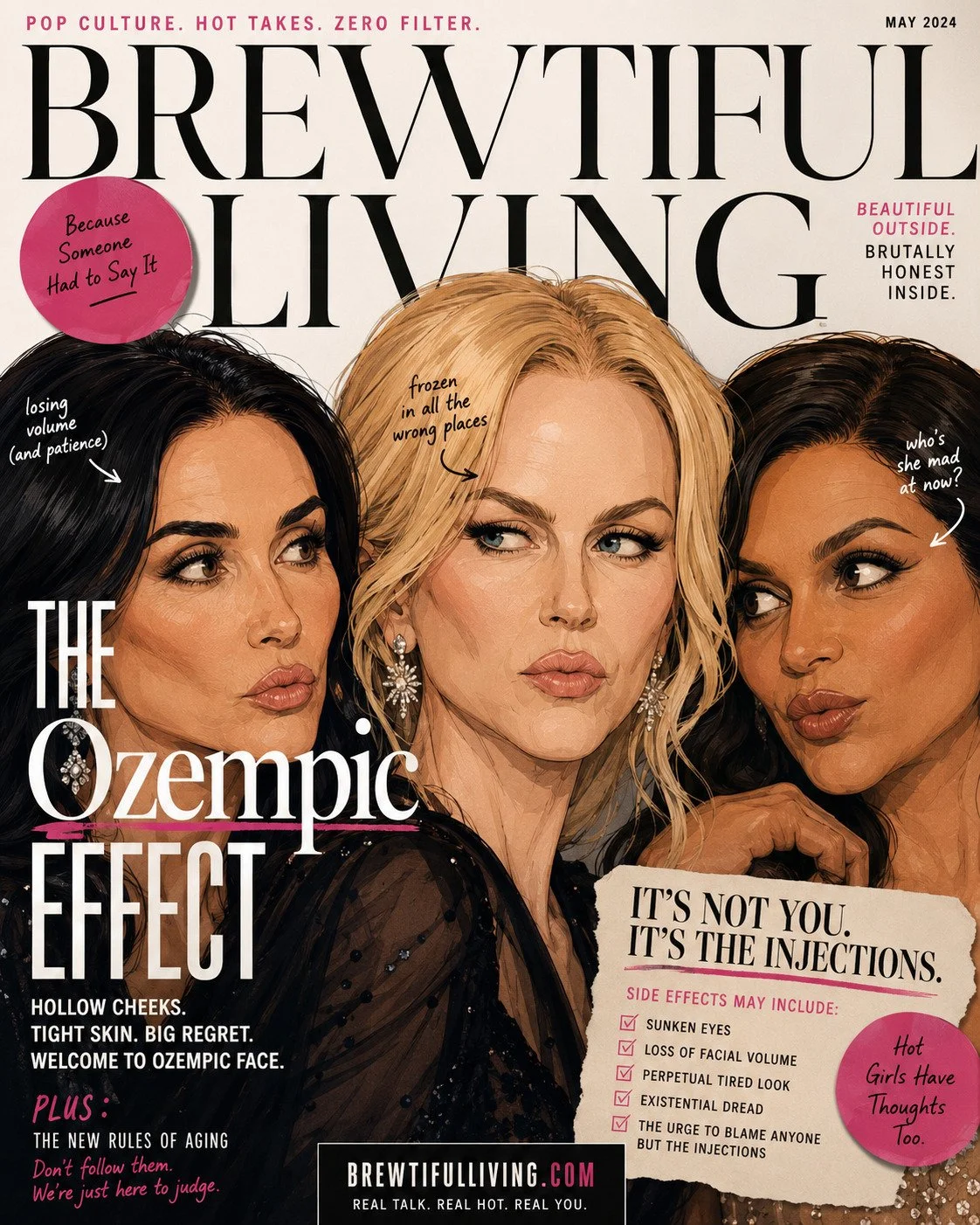
There are beauty trends, and then there are beauty panics. Ozempic face is both. It is a medical side conversation, a celebrity guessing game, a wellness industry fever dream, and another reminder that the internet has never met a human face it didn’t want to investigate like a true crime documentary.
There is a very specific face haunting celebrity culture right now.
Sharper. Smaller. Hollower. Slightly expensive-looking. Slightly exhausted. The kind of face that looks like it drinks electrolytes recreationally and has complicated opinions about inflammation.
The internet gave it a name immediately because the internet names things before it understands them: Ozempic face.
And suddenly everyone became a detective.
People are zooming into Getty Images like unpaid FBI interns. TikTok users are analyzing cheekbones with the emotional intensity of conspiracy theorists decoding crop circles. Every red carpet photo now arrives with comments that sound medically concerned but are really just gossip wearing scrubs.
“She looks different.”
“He looks gaunt.”
“Is anyone else noticing this?”
Which is fascinating because culture spent twenty years worshipping thinness before abruptly pretending to be alarmed when people started becoming visibly thinner.
The body became content years ago. Now the face is evidence.
PUBLICIST CALMING STATEMENT
This article is satire, cultural commentary, internet anthropology, and one woman staring at Getty Images for an unreasonable amount of time. Brewtiful Living is not claiming any specific celebrity is using Ozempic, GLP-1 medications, semaglutide, moon dust, chlorophyll water, injectable optimism, or emotionally devastating Pilates classes.
We are simply observing that Hollywood collectively entered an era where everyone suddenly looks expensive, angular, mildly dehydrated, and spiritually sponsored by Erewhon.
If you personally feel identified by the phrase “wealthy but alarmingly hollow,” that is between you and your mirror.
COMMON SIDE EFFECTS OF MODERN HOLLYWOOD THINNESS
- Looking vaguely furious at bread
- Jawlines sharp enough to open Amazon boxes
- Developing the facial energy of a wealthy Victorian orphan
- Sudden devotion to infrared saunas and emotional detachment
- Appearing both 34 and 67 simultaneously
- Accidentally aging backwards and forwards at the same time
Ozempic did not invent beauty pressure. It just gave it a prescription pad and better lighting.
The internet immediately made it weird
What Is Ozempic Face, Really?
“Ozempic face” is not an official medical diagnosis. Nobody is getting a chart note that says “tragically diminished cheek economy.” The term refers to facial changes that can happen after significant or rapid weight loss, especially volume loss in the cheeks, temples, jawline, and under-eye area.
It is often linked to GLP-1 medications because drugs like semaglutide have become part of the public conversation around rapid weight loss. Ozempic itself is approved for adults with type 2 diabetes, while other semaglutide medications may be prescribed for chronic weight management in certain patients. The internet, being the internet, flattened all of that nuance into one phrase and threw it into a TikTok caption with dramatic music.
The look people are talking about usually includes sunken cheeks, deeper smile lines, looser skin, under-eye hollowness, and a more gaunt appearance. Sometimes it looks dramatic. Sometimes it just looks like someone lost weight quickly and the face has not caught up yet. Sometimes it is aging. Sometimes it is lighting. Sometimes it is buccal fat removal. Sometimes it is stress. Sometimes it is none of our business, a phrase the internet treats like a personal insult.
Research Note
Doctors noticed the internet noticed. Chilling.
A 2024 paper in the Journal of Plastic, Reconstructive & Aesthetic Surgery examined the rise of “Ozempic Face” as a trend tied to rapid facial weight loss from GLP-1 agonists. The issue is not just aesthetic gossip. Sudden facial volume loss can create real treatment and counselling challenges for clinicians.
Why the Face Changes First, or at Least Feels Like It Does
The face is where change becomes public. You can hide a changing waistline under a blazer. You cannot hide your cheek structure unless you plan to conduct all social interactions from behind a tasteful curtain.
This is why facial weight loss feels so personal. The face is identity. It is what your friends recognize before you speak. It is what your phone unlocks. It is what strangers judge in half a second because apparently evolution gave us fire, language, and the ability to decide someone is tired based on their nasolabial folds.
When facial volume disappears quickly, the effect can be jarring. Fullness in the cheeks can soften the face. Fat around the temples and under-eyes can make someone look rested. Volume around the jaw and lower face can support the skin. Remove some of that support and the same face can suddenly look sharper, older, or simply unfamiliar.
That does not mean thin equals bad or full equals good. This is not a ransom note from Big Cheek. It means the face is a balance of structure, tissue, movement, and time. When one piece changes fast, everything else starts behaving like the group project member who did not read the brief.
There is also the speed problem. Slow weight loss gives the face more time to adapt. Rapid weight loss can make the change feel abrupt. That is part of why people find it so shocking. It is not just that someone looks smaller. It is that they seem to have changed genres.
Yesterday: approachable celebrity with soft glam. Today: elegant widow in a limited series about inheritance fraud.
Everyone in Hollywood Suddenly Looks Rendered
The strange thing about the Ozempic era is not that people lost weight. Hollywood has always treated body fat like an administrative error. The strange thing is how visually similar everyone started becoming afterward.
Actors. Influencers. Wellness founders. Former sitcom dads. Podcast men who suddenly look like emotionally unavailable divorce attorneys named Brent. Women who used to radiate “soft luxury” now looking like they survived a very expensive famine.
We spent ten years inflating faces with filler until everyone looked softly laminated, then culture abruptly pivoted into dissolving volume until everyone started resembling exhausted renaissance paintings with exceptional skincare.
Nobody looks unhealthy exactly. That would almost be easier to understand. Everyone just looks optimized in a way that feels slightly haunted.
The modern celebrity face now signals status the way handbags used to.
Sharp cheekbones say discipline. Hollow cheeks say exclusivity. Looking faintly exhausted now reads as wealthy because apparently the final stage of luxury culture is looking like you survive entirely on electrolytes and private appointments.
And men are absolutely doing this too, which somehow makes the entire thing funnier.
One minute certain Hollywood men looked like regular aging actors. The next minute they looked like founders of a startup called Human Optimization Lab where everyone sleeps on magnesium sheets and refers to coffee as “inflammatory.”
There is a very specific face spreading across celebrity culture right now. Tight skin. Smaller features. Hollowed cheeks. Aggressively whitened teeth. The expression of someone who definitely owns a sauna blanket.
It is becoming less of a beauty trend and more of a visual economic class marker.
The old rich looked overfed. The new rich look nutritionally supervised.
Wellness Culture Is Just Diet Culture Wearing Beige
The most fascinating part of this entire Ozempic conversation is how desperately culture keeps trying to pretend it evolved.
The language changed. The obsession did not.
Nobody says “I want to be skinny” anymore because wellness culture hired a branding team. Now the vocabulary is optimization. Longevity. Inflammation. Hormone balance. Metabolic health. Clean living. Gut support. Functional medicine.
Which is interesting because somehow all roads still mysteriously lead to being thinner.
The modern wellness industry figured out something genius: people reject vanity, but they trust medical language.
So now beauty standards arrive disguised as health initiatives.
Nobody is dieting anymore. They are “reducing inflammation.” Nobody wants to lose weight. They want to “feel their best.” Nobody is hungry. They are “prioritizing protein.”
Same panic. Better fonts.
And because the internet cannot experience a cultural shift normally, the entire thing became aesthetic almost immediately.
The “wellness face” is now its own category online. Slightly hollow. Hyper-toned. Rich-looking in a medically supervised way. Like someone who owns multiple matching water bottles and quietly judges seed oils.
Ozempic face became such a powerful phrase because it punctured the illusion. Suddenly people could see the machinery behind the aesthetic.
The shrinking. The optimizing. The endless pursuit of smaller.
And culture hates when you notice the machinery.
The culture wanted everyone smaller. Then it acted shocked when the shrinking showed up on their faces.
Extremely normal society, doing great
The Internet Pretends Concern Is Morality
The internet says it cares about health the way a vulture says it cares about wildlife.
Every celebrity conversation now arrives disguised as concern.
“She looks too thin.”
“He looks gaunt.”
“Are they okay?”
“They don’t look healthy.”
Which would feel more sincere if the exact same internet had not spent twenty years rewarding thinness like it was a personality trait.
That is what makes Ozempic face so culturally explosive. It exposes the contradiction directly.
Culture still worships thinness. It just no longer wants to admit it publicly.
So instead we perform concern while continuing to reward the exact aesthetic producing the concern in the first place.
The celebrity body became content years ago. Now the face is evidence.
Every red carpet photo gets treated like forensic material. Everyone zooming into jawlines like unpaid detectives trying to solve a cheekbone-related crime.
And honestly? The weirdest part is how quickly everyone adapted to this visually.
Faces that would have looked alarmingly thin ten years ago now register as aspirational because the collective visual baseline shifted.
That is how beauty culture works. It moves the target slowly enough that everyone thinks they arrived there naturally.
The Medication Is Not the Villain. The Culture Is Worse, Obviously.
There is a lazy version of this conversation that treats everyone using GLP-1 medication as vain, weak, or secretly tragic. That version is stupid and should be escorted out quietly.
GLP-1 medications can be medically significant for people managing type 2 diabetes, obesity, and related health concerns. For many people, these drugs are not a celebrity shortcut or a vanity project. They are healthcare. They are relief. They are the first thing that has worked after years of being told to “just eat less,” which is less medical advice and more a bumper sticker written by someone with a metabolism like a furnace.
The problem is what happens when a serious medication enters an unserious culture. A drug created for metabolic health gets absorbed into celebrity gossip, beauty standards, thinness panic, and TikTok’s endless little shopping mall of misinformation. Suddenly every dinner table has a GLP-1 theory. Every red carpet has amateur endocrinologists. Every face becomes a clue.
We are not good at nuance because nuance does not photograph well. We prefer villains, miracles, glow-ups, scandals, and captions with the word “finally.” Ozempic face sits right in the middle of all of it, looking tired.
Why Everyone Is So Obsessed With the Face
The face is where society keeps its receipts.
We say we care about health, but we reward appearance. We say we admire confidence, but we inspect bodies. We say aging is natural, then sell people thirty-seven products to make sure nobody sees it happening. The face is where all these contradictions gather, apply concealer, and pretend they are fine.
Ozempic face became a phenomenon because it exposes a problem beauty culture does not know how to solve. Thinness is still desirable, but youth is also desirable. Weight loss can make the body closer to the current ideal, while making the face look older by current standards. So now the person who “wins” the body game may be punished in the face game.
This is the trap. There is always another game.
Lose weight, but not too fast. Age, but invisibly. Use injectables, but do not look injected. Be natural, but not naturally tired. Be thin, but not gaunt. Be healthy, but make it photogenic. Be honest, but only in a way that protects everyone else’s fantasy.
It is less beauty culture and more administrative violence with lip gloss.
Can Ozempic Face Be Reversed?
Sometimes the appearance may soften if weight stabilizes, nutrition improves, hydration is consistent, and the skin has time to adjust. Sometimes it does not. Sometimes people pursue cosmetic treatments. Sometimes they do nothing because, radical thought, they are busy living an actual life.
Common aesthetic approaches may include dermal fillers, biostimulatory injectables, skin tightening treatments, lasers, or fat transfer. But none of this should be treated like a one-size-fits-all rescue mission. A twenty-eight-year-old who lost twenty pounds quickly is not the same as a fifty-eight-year-old who lost eighty pounds after years of collagen decline. The face has context. Annoying, but true.
The better prevention conversation is boring, which is usually how you know it might be useful. Gradual weight loss when possible. Enough protein. Resistance training. Hydration. Sleep. Medical supervision. Not treating nausea like proof of moral superiority. Not buying a “face rebuilding” serum from someone filming in their car.
Anyone using or considering a GLP-1 medication should work with a qualified medical provider, especially if they are dealing with side effects, rapid weight loss, nutritional concerns, muscle loss, or medication sourcing questions.
The FDA has warned about dosing errors associated with some compounded injectable semaglutide products. Which is a sterile government way of saying: maybe do not get your metabolic medication from a website that looks like it also sells fake concert tickets.
The Real Epidemic Is the Commentary
The word “epidemic” gets thrown around because it sounds dramatic. And yes, the trend is everywhere. But the real epidemic is not hollow cheeks. It is the surveillance. The constant looking. The way the internet turns every visible change into a group project.
Someone gains weight and the internet calls it concern. Someone loses weight and the internet calls it concern. Someone gets filler and the internet calls it concern. Someone dissolves filler and the internet calls it concern. Concern, at this point, is just cruelty with a better publicist.
Ozempic face is the perfect beauty culture scandal because everyone can pretend they are talking about health while actually talking about appearance. It gives people permission to say the quiet part with a stethoscope around its neck.
And that is why the phrase works. It lets people point at the cost of the current ideal without admitting they helped create the demand for it.
This article is for you if…
You searched what Ozempic face means and accidentally found the cultural autopsy.
You are tired of everyone pretending beauty standards got nicer because the fonts got softer.
You want research, but you also want the thing to have a pulse.
You have noticed that “wellness” keeps arriving dressed as diet culture with a tote bag.
Skip it if you…
Want a medical prescription. This is commentary, not a consultation.
Think celebrity bodies should be discussed like quarterly earnings.
Believe the internet’s concern is usually sincere. Sweet.
Cannot handle the idea that the culture may be the problem. Again.
So Where Does That Leave Us?
Somewhere uncomfortable, which is usually where the truth lives when it cannot afford better housing.
Ozempic face is real enough to discuss, but not simple enough to weaponize. It can be a legitimate aesthetic concern. It can also be a cruel internet label. It can involve medicine, aging, beauty pressure, class anxiety, celebrity culture, and our collective inability to leave human faces alone for five minutes.
The most honest thing to say is that the face has become another battlefield in the same old war. The war just has new branding now. Cleaner fonts. Better lighting. More clinical language. A terrifying number of people saying “inflammation” when they mean weight.
And maybe that is why this topic feels so charged. It is not only about Ozempic. It is about the fact that beauty culture keeps changing the assignment and then grading everyone in public.
Final Thought
The face always tells on the culture.
Ozempic face is a beauty trend, a medical side conversation, a search trend, a celebrity obsession, and a mirror held up to the part of society that never really stopped worshipping thinness. It just learned softer language.
The face people are panicking over is not just a side effect. It is a symbol. Of speed. Of status. Of the new body economy. Of how fast we can rebrand disappearance as discipline and then act surprised when everyone looks tired.
Maybe the real epidemic is not Ozempic face. Maybe it is our need to turn every face into proof that someone is winning or losing.
Ozempic Face
GLP-1
Semaglutide
Facial Volume Loss
Beauty Culture
Celebrity Culture
Body Image
Wellness Culture
More beauty culture with a pulse.
Browse Beauty, where the mirror gets questioned first.
Browse Beauty →