The Housemaid Book vs Movie: Same Story, Different Manipulation
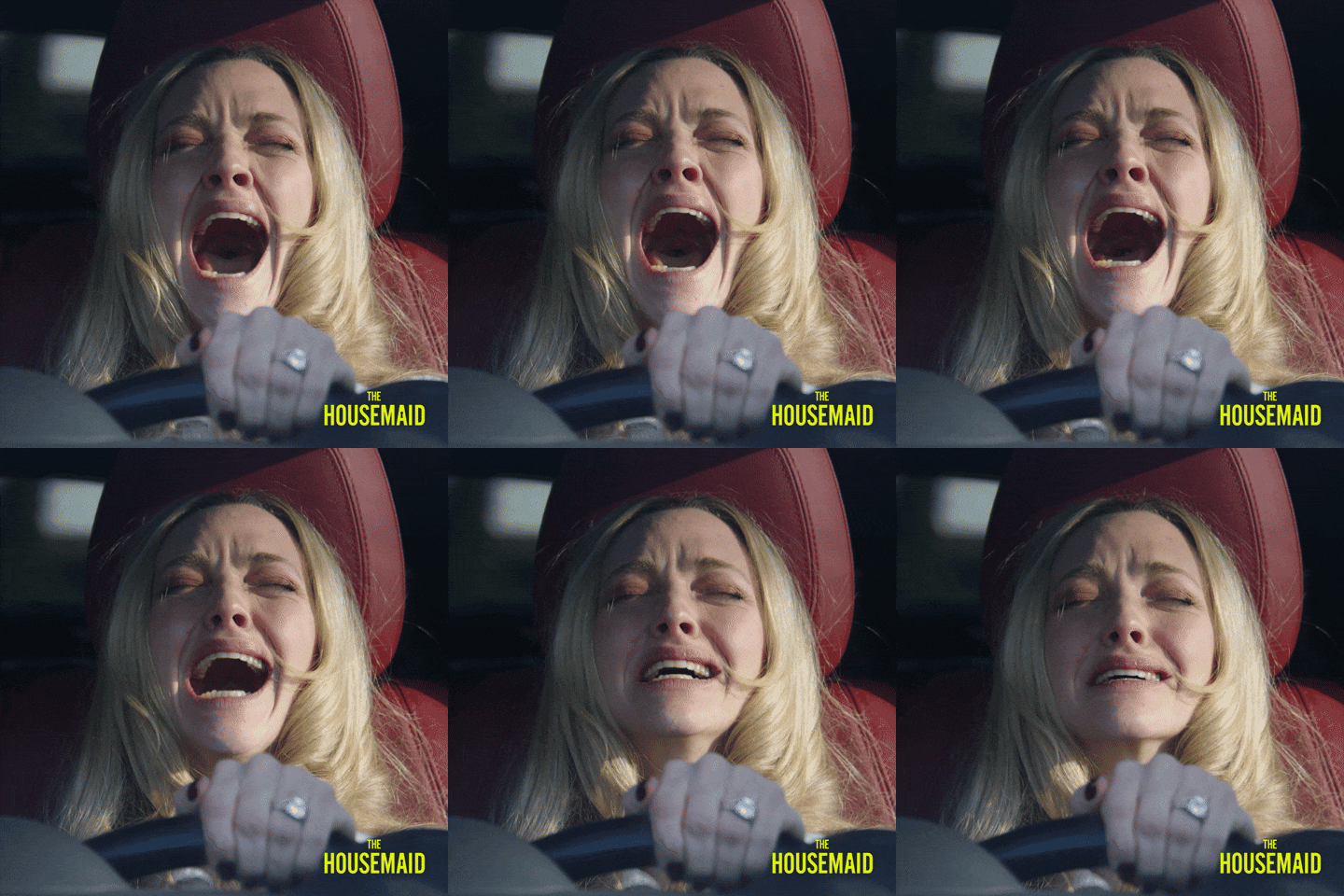
There are two ways to experience The Housemaid.
You can read the book and feel your brain quietly rearranging itself like furniture in a room you didn’t realize was haunted.
Or you can watch the movie and feel that same room lit up with expensive lighting, polished dialogue, and a cast so gorgeous you almost forget someone is about to get emotionally eviscerated.
Both versions tell the same story. A woman with a past takes a job in a rich family’s home. The house is beautiful. The wife is erratic. The husband is charming. The rules are weird. The bedroom door locks from the outside.
And slowly, the job stops being a job and starts being a psychological trap with designer countertops.
Freida McFadden’s The Housemaid is one of those thrillers people don’t recommend. They shove it at you like contraband. It’s bingeable, brutal, and engineered to make you say “just one more chapter” until you look up and it’s 2 a.m. and your standards for men have dropped another inch out of pure exhaustion.
The movie adaptation, directed by Paul Feig and starring Sydney Sweeney and Amanda Seyfried, takes the same ingredients and cooks them differently. It’s slicker. It’s more cinematic. It’s also less claustrophobic, because movies can’t trap you in someone’s skull the way a book can.
Which is why the comparison is fascinating.
Because the biggest difference between the book and the movie isn’t what happens.
It’s who gets to control the story.
The Housemaid: The Plot (No Spoilers… Yet)
Millie is broke, desperate, and carrying a past she can’t afford to explain. When she lands a live-in housekeeping job for the Winchester family, it feels like a reset. Nina Winchester is wealthy, unpredictable, and constantly changing the rules. Andrew Winchester is calm, handsome, and the kind of man who seems like he’s been professionally trained to make women feel safe.
The house is stunning. The pay is solid. The arrangement seems simple.
Then Millie sees the bedroom she’ll be staying in.
It’s tiny. It’s isolated. And the door locks from the outside.
This is the kind of detail that doesn’t scream danger right away. It whispers it. It says, “It’s probably fine,” while your nervous system is already packing its bags.
McFadden understands something basic about fear: you don’t need monsters. You need discomfort that’s easy to excuse.
And The Housemaid is built entirely on that.
The Book vs The Movie: Why the Same Story Feels So Different
When people compare books and movies, they usually focus on surface-level differences. Scenes removed, lines changed, characters combined.
But The Housemaid is a better example of something deeper.
The book and the movie are the same story told through two completely different kinds of manipulation.
The novel manipulates you through intimacy.
The film manipulates you through performance.
And those are not the same weapon.
The Book Traps You Inside Millie’s Survival Brain
The book works because you’re stuck in Millie’s head. Not just her thoughts, but her logic. Her justifications. Her internal bargaining.
She is constantly calculating risk.
She’s reading tone, body language, social class cues, power shifts. She’s trying to survive, not just financially, but socially. She’s aware that she is the kind of woman society likes to label as disposable. The kind of woman people assume is lying before she even opens her mouth.
So when Nina does something bizarre or cruel, Millie doesn’t respond the way a normal person would. She responds the way a person with no options responds.
She shrinks.
She swallows it.
She makes herself smaller to keep the job.
That’s the real tension of the book. Not the mystery. Not the twist.
The tension is watching a woman rationalize her own discomfort because she has no other choice.
And you, the reader, end up rationalizing it too.
Because you’re inside the same cage.
The Movie Turns Millie Into Someone You Watch, Not Someone You Become
In the film, you’re not inside Millie. You’re beside her.
That sounds like a small change, but it’s everything.
In a book, you can spend pages inside someone’s dread. You can sit with their spiraling thoughts. You can watch their mind make excuses and then watch those excuses collapse.
In a movie, dread has to be externalized. It has to be shown.
So the film uses:
facial expressions
awkward pauses
music cues
framing
lighting
physical distance between characters
Instead of living inside Millie’s fear, you’re watching it play out in a room.
And that changes the entire emotional experience.
The book feels like being trapped in a job you can’t quit.
The movie feels like watching someone else trapped in a job you’d quit immediately.
That gap matters.
The Pacing: Chapter Cliffhangers vs Scene Architecture
Freida McFadden writes like she’s trying to ruin your sleep schedule.
Her chapters are short. They end on micro-cliffhangers. She constantly gives you information and then immediately yanks it back, forcing your brain to chase the next piece.
It’s addictive on purpose.
The structure is basically:
Something unsettling happens.
Millie tries to explain it away.
A new detail makes it worse.
Chapter ends.
Your self-control collapses.
This is why her books feel “juicy.” They’re engineered like reality TV. You’re always one scene away from the next emotional escalation.
Movies can’t do that. A scene is heavier than a chapter. You can’t cut away every thirty seconds and still have a coherent film.
So the movie has to compress tension. It has to build longer arcs of discomfort instead of quick spikes.
This is where adaptations often lose something.
McFadden’s writing style is pure momentum. The movie can replicate the plot, but it can’t replicate that sensation of being dragged forward.
It’s like the difference between scrolling and reading a printed magazine. Same content, different chemistry.
Nina Winchester: The Book Makes Her a Moving Target
In the book, Nina is a masterclass in unstable power.
One moment she’s sweet. The next she’s cruel. Then she’s apologetic. Then she’s vindictive. She oscillates so fast that Millie can’t get her footing.
This isn’t just character writing. It’s psychological warfare.
McFadden writes Nina like someone who understands how to keep another woman off balance. She’s not simply “mean.” She’s strategic in a way that feels terrifyingly realistic.
Nina doesn’t just want control. She wants Millie confused.
And confusion is a powerful form of captivity.
Because if you can’t trust your interpretation of reality, you can’t advocate for yourself.
The Movie Makes Nina More Readable, Even When It Tries Not To
The film has Amanda Seyfried, which is both a gift and a problem.
She’s too charismatic. Too intelligent-looking. Too controlled, even when she’s playing unhinged.
That means the movie has to work harder to convince the audience that Nina is truly unpredictable. Because the moment you cast someone with that kind of composed presence, viewers instinctively assume she knows what she’s doing.
In the book, Nina can feel like chaos.
In the film, Nina feels like performance.
And that subtly shifts the tone.
Instead of “Is Nina mentally unstable?” the question becomes “What is Nina hiding?”
Which is a completely different kind of suspense.
Andrew Winchester: The Book Uses Him as a Fantasy Trap
Andrew is the perfect example of McFadden’s ability to weaponize charm.
In the book, he’s written like a soft place to land. He’s calm. He’s handsome. He seems reasonable. He seems like the only adult in the room.
He is exactly the kind of man women are trained to trust. The kind of man who looks like stability in a world full of noise.
And that is why he’s dangerous.
Because McFadden understands that the most effective predators don’t act like villains. They act like relief.
They act like the person you want to believe in.
The Movie Makes Andrew Hotter, Which Makes Everything Worse
In the film, Andrew’s appeal is amplified because cinema is shallow by design. It’s visual. It’s immediate. It’s based on vibes.
So if Andrew is cast and styled as “the handsome, patient husband dealing with a difficult wife,” the audience feels that archetype in their bones.
Which makes the story hit differently.
In the book, Andrew is suspicious because Millie’s narration keeps you alert.
In the film, Andrew is suspicious because you’ve seen enough thrillers to know no man is ever that calm unless he’s hiding something or has murdered someone in a previous scene.
It becomes meta.
The movie doesn’t just ask you to watch Andrew.
It asks you to interrogate your own attraction to him.
And honestly, that’s kind of brilliant.
The House Itself: In the Book, It’s a Cage. In the Movie, It’s a Character.
In McFadden’s novel, the house is described in a way that feels like intimidation.
It’s clean. Vast. Wealthy. Quiet.
The kind of place where your footsteps sound too loud and your presence feels like a stain.
Millie isn’t just living in a rich home.
She’s living inside someone else’s power.
The locked bedroom door is not just a creepy detail. It’s a metaphor. It’s the story’s entire thesis in one object.
The house says: You are here because we allow you to be.
The movie leans into the visuals of that. It uses lighting and framing to make the house feel like a labyrinth. Long hallways. Closed doors. Spaces that swallow people.
It’s gorgeous, but it also feels colder.
The film understands that wealth is not comforting when you’re the one cleaning it.
The Biggest Difference: The Book Recruits You as an Accomplice
This is where McFadden’s writing gets nasty, in the best way.
In the book, you don’t just observe Millie’s choices.
You start agreeing with them.
You start thinking like her.
You start rationalizing red flags because you understand her desperation. You understand her hunger. You understand what it feels like to be one bad decision away from homelessness.
So when she stays, you don’t scream at her.
You stay too.
And that’s what makes the twist hit so hard.
Because McFadden doesn’t just trick you with plot.
She tricks you with empathy.
She manipulates your ability to care about someone.
The movie can’t do that as effectively, because movies are inherently less intimate. You can’t sit inside someone’s inner justifications for hours. You get glimpses. You get moments.
But you don’t get full immersion.
So the film shifts the suspense outward.
Instead of “What is Millie thinking?” the tension becomes “What is everyone doing?”
The audience becomes a detective, not a hostage.
And that changes the experience completely.
Spoiler Zone: Book vs Movie Differences That Actually Matter
If you haven’t read the book or watched the movie and you want to enjoy the twists blind, stop here.
Go experience the chaos first.
Then come back and let’s dissect the wreckage.
The Twist Structure: Books Can Hide Information Better
One of McFadden’s strongest skills is controlling what you know and when you know it.
In a novel, she can simply choose not to tell you something. She can hide it behind narration, behind pacing, behind perspective. You only know what Millie knows, and Millie is not always reliable.
That’s the key.
In a film, hiding information is harder. Viewers can see details Millie doesn’t notice. The camera can accidentally reveal clues. Even the way a room is staged can hint at the truth.
So the movie has to be more deliberate.
It can’t rely on omission alone.
It has to rely on distraction.
That means the film tends to:
rearrange the order of reveals
introduce new visual misdirects
compress certain scenes so the audience doesn’t have time to overanalyze
The book’s twist feels like betrayal.
The movie’s twist feels like a reveal.
Same outcome, different emotional punch.
Millie’s Past: The Book Makes It a Slow-Burning Threat
In the novel, Millie’s backstory is a shadow hanging over everything. You feel it in her choices. Her fear. Her hypervigilance.
Her past isn’t just a plot point. It’s a constant presence.
And McFadden uses that to build dread.
Millie doesn’t just feel vulnerable because she’s broke.
She feels vulnerable because she’s already been marked by something society doesn’t forgive easily.
The movie has less time to do that. It has to communicate her past through quick exposition, hints, and performance.
Sydney Sweeney does a good job with the quiet panic, the “I am trying to be normal” tension, but the movie inevitably makes her backstory feel more like a narrative device than a lived burden.
The book makes you feel the weight of Millie’s history.
The movie makes you understand it.
Those are not the same thing.
Nina’s Behavior: The Book Makes You Hate Her First
In the novel, Nina is written to provoke a visceral reaction.
You are meant to feel the injustice of her cruelty. You are meant to be furious on Millie’s behalf. You are meant to think, “This woman is evil.”
And then McFadden does what she always does.
She flips the emotional script and forces you to revisit every assumption you made.
This is part of why the book is so satisfying. It punishes the reader’s instinct to label women as either victims or villains. It shows how easily we fall into that binary.
The movie can’t sustain hatred as long. It has to pace the audience’s emotional journey differently. It can’t risk making Nina irredeemable too early because then the reveal feels implausible.
So the film’s Nina is still cruel, but she’s more layered from the beginning. There are moments of vulnerability, flickers of something behind the mask.
It’s more balanced.
It’s also less vicious.
And that means the payoff feels different.
The book makes you feel guilty for misjudging her.
The movie makes you feel like you were supposed to see it coming.
The Power Dynamics: The Book Is About Class Warfare in a Pretty Dress
This is the part people don’t talk about enough.
The Housemaid is not just a thriller. It’s a story about economic vulnerability and social hierarchy.
Millie is not trapped because she’s naive.
She’s trapped because she is poor.
Because she has a record.
Because she is one bad day away from losing everything.
The Winchester house is a physical manifestation of that imbalance. It’s wealth as a weapon. It’s comfort as control.
In the book, this theme is sharper because you live inside Millie’s humiliation. The little moments matter: being watched while cleaning, being spoken to like a child, being treated as invisible until someone needs something.
The movie shows this, but it’s inevitably softened by the glamour of the setting and the charisma of the cast.
The house is still intimidating, but it’s also beautiful.
And beauty has a way of dulling horror.
The book makes the mansion feel like a prison.
The movie makes it feel like a set.
The Bedroom Door: In the Book It’s Psychological Torture. In the Movie It’s a Horror Prop.
The locked bedroom door is one of the most effective details in the entire story.
In the novel, it’s not just creepy. It’s dehumanizing.
It tells Millie, every night, that she is not trusted. That she is not safe. That her freedom is conditional.
It’s the kind of violation that doesn’t leave bruises but still changes the way you sleep.
The book lets you sit with that.
The movie uses it as a visual symbol, a horror element. It’s still unsettling, but it functions differently. On screen, a locked door is a familiar trope.
In the book, it feels personal.
It feels like something that could happen to you.
And that’s why it’s more disturbing on the page.
The Ending: The Book Wants to Shock You. The Movie Wants to Satisfy You.
McFadden’s endings are designed like rollercoasters.
They’re not subtle. They’re not slow-bloom literary revelations.
They are engineered dopamine. A sudden drop. A scream. A breathless laugh.
The book’s ending feels like you’ve been played. Like you were tricked into trusting the wrong person, then tricked again for thinking you were smarter than the trick.
It’s satisfying because it’s humiliating.
The movie’s ending has to feel more conclusive. Films are expected to wrap things up with emotional closure. The audience wants catharsis, not just shock.
So the adaptation leans more into resolution.
It wants you to leave the theater feeling like the story is complete.
The book wants you to close it and stare at the wall.
Different goals. Different aftertaste.
Why Freida McFadden’s Books Are So Addictive (The Real Reasons)
People love to call McFadden’s writing “junk food fiction,” like that’s an insult.
But if you’ve ever eaten junk food while stressed, you know it’s not about taste.
It’s about chemistry.
McFadden writes thrillers the way fast food chains design menus: engineered for compulsion.
Here’s why her books are so juicy.
She Writes Like Gossip With Consequences
McFadden’s plots feel like overhearing the most scandalous conversation at a dinner party.
Except instead of someone cheating, someone might end up dead.
She understands that suspense isn’t just about danger.
It’s about secrets.
And secrets are inherently delicious.
Her books feed the reader the same feeling as gossip: curiosity, judgment, fascination, moral superiority, dread.
It’s ugly. It’s human. It works.
She Keeps the Writing Invisible
McFadden doesn’t write sentences that demand admiration.
She writes sentences that demand momentum.
Her prose is functional, clean, fast. It exists to deliver plot and emotion without slowing the reader down. There’s no lyrical detour, no indulgent description that risks breaking tension.
The writing is a vehicle.
And the destination is chaos.
She Understands Female Humiliation as Horror
This is the darkest reason her books hit.
McFadden knows that women’s fear is often social before it’s physical.
Embarrassment. Disbelief. Being called dramatic. Being dismissed. Being gaslit until you start questioning your own memory.
Millie’s terror isn’t just that she might be harmed.
It’s that she might be trapped and no one would care.
That’s what makes the story feel real.
Not the mansion.
Not the locked door.
The social dynamics.
She Builds Trust, Then Commits Emotional Fraud
McFadden’s twist writing isn’t just clever.
It’s personal.
She gets you to emotionally align with a character, to believe their perspective, to accept their assumptions, and then she pulls the rug out from under you.
And suddenly you’re not just shocked.
You feel complicit.
That’s the secret sauce.
The twist isn’t just a plot twist.
It’s a moral twist.
She Gives You Villains You Recognize
McFadden’s antagonists don’t feel like cartoon villains.
They feel like people you’ve met.
A controlling spouse who smiles too much.
A woman who weaponizes social status.
A person who pretends to be kind but uses kindness as leverage.
These characters aren’t scary because they’re extreme.
They’re scary because they’re believable.
That’s why the story sticks.
Because it doesn’t feel like fiction.
It feels like a warning.
So… Is the Book Better Than the Movie?
It depends on what you want.
If you want the rawest version of the story, the book wins.
It’s sharper, more intimate, and more psychologically punishing. It traps you inside Millie’s desperation and forces you to sit in discomfort longer than a movie ever could.
If you want a polished, entertaining adaptation with strong performances and a more cinematic sense of suspense, the movie delivers.
Sydney Sweeney brings a quiet, simmering vulnerability to Millie that makes her feel constantly on edge, like she’s trying to act normal while her body is screaming. Amanda Seyfried plays Nina with the perfect balance of glamour and menace. The film understands that a wealthy home can be both aspirational and terrifying.
But the book does something the movie can’t.
It makes you feel trapped.
And that is the true horror of The Housemaid.
Not the plot.
Not the twist.
The feeling.
The sense that you’re watching a woman slowly lose her footing, and you can’t stop her, because you understand exactly why she stays.
Final Thoughts: The Housemaid Isn’t Just a Thriller. It’s a Story About Power.
At its core, The Housemaid is about what happens when someone has more money, more credibility, and more control over the narrative.
The Winchesters don’t just own a mansion.
They own the social reality inside it.
And Millie enters that reality like a guest who can be uninvited at any time.
That’s what makes McFadden’s books so bingeable.
She doesn’t just write suspense.
She writes imbalance.
She writes fear that feels socially plausible.
She writes women navigating a world where being believed is never guaranteed.
And she wraps it all in a plot so addictive you don’t even realize you’ve been manipulated until the last page.
Or the final scene.
And by then, it’s too late.
You’re already searching for the next book in the series like an addict with a library card.
Quick Verdict: Book vs Movie
The Housemaid (Book):
More claustrophobic, more psychologically brutal, more addictive.
The Housemaid (Movie):
More polished, more cinematic, more performance-driven, and slightly less punishing.
Best way to experience it:
Read the book first, then watch the movie. The book will make you paranoid. The movie will make you smug. Together, they make a complete experience of being emotionally played.
And honestly?
That’s the whole point.