The Housemaid: Book vs Movie — Same Story, Different Manipulation | Brewtiful Living
Brewtiful Living · The Bookshelf · Book vs Movie
The Housemaid: Book vs Movie
Same story. Completely different manipulation.
Freida McFadden · Book vs Film · Reviewed by Sara Alba · Brewtiful Living · February 15, 2026
The Housemaid
Freida McFadden
The Housemaid
Freida McFadden · 2022 · Film: dir. Paul Feig, 2025
Psychological ThrillerBook vs FilmSydney SweeneyAmanda SeyfriedClass & Power
Book: 5/5 · Film: 4/5 · Read the book first. Then feel smug watching the film.
Sara's VerdictThe book traps you inside Millie's survival brain. The movie puts you beside her. That's a small difference that changes everything about how this story feels.
There are two ways to experience The Housemaid. You can read the book and feel your brain quietly rearranging itself like furniture in a room you didn't realise was haunted. Or you can watch the movie and feel that same room lit with expensive lighting, gorgeous performances, and a soundtrack that tells you exactly how to feel.
Both versions tell the same story. A woman with a past takes a job in a rich family's home. The house is beautiful. The wife is erratic. The husband is charming. The rules are weird. The bedroom door locks from the outside. And slowly, the job stops being a job and starts being a psychological trap with designer countertops.
Freida McFadden's novel is one of those thrillers people don't recommend — they shove it at you like contraband. It's bingeable, brutal, and engineered on a level we've written about in detail: chapter cliffhangers, micro-threats, the specific horror of a woman calculating risk with no margin for error. The movie, directed by Paul Feig and starring Sydney Sweeney and Amanda Seyfried, takes the same ingredients and cooks them differently. Slicker. More cinematic. Less claustrophobic — because movies can't trap you in someone's skull the way a book can.
The biggest difference between them isn't what happens. It's who gets to control the story — and who gets to control you.
Head to Head — Where Each Version Wins
The BookVSThe Movie
Traps you inside Millie's survival brain. Her dread is your dread.
Intimacy
Puts you beside Millie. You watch her fear. You don't feel it.
Short chapters ending on micro-cliffhangers. Your self-control doesn't stand a chance.
Pacing
Compressed tension. Longer arcs of dread. More cinematic, slightly less addictive.
Nina feels like chaos. You can't get your footing and neither can Millie.
Nina
Amanda Seyfried is too composed to feel truly unhinged. Nina shifts from "is she unstable?" to "what is she hiding?"
Andrew is dangerous because Millie's narration keeps you alert to him.
Andrew
Andrew is dangerous because the movie asks you to interrogate your own attraction to him. That's actually brilliant.
Millie's past is a constant presence. A shadow in every scene. You feel the weight.
Millie's Past
Communicated through quick exposition. You understand it. You don't feel it.
The mansion feels like a prison. Wealth as control. Your footsteps sound too loud.
The House
Gorgeous and intimidating. But also beautiful. Beauty dulls horror. The film can't avoid this.
Twist feels like betrayal. You were manipulated with empathy, not just plot.
The Twist
Twist feels like a reveal. Satisfying, but you saw it coming. The detective, not the hostage.
Wants to shock you. Closes and makes you stare at the wall.
The Ending
Wants to satisfy you. More emotional closure. Leaves you complete, not destabilised.
The Characters — Book vs Film, One at a Time
Millie — Who You Are vs Who You Watch
In the book, you're inside Millie's head — not just her thoughts, but her logic, her justifications, her constant risk calculation. She's reading tone, body language, power shifts. She's aware that she is the kind of woman society labels as disposable before she even opens her mouth. When Nina does something bizarre, Millie doesn't respond like someone with options. She responds like someone who has none. She shrinks. She swallows it. She makes herself smaller to keep the job.
That's the real tension of the novel — not the mystery, not the twist. Watching a woman rationalise her own discomfort because she has no other choice. And because you're inside the same cage, you rationalise it too. Julie Chan Is Dead does something similar — it makes you understand a desperate woman's logic from the inside until you can't fully condemn it. Both books weaponise empathy.
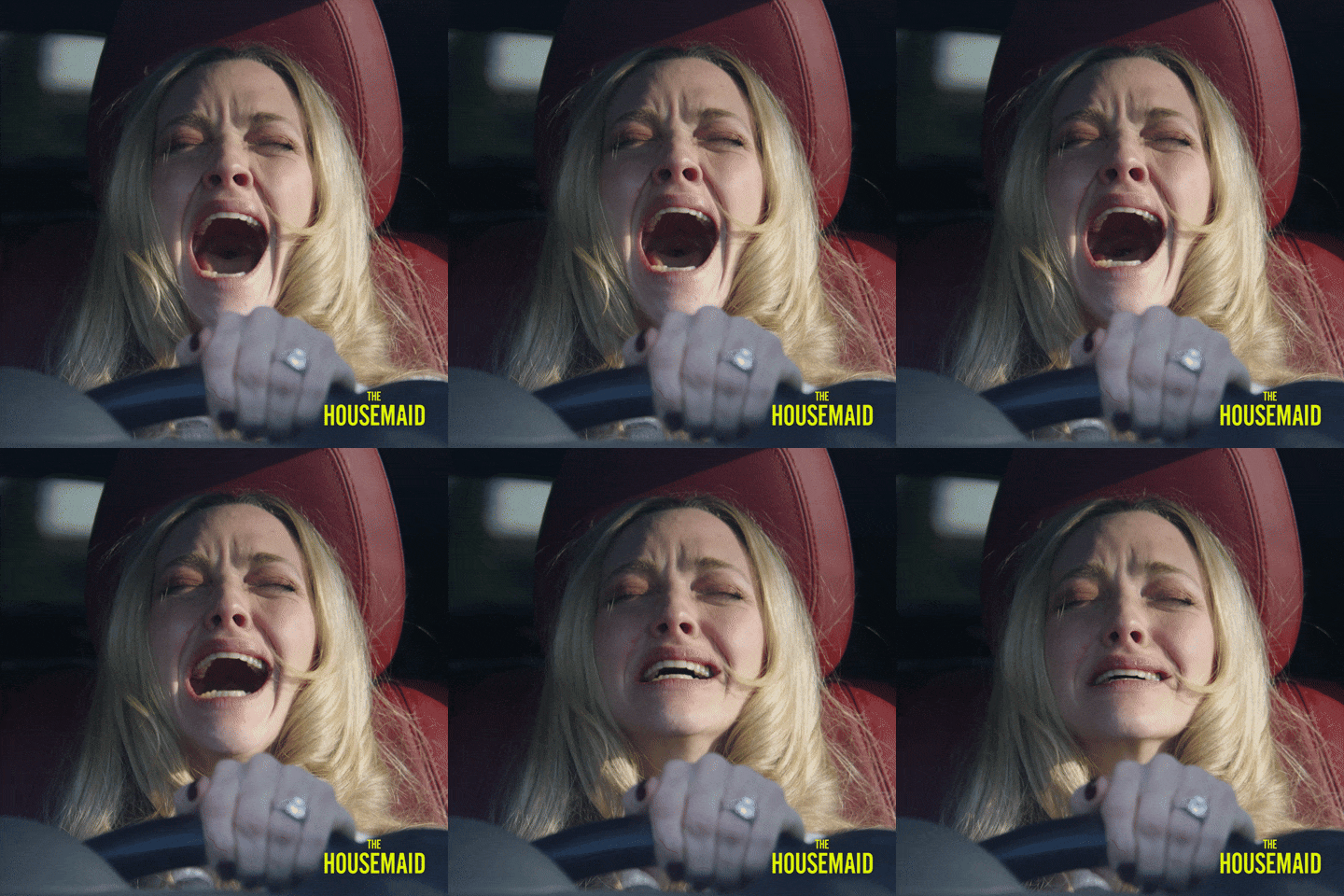
In the film, Millie is beside you. Sydney Sweeney brings quiet, simmering vulnerability — the sense of constantly trying to act normal while something is screaming. But you're watching her fear, not feeling it. That's a fundamentally different relationship with the character.
Book Wins
Nina — Chaos vs Performance
McFadden writes Nina as a masterclass in unstable power. One moment sweet, the next cruel, then apologetic, then vindictive. She oscillates so fast Millie can't get her footing. This isn't just difficult character writing — it's psychological warfare. Nina doesn't just want control. She wants Millie confused. And confusion is a powerful form of captivity. If you can't trust your interpretation of reality, you can't advocate for yourself.
In the film, the problem is Amanda Seyfried. She's too charismatic, too intelligent-looking, too composed even when playing unhinged. So the question subtly shifts. The book asks: is Nina mentally unstable? The film asks: what is Nina hiding? Same character, completely different kind of suspense. The film's Nina is more layered from the beginning — there are moments of vulnerability, flickers of something behind the mask. More balanced. Also less vicious.
The book makes you hate Nina first, then forces you to revisit every assumption you made. The film asks you to stay curious rather than furious. Different strategy, slightly less satisfying payoff.
Book Wins (Barely)
Andrew — Fantasy Trap vs Meta-Interrogation
McFadden writes Andrew like a soft place to land. Calm, handsome, seemingly the only adult in the room. The kind of man women are trained to trust. The kind of man who looks like stability in a world full of noise. That's why he's dangerous — the most effective predators don't act like villains. They act like relief. In the book, this works because Millie's narration keeps you alert to him, even as you're drawn to the same things she is.
In the film, something more interesting happens. Andrew's appeal is amplified by cinema's visual immediacy. If he's cast and styled as the handsome patient husband dealing with a difficult wife, the audience feels that archetype in their bones. And then the film does something clever: it asks you to interrogate your own attraction to him. You're not just watching Andrew — you're watching yourself watch Andrew. That's a kind of meta-suspense the book can't quite achieve.
Film Wins
The House — Prison vs Character
In the novel, the house is described as intimidation. Vast, clean, wealthy, quiet. The kind of place where your footsteps sound too loud and your presence feels like a stain. Millie isn't living in a rich home — she's living inside someone else's power. The locked bedroom door isn't just a creepy detail. It's the story's entire thesis in one object. The house says: you are here because we allow you to be. In the book, it feels personal. It feels like something that could happen to you.
The film understands that wealth is not comforting when you're the one cleaning it, and it uses lighting and framing effectively. Long hallways, closed doors, spaces that swallow people. It's gorgeous. It's also colder. And beauty has a way of dulling horror — you can't fully escape the fact that it's a spectacular house, which means it can never quite feel like the prison the book makes it.
Book Wins
"McFadden doesn't just trick you with plot. She tricks you with empathy. She manipulates your ability to care about someone."
— Sara Alba · Brewtiful Living · On The Housemaid
The biggest difference between the book and the movie is this: the book recruits you as an accomplice. You don't just observe Millie's choices — you start agreeing with them. You start thinking like her. You start rationalising red flags because you understand her desperation, her hunger, what it feels like to be one bad decision away from homelessness. So when she stays, you don't scream at her. You stay too. And that's what makes the twist hit so hard — because McFadden doesn't just trick you with plot. She tricks you with empathy.
The movie can't do that as effectively. Instead, it shifts the suspense outward. Instead of "what is Millie thinking?", the tension becomes "what is everyone doing?" The audience becomes a detective, not a hostage. And that's a legitimate and entertaining version of the same story. It's just a fundamentally different emotional experience. The same dynamic applies to most psychological thriller adaptations — the book can hide things in narration that the camera accidentally reveals. The movie has to compensate with distraction rather than omission.
At its core, The Housemaid is about what happens when someone has more money, more credibility, and more control over the narrative. The Winchesters don't just own a mansion — they own the social reality inside it. And Millie enters that reality like a guest who can be uninvited at any moment. McFadden doesn't just write suspense — she writes imbalance. She writes the specific fear of not being believed. The social dynamics are the horror. Not the mansion. Not the door.
Interactive · Know Yourself
Should You Read It, Watch It, or Both?
Five questions. One honest recommendation. We already know but let's confirm.
Question 1 of 5
01
What do you want from a thriller?
02
You started reading something at 10pm and it's now 2am. You feel —
03
Sydney Sweeney and Amanda Seyfried as the leads. Your immediate reaction is —
04
The twist. What do you want from it?
05
After finishing, you want to feel —
Read the Book.The Claustrophobic Version · The One That Follows You Home
You want the rawest version — the one that traps you inside Millie's survival brain and makes you rationalise her choices alongside her. The book is sharper, more intimate, and more psychologically punishing. It won't let you out of the cage. It won't explain the dread in a way that makes it easier to hold. It will just make you stay. And by the time the twist arrives, you'll be so deep inside Millie's logic that it won't just feel like a plot twist — it'll feel personal.
Watch the Movie.The Polished Version · The One That Satisfies You
You want the cinematic experience — strong performances, visual tension, and a resolution that wraps things up with emotional closure. Sydney Sweeney brings a simmering quiet panic that works beautifully on screen. Amanda Seyfried plays Nina with the exact balance of glamour and menace the role requires. The film is entertaining, well-made, and considerably less punishing than the book. You'll leave satisfied. You won't stare at the wall. That's the correct version for you right now.
Read the Book First. Then Watch.The Complete Experience · The Smug Version
Read the book first. It will make you paranoid. Then watch the movie. It will make you smug — because you'll know exactly what's coming and you can spend the runtime watching other people not know. Together, they make a complete experience of being emotionally played at two different speeds in two different formats. The book is the hostage experience. The movie is the detective experience. Both are valid. You need both. You already knew this. You just wanted someone to confirm it.
Five Reasons McFadden's Books Are Actually Engineering
Why Her Books Are So Juicy — The Real Reasons
She writes like gossip with consequences. Her plots feed the same feeling as overhearing a scandal — curiosity, judgment, fascination, moral superiority, dread. All at once.
Her prose exists to deliver momentum, not admiration. Clean, fast, invisible. The writing is a vehicle and the destination is chaos.
She understands that women's fear is often social before it's physical. Embarrassment. Disbelief. Being called dramatic. Gaslit until you question your own memory. That's what makes the story feel real.
She builds trust, then commits emotional fraud. The twist isn't just a plot twist — it's a moral twist. You're not just shocked. You feel complicit.
Her villains feel like people you've met. A controlling spouse who smiles too much. A woman who weaponises social status. A person who uses kindness as leverage. Recognisable. That's why it sticks.
The book wants you to close it and stare at the wall. The movie wants you to leave the theatre feeling like the story is complete. Both are honest about what they're doing. Read the book first. Then watch the movie and feel smug. Then close your laptop and wonder why you're still thinking about a locked bedroom door at 11pm. That's the whole point. That's always been the whole point.
— Sara Alba · Brewtiful Living · The Bookshelf · February 15, 2026
The HousemaidFreida McFaddenBook vs MoviePsychological ThrillerSydney SweeneyAmanda SeyfriedThe Bookshelf
More reads worth your time. And a few that weren't.