Brewtiful Living · The Bookshelf · Finished Review
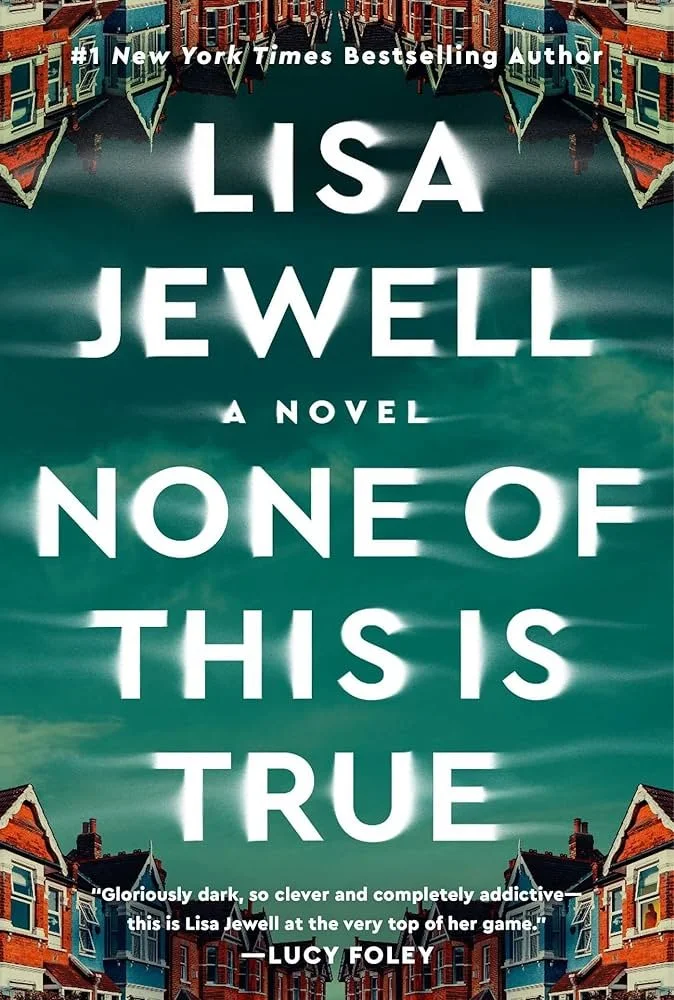
None of This Is True
Lisa Jewell wrote a slow burn so slow it takes half the book to realise you were already inside the fire.
UPDATED AFTER FINISHING THE BOOKLisa Jewell · Review, Summary & Ending Explained by Sara Alba · Brewtiful Living · March 2026
None of This Is True · Lisa Jewell · Finished review, ending explained, and red-flag evidence file
!
UPDATE: Sara finished the book. What started as a mid-read psychological spiral has now become a completed incident report. The original sections below were written in real time while Lisa Jewell slowly rearranged the furniture inside my brain. I left some of that panic intact on purpose because honestly? It is funnier this way. But this review now includes a proper ending breakdown, spoiler analysis, character analysis, and post-book emotional damage assessment. Spoilers are marked. We are reckless, not unethical.
Opening · Two women. Same pub. Same birthday.Ending · Case closed. Damage logged.
Opening · Two women. Same pub. Same birthday.The ending · Evidence collected.
Finished VerdictLisa Jewell knew exactly what she was doing. The ending did not ruin the slow burn. It proved the slow burn was the weapon.
Quick Answer
Is None of This Is True Worth Reading?
Yes, especially if you like psychological thrillers that feel less like a chase and more like someone quietly moving into your life while you keep telling yourself it is fine. The beginning is slow by design. The slow was always the trap. By the end, the book has trained you to question every version of the story, including your own.
Post-Read Update
I finished it. The mid-read panic was justified. The ending does not make the book simpler. It makes the entire structure nastier in retrospect, like realizing the nice neighbour has been measuring your windows and already knows which one sticks.
There is a specific kind of book that does something quietly sinister in its opening chapters. It does not alarm you. It does not grab you by the collar and announce itself. It simply pulls up a chair, sits across from you, and begins talking in a very normal, pleasant voice while your brain slowly registers that something in the room has changed and you cannot identify what it is or when it happened.
None of This Is True by Lisa Jewell is that book. I started writing about it before I was done, which felt reckless and therefore correct. Now I have finished it, and the original panic still stands. If anything, the ending made the earlier unease feel more deliberate, like finding out the floorboards were arranged to creak in order.
This began as a dispatch from the middle of a psychological thriller that was slowly, methodically, and rather brilliantly dismantling my sense of who to trust. Now it is a finished review and the answer is worse: trust no one, including the structure.
None of This Is True Summary
The Setup — Two Women. Same Birthday. Same Pub.
Alix Summer is a true crime podcaster — successful, polished, the kind of woman whose life looks assembled rather than lived in. Josie Fair is none of those things. She is quiet, unremarkable, slightly off in a way you cannot immediately name. She tells Alix she has a story to tell. She tells Alix she is on the cusp of great changes. She tells Alix she would be the perfect subject for her next podcast series.
Alix, who is a journalist and therefore constitutionally incapable of leaving a story alone, agrees. This is, as you may have already gathered from the title of the book, a decision that does not go well. Slowly Alix starts to realise that Josie has been hiding some very dark secrets, and before she knows it, Josie has inveigled her way into Alix's life — and into her home. That last part is where I currently am, and every page of it is deeply uncomfortable in a way that is completely deliberate and completely effective.
Jewell structures the book as a kind of true crime documentary — alternating between present-tense narrative and interview excerpts from the podcast, witness accounts, and outside perspectives that slowly fill in what the main narrative withholds. It is a format that works on two levels simultaneously: it tells you something is going to go very wrong (because why else would there be a documentary) while keeping you in the dark about exactly what and exactly how. The title is doing enormous work throughout. None of This Is True is both a statement about the story and an instruction to the reader: do not get comfortable with what you think you know.
Book Architecture · No Spoilers
How the Tension Builds — Quarter by Quarter
Jewell is not in a hurry. This is intentional. Stay with it.
First quarter
Atmospheric. Character-building. The hum is there if you listen.
Second quarter
The instincts are being trained. You know something is wrong.
Third quarter
Where the spiral began.
Final quarter
She knows now. Somehow worse.
Can You Trust Josie Fair?
On Josie Fair — Who Is a Lot
Josie is the kind of character who would register immediately as a red flag in real life and whom you would clock within minutes of meeting. She is too eager. Too interested. Too available. She mirrors Alix's energy back at her with just enough delay that it reads as admiration rather than calculation — and it is only because you are reading a psychological thriller that you see it for what it is. In real life, you might not.
That is the uncomfortable truth at the centre of this book. The reason Josie gets as far as she does is not because Alix is naive. It is because Josie is very good at this — and because the qualities that make Alix good at her job (curiosity, openness, the inability to leave a story unfinished) are also the qualities that make her vulnerable to someone who knows how to exploit them. We've written about how this archetype operates in real life — the mirroring, the gradual boundary erosion, the way they make you feel responsible for their wellbeing before you've noticed the shift. Josie Fair is a fictional case study. She is not invented. People like this exist. They are just rarely this well-written.
Character Study · Josie Fair · No Ending Spoilers
Josie's Red Flags — What Jewell Is Doing With Each One
Click each flag. They compound. That's the point.
🪞
She mirrors Alix's energy with a slight delay.The mirroring tactic · Reads as admiration · Is not admiration
The delay is key. Immediate mirroring reads as obvious. Delayed mirroring reads as someone absorbing what you said and reflecting it back thoughtfully. Josie has learned this. She waits a beat before responding in a way that echoes Alix's position back to her, which makes Alix feel understood. That feeling of being understood is the hook. Once someone has made you feel genuinely understood, you are reluctant to question them — because questioning them would mean questioning the understanding, which feels ungrateful.
+
📅
She is always available. Perfectly, suspiciously available.No competing demands · Every text answered immediately · This is not normal
Availability functions as flattery. If someone is always free for you, the implication is that you matter more than anything else in their life. This is appealing until you stop and ask: what does this person's life actually look like, that they are perpetually available? The answer, in Josie's case, is something Jewell reveals gradually. The availability is not devotion. It is infrastructure. She has arranged her entire existence around this proximity and is counting on Alix to be too flattered to notice.
+
🎭
She frames herself as the protagonist of her own damage.Performed vulnerability · Carefully calibrated · We've written about this archetype
Josie's backstory is presented to Alix in a specific order: the suffering comes first, the context that complicates it comes later. This is not accidental. If you lead with damage, you invite empathy before judgment. By the time Alix has the fuller picture, she has already emotionally invested in Josie's version of events. Unwinding that investment feels unkind. Josie knows this. She has always known this.
+
🏠
She gets into the house.The domestic invasion · By the time it happens it feels inevitable · It should not feel inevitable
This is where I currently am, and I need you to understand what Jewell does here. The house is not breached suddenly or dramatically. It happens through a series of small incremental steps, each one of which seems reasonable given the step before it. This is how physical boundaries erode: not in a single crossing but in a series of movements that individually feel fine and collectively constitute an invasion. The Housemaid does something similar with the locked bedroom door — the horror is not that it happened, but that it happened gradually enough that no single moment felt like the moment to stop it.
+
🧠
She never lies directly. She just withholds the parts that change everything.Strategic omission · Technically truthful · The worst kind
Josie's deception is not the crude kind — she doesn't tell Alix things that are straightforwardly false. She tells Alix things that are true in isolation and misleading in context. She withholds the piece of information that would reframe everything Alix already knows. This is the most effective form of manipulation because it gives the victim nothing to point at. You cannot say "she lied to me." You can only say "she never told me the thing that would have changed my mind." These are very different complaints, and only one of them sounds credible in hindsight.
+
"The beginning is the training. She is teaching you how Josie moves, so that when your instincts are confirmed — and then subverted — you feel it in your body and not just your brain."
— Sara Alba · Brewtiful Living · On None of This Is True · Mid-Read Dispatch
What Jewell is doing in those early chapters is training you. She is teaching you how Josie moves — the specific texture of her, the way she presents herself, the gap between what she says and what sits just beneath it. She is building your instincts about this woman so that when those instincts are confirmed, and then subverted, and then confirmed again in a different way, you feel it in your body and not just your brain. It starts slow but the sinister feeling tingles beneath your neck, warning you bad things are about to come.
The first quarter of this book is not fast. It is not packed with incident. It is Alix and Josie having conversations, Josie's life being gradually revealed in pieces, and a low-grade sense of wrongness that hums underneath every scene without ever resolving into anything you can point at. This is the whole mechanism of the book and it is brilliant and I did not fully appreciate it until I was deep enough in to see what Jewell was building. We've written about how McFadden uses micro-threats to keep you reading — small inconsistencies, missing context, awkward timing. Jewell uses the same principle at a slower tempo. The difference is that Jewell wants you to feel the accumulation rather than the spike. It pays off later. I am in the later now. It is paying off.
It's like listening to a concerto that slowly raises its tempo. As you reach the ending, you hear the crescendo. I am not at the crescendo yet. I am at the part where the tempo is unmistakably rising and I keep reading one more chapter telling myself it's fine. It is absolutely not fine.
Interactive · Self-Assessment · Be Honest
Are You an Alix, a Josie, or Neither?
Five questions. Three results. The book is going to make at least one of these uncomfortable.
Question 1 of 5
01
Someone tells you they have a story that would be perfect for your project. Your reaction is —
02
Someone new is very interested in you. More interested than seems warranted. You feel —
03
A boundary you set has gradually been eroded. You realise it in retrospect. You feel —
04
Your strongest quality is also the thing that makes you most vulnerable. True?
05
Reading about Josie, you feel —
You're an Alix.The Curious One · The One Who Always Follows the Story · The One This Book Knows
Your best qualities are also your vulnerabilities, and you know it but can't entirely stop it. The curiosity, the openness, the inability to leave a story unfinished — these are what make you good at what you do and good at being a person. They are also what Josie identifies and exploits. This book will be uncomfortable for you in the specific way of watching someone make decisions you recognise. The discomfort is the book working. Stay in it.
You're the Wary Reader.Aware But Not Immune · The One Who Notices and Stays Anyway
You see the flags. You're tracking Josie from the first chapter. You keep reading anyway because awareness does not equal immunity — and because Jewell makes sure the story is compelling enough that even knowing you're being played doesn't fully protect you. This is the most honest position to read a psychological thriller from. You are the reader Jewell most respects, probably. She'll still get you. She always does.
You're a Josie.The One Who Understands the Mechanism · Handle With Care
You recognise Josie's techniques because you have seen them — possibly deployed them — in some form. This does not make you a villain. It makes you someone who has learned how social dynamics work and has, at some point, used that understanding. The book will be interesting to you in a different way: less about being surprised and more about watching Jewell's precision. The question it will leave you with is about where the line is, and whether you've always known where it is.
What Sara Knows Now — After the Ending
I finished it. The chapters did exactly what they were threatening to do: tightened, narrowed, and then made the earlier slowness feel less like pacing and more like evidence collection. Every answer opened two more questions. Every scene I thought I understood came back wearing a worse outfit.
Now that I know how it ends, I can say this: if you started it and found the opening slow, go back. The slow is the point. The slow is the whole setup for everything that follows. This sits alongside The Housemaid as further evidence that the domestic thriller genre, when done properly, is doing something genuinely interesting about women, power, and the particular violence of being underestimated. Josie is underestimated. Alix underestimates her. The reader underestimates her. That is the engine of the whole thing.
The full review is now here, the evidence has been processed, and unfortunately Lisa Jewell absolutely knew what she was doing the entire time. The slow burn was never filler. It was conditioning. By the end of the book, the reader has been trained to doubt everybody, including themselves.
Which honestly feels like the point.
Post-Read Analysis
Why None of This Is True Works So Well
This book performs exceptionally well with thriller readers because it weaponizes familiarity. The structure feels like a Netflix true crime documentary, a manipulative podcast series, and a domestic paranoia spiral all stitched together into one increasingly uncomfortable experience.
And honestly? That explains why readers keep searching things like:
None of This Is True ending explained
Is Josie Fair lying?
Who was manipulating who in None of This Is True?
Is None of This Is True worth reading?
Books like None of This Is True
The novel creates the exact kind of ambiguity thriller readers obsess over online. Nobody finishes this book calmly. Everyone immediately opens Reddit, Google, TikTok, or a group chat to ask the same question: “Wait. So what actually happened here?”
None of This Is True Ending Explained
Spoilers from here. The ending works because it refuses to give the reader one clean moral math problem. Lisa Jewell does not simply ask whether Josie lied. She asks who got to shape the story, who benefited from being believed, and whether truth even survives once everyone has learned how to perform it.
The final effect is not tidy revelation. It is contamination. By the end, every earlier scene feels different because the book has trained you to understand that “truth” is not a stable object here. It is edited, framed, withheld, polished, sold, and repackaged through a podcast format that turns private damage into public entertainment. Very normal. Very healthy. No notes.
What Changed After I Finished the Book
The funniest part of rereading my own earlier notes is realising how desperately I wanted to believe this was going somewhere normal. I kept trying to treat Josie like an uncomfortable social interaction instead of the literary equivalent of accidentally letting carbon monoxide into the house.
Finishing the book changes the earlier chapters completely. The slowness stops feeling like pacing and starts feeling like surveillance footage. Every tiny interaction suddenly looks loaded. Every conversation feels rehearsed in retrospect. Lisa Jewell does something very clever here: she trains the reader to participate in the manipulation.
Which is honestly rude of her.
Who Was Manipulating Who?
Josie is the obvious manipulator, but the book is sharper than that. Alix also benefits from the story. The podcast format turns Josie’s life into content, and that is where the novel gets mean in the best way. Everyone wants a narrative. Everyone wants control. Everyone wants to be the person holding the microphone instead of the person being recorded.
Why None of This Is True Feels So Unsettling
The fear is not jump-scare fear. It is boundary fear. The horror comes from watching someone enter another person’s life through tiny permissions that seem harmless until they become architecture. A drink. A conversation. A recording. A visit. A favour. A presence in the house. Nothing looks dramatic enough to stop until it is already too late.
Books Like None of This Is True
If this book worked for you psychologically, read The Housemaid for domestic invasion and manipulation disguised as vulnerability, Julie Chan Is Dead for identity collapse and internet performance culture, and Gone Girl if you enjoy relationships that feel like hostage negotiations wearing expensive sweaters.
This entire category of thriller performs well because readers are no longer looking for monsters hiding in basements. They want socially functional danger. They want characters who smile correctly while quietly ruining lives in the background.
Best Read With · Before You Start
Set the Conditions. Jewell Requires Them.
A free evening. Not a "just one more chapter before bed" evening. A full, surrendered evening.
The patience to sit with slow in the first quarter. The slow is the mechanism. It is not the problem.
A working knowledge of how emotional predators actually operate — or a willingness to acquire one. Josie will teach you.
Someone you trust who has already read it and who has agreed, under social contract, not to tell you anything.
A theory you're willing to be wrong about. You will be. That's the point.
Read it. Start with the slow. Trust the slow. The concerto built for a reason, and the ending proves every earlier note was laying track for the collapse.
— Sara Alba · Brewtiful Living · The Bookshelf · March 2026 · Finished review. Former dispatch. Current psychological evidence file.
None of This Is TrueLisa JewellMid-Read DispatchPsychological ThrillerSlow BurnDomestic ThrillerThe Bookshelf
More reads worth your time. And a few that weren't.