40 Facts You May Know If You're A 90s Kid
40 THINGS EVERY '90S KIDWILL INSTANTLY REMEMBER
The '90s were loud, plastic, weirdly sticky, and objectively elite. A decade built on cartoon marathons, landline politics, fluorescent accessories, and technology that demanded patience like it was a moral virtue. We did not simply exist in the '90s. We collected, rewound, traded, waited, begged, and occasionally destroyed our own emotional stability over a digital pet the size of a keychain.
plastic packaging
your entire social life
processed properly
for your trauma
You did not simply exist in the '90s. You collected, rewound, traded, waited, begged, and occasionally destroyed your own emotional stability over a digital pet the size of a keychain. This is the evidence file.
Maybe it is because '90s culture had texture. You could hear it in the screech of dial-up, feel it in the snap of a slap bracelet, and smell it in a fresh pack of scented gel pens that were technically for school and practically for identity. Entertainment was an event. Music had to be requested, recorded, or hunted down. Cartoons required scheduling discipline. Friendship required calling a landline and surviving a parent on the other end first. Even collective panic came with branding, which is how we all ended up briefly acting like Y2K might erase civilisation at midnight — and then waking up on January 1st to discover that the computers were fine and we still had to go back to school in January.
The beauty of the decade was that every obsession felt oddly total. You were not casually into Pokémon cards. You were in negotiations. You were not lightly invested in Blockbuster. You were pacing aisles under fluorescent light praying your movie was still there and not ruined by someone's kid who spilled Dunkaroo frosting on it in 1997. This list is less a ranking and more an evidence file. Forty items. All of them true. Most of them formative in ways that would take years to fully understand.
1. Cartoon Marathons
Getting up early on purpose felt illegal unless Rugrats, Doug, and Hey Arnold! were on the schedule. That block of time was sacred, non-negotiable, and better than most things that came later.
The streaming era took away appointment viewing. It also took away the joy of showing up for something.2. Blockbuster Nights
Walking the aisles felt like making a life decision. The wrong VHS could ruin a whole Friday. Family democracy conducted under fluorescent lighting with no algorithm to blame.
Before algorithms decided what you were, you had to physically browse and defend your choice in public. Barbaric. Beautiful.3. VHS Tapes
You had to rewind. You had to track. You had to pray nobody taped over your movie with a hockey game. Media had consequences and consequences were personal.
If you ruined the family tape, the evidence lived forever in static. Be kind, rewind was a moral instruction.4. TGIF
Friday night television had a schedule, a vibe, and a full understanding that families needed sitcoms before collapsing into the weekend. Culture had a shared living room.
Full House, Boy Meets World, Step by Step. You showed up or you missed it. Commitment was required.5. Disney Channel Original Movies
Smart House, Zenon, Halloweentown. Cinema with lower budgets and a stronger grip on your personality than most theatrical releases ever managed.
These movies had no business being that formative. And yet here we are, still saying "zetus lapetus" like a diagnosis.6. Goosebumps
Those covers were terrifying, the plots were genuinely unhinged, and every book felt like it came with a mild curse. Scholastic really said: here, develop anxiety in paperback. For children.
The choose-your-own-ending books were the only ones where you could survive. You still chose the bad ending. Repeatedly.7. Theme Songs You Still Know
You knew every word of the Fresh Prince theme. Everyone knew every word. Society briefly agreed on one curriculum. This is what a shared culture felt like.
Also: Saved by the Bell, Full House, Animaniacs. Oral tradition with better lighting.8. The TV Guide Channel
You watched the listings scroll by in slow motion, missed your channel, and had to wait for the entire wheel of fate to come around again. Patience was built into the interface.
Modern streaming could never. You had to want it enough to sit through the whole scroll.9. Dial-Up Internet
The internet did not arrive quietly. It screamed, crackled, and held your household phone line hostage. Logging on felt ceremonial. You earned every webpage through noise, delay, and catastrophically low expectations.
The whole household knew when you were online. Privacy had not been invented yet.10. Away Messages
You were not offline. You were curating absence. A lyric, a mood, a passive-aggressive message to one specific person who absolutely understood it was about them. Art, really.
Before Instagram stories, the AIM away message was where teenagers discovered branding and plausible deniability.11. Game Boy
The screen was barely visible unless you angled it toward a specific light source like you were contacting another realm. Batteries died mid-dungeon. You replayed the whole thing.
Portable gaming required patience, resources, and the neck posture of someone studying ancient tablets. Worth it.12. CD Players That Skipped
Walking too confidently could destroy a chorus. Running was not an option. Portable music was technically portable but emotionally fragile. Anti-skip technology felt like space exploration.
The skip was a consequence. You learned to move carefully. Music made you a more measured person.13. The Computer Room
The computer lived in a public area, meaning your digital life was conducted under the threat of someone walking by with laundry. You typed quickly and minimised windows like a fugitive.
Privacy was a concept that had not reached the house yet. Everyone knew everything. The printer was in the hall.14. Disposable Cameras
You took 27 photos and hoped four of them were not thumb, blur, or someone mid-blink. The results arrived days later. The horror was delayed and therefore somehow worse.
Photos had suspense. You did not know you looked terrible until it was too late to care, which was merciful.15. Cordless Phones
You could finally pace while talking, which made every conversation feel more dramatic and considerably more powerful. The battery dying mid-confession was technology's favourite joke.
The cordless phone was freedom with a range limit. You learned the hard way where the signal died.16. Y2K Panic
Adults briefly convinced everyone that computers might collapse civilisation because the calendar could not emotionally handle the year 2000. Midnight arrived. The computers were fine. Embarrassing for everyone.
It was our first mass tech anxiety. Cute, in retrospect, compared to everything that followed.The '90s were not simpler because life was easier. They were simpler because everything took longer and nobody could refresh the page to ruin their own day faster.
— Sara Alba · Brewtiful Living17. Tamagotchis
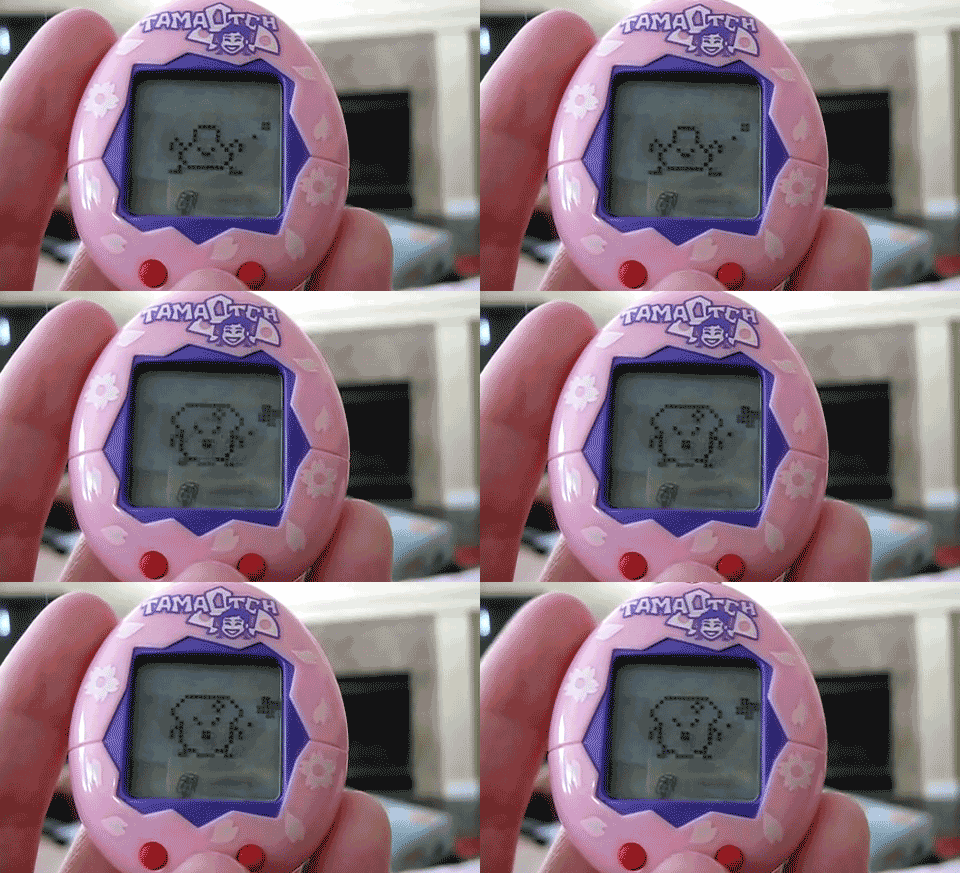
An egg-shaped keychain taught a generation responsibility, anxiety, guilt, and grief. Usually before lunch. The battery dying was a mercy. You still blamed yourself.
Pet ownership without fur or legal protections. All of the emotional consequences. None of the documentation.18. Pokémon Cards
The playground ran on holographic Charizards, questionable trades, and at least one kid who absolutely knew he was scamming you and made eye contact while doing it. You traded anyway.
Currency, status, investment strategy, and emotional warfare in one glossy rectangle. Peak capitalism for children.19. Beanie Babies
Adults said they would be worth money someday. Children said they were cute. The children had the stronger investment thesis. The adults still have the Beanie Babies in the attic.
Capitalism with button eyes and a swing tag. Everyone participated. Nobody came out richer.20. Slap Bracelets
Jewellery that doubled as a minor workplace hazard for children. You smacked it on your wrist and briefly felt invincible and very accessorised. Schools banned them. This made them better.
Fashion with sound effects, which is more than most modern accessories can say for themselves.21. Polly Pocket
Tiny worlds for tiny hands, full of tiny accessories designed by physics to vanish immediately into carpet pile and haunt parents in bare feet forever at 2am.
Miniature domesticity, extremely losable. The accessories were also a choking hazard, which made them feel exciting.22. Pogs
Small cardboard circles became a competitive sport, a collecting habit, and a reason to own a slammer. They made no sense. This was exactly why they worked.
Childhood did not require a business model. Pogs proved this comprehensively.YOUR PENCIL CASE WAS A SOCIAL SIGNAL. YOUR GEL PEN COLLECTION WAS AN IDENTITY STATEMENT. YOUR FOLDER WAS A LISA FRANK SPIRITUAL EVENT. THE SCHOOL SUPPLY ECONOMY WAS THRIVING.
23. Scented Gel Pens
Writing notes in glittery grape ink made everything feel important, even when the note only said "do you like him — yes/no/maybe." The smell was the whole point. The glitter was non-negotiable.
Stationery had personality. Your pencil case was a social signal. The economy was thriving and smelled like grape.24. Scholastic Book Fairs
The gym became a bookstore and suddenly you were budgeting like a tiny CFO with a specific weakness for erasers shaped like food and posters that had the emotional pull of fine art.
Book fairs made reading feel like contraband. The smell of new books in a gymnasium remains undefeated.25. Lisa Frank Everything
Neon dolphins, rainbow tigers, glitter everywhere. Your folder was a spiritual event. Your binder was a vision. Lisa Frank understood maximalism before branding teams ruined the word entirely.
The colour palette should have been too much. It was exactly enough. This remains true.26. Fortune Tellers
A folded paper oracle told you who you liked, what colour you were, and whether your future was doomed. Every classroom had one child running a prophecy business during recess.
Before dating apps, destiny was calculated in notebook squares. Somehow more scientific.27. MASH
Your entire future — house, partner, children, car — decided by notebook paper, a spiral, and the cruel random number selected by a friend who absolutely had opinions about the outcome.
Mansion, apartment, shack, house. The shack always appeared at exactly the wrong moment.28. Passing Notes
Handwritten messages folded into tiny architectural miracles, delivered under threat of teacher interception and public humiliation. The original encrypted messaging. Not secure. Very committed to drama.
If intercepted, the teacher read it aloud. The lesson was learned. Nobody learned it.29. Dunkaroos
A snack that understood frosting was the point and the cookie was merely a delivery device. Honest commercial branding, for once. You always ran out of frosting before cookies. This was a character flaw.
Dunkaroos taught portion control by letting you ignore it entirely. The frosting-to-cookie ratio was the '90s in one statistic.30. Lunchables
A cold tray of tiny food circles that made you feel rich, independent, and nutritionally unsupervised in the best possible way. The pizza ones were the pinnacle. The nachos ones were a lie.
Not lunch. An edible status symbol with a Capri Sun chaser and no parental oversight of the cracker-to-cheese ratio.31. Capri Sun
The pouch was silver, the straw was tiny, and puncturing it correctly felt like a standardised test. Many tried. Many stabbed through the back and launched juice at their own face.
Hydration with an engineering component. The reward was worth the challenge. Mostly.32. Fruit Roll-Ups
Snack, craft project, edible tattoo machine. Less food than sticky infrastructure. The ones that left rings around your tongue were the superior ones and nobody is arguing about this.
Children wanted sugar and a tactile experience. Fruit Roll-Ups delivered both and asked no further questions.33. Claire's Accessories
A tiny palace of plastic butterflies, mood rings, glitter lip gloss, and earrings that turned your ears a suspicious shade of green. Where style, allowance money, and questionable metal alloys met in holy chaos.
The ear piercing station in the back. The gun. The inexperienced teenager with the gun. You survived.34. Butterfly Clips
Your hair was not done until twelve plastic butterflies were gripping your scalp with unreasonable confidence and a vague structural tension that somehow held. They're back. You knew they would be.
Butterfly clips gave every head a tiny ecosystem. Delicate, chaotic, occasionally painful, and completely correct.35. Platform Sneakers
Spice Girls made everyone believe footwear should come with structural ambition and a real chance of ankle betrayal. You wore them anyway. The height was worth the risk. It was always worth the risk.
Platform sneakers were fashion with elevation, literally and socially. Also a potential A&E visit.36. Photo Booths
Four tiny pictures, bad lighting, one strip of evidence that you had friends and bangs. Grainy. Physical. Impossible to edit. Horrifying in retrospect and also one of the best things.
Social proof before social media. You taped it to your mirror and looked at it daily. This was enough.37. The Mall Food Court
Pizza slice, fountain pop, no adult hovering, everyone pretending this was a city. It was public space for teenagers before every public space became optimised, surveilled, and a parking lot.
Independence began here. You knew the food court layout better than your times tables.38. Boy Band Posters
Your wall was a shrine. Your magazine was a sacred text. Your favourite member was a personality test that turned out to be more accurate than anything that followed. It still matters which one.
Before fandom lived online, it lived on bedroom walls with tape damage and dreams.39. Recording Songs Off the Radio
You waited with your finger on record, praying the DJ would stop talking over the intro like a personal enemy. Every mixtape had scars, static, and one botched first verse that you left in because it was still better than nothing.
Music collecting involved labour. The labour made it mean more. The skips and cuts were documentation.40. The Slow Classroom Tech
The teacher rolled in the glowing machine with the transparency sheets and suddenly class felt like a low-budget science lab. The squeak of the marker. Someone blocking the light. This was education.
Nothing said "we have the budget" like an overhead projector and a VHS player on a cart with wheels that didn't quite work.WHICH '90S KID WERE YOU?
Five questions. One verdict. Your childhood already left the evidence.
Friday night. The Blockbuster wall is full. You pick:
Your pencil case in 1997. Describe it honestly.
Your Tamagotchi dies in class. You:
Your AIM away message right now, 1999. What does it say?
The Dunkaroo frosting runs out before the cookies. You:
You treated Saturday morning like church, but with better cereal and significantly more talking animals. You had a schedule. You kept the schedule. You got up early because the cartoons required it and the cartoons had never let you down. You probably still have strong opinions about what belongs on a Saturday morning and what doesn't. You are correct. You were always correct about this.
Your gel pens, folders, erasers, and pencil case were not supplies. They were identity. Your binder was a statement. Your desk arrangement had logic that outsiders could not access. You are probably very organised now, or very chaotic in a specific way that makes sense from the inside. The gel pen collection was the beginning. Everything since is downstream of that grape-scented decision.
You lived for CD-ROM games, dial-up noises, and printer paper with perforated edges. You understood the internet before most adults did. You explained things to your parents and felt the specific power of that. The computer room was your domain. You memorised cheat codes. You are probably fine with software updates in a way that other people are not, and you find their panic mildly baffling.
You knew the food court layout better than your multiplication tables and this was a reasonable priority. The mall was where life happened. Photo booths, Claire's, the walk between stores that was actually the point — you understood the social infrastructure of shared public space before anyone taught you the concept. You miss it. The parking-lot economy that replaced it is not the same. You are correct about this too.