The Best Reality TV Shows of All Time, Ranked
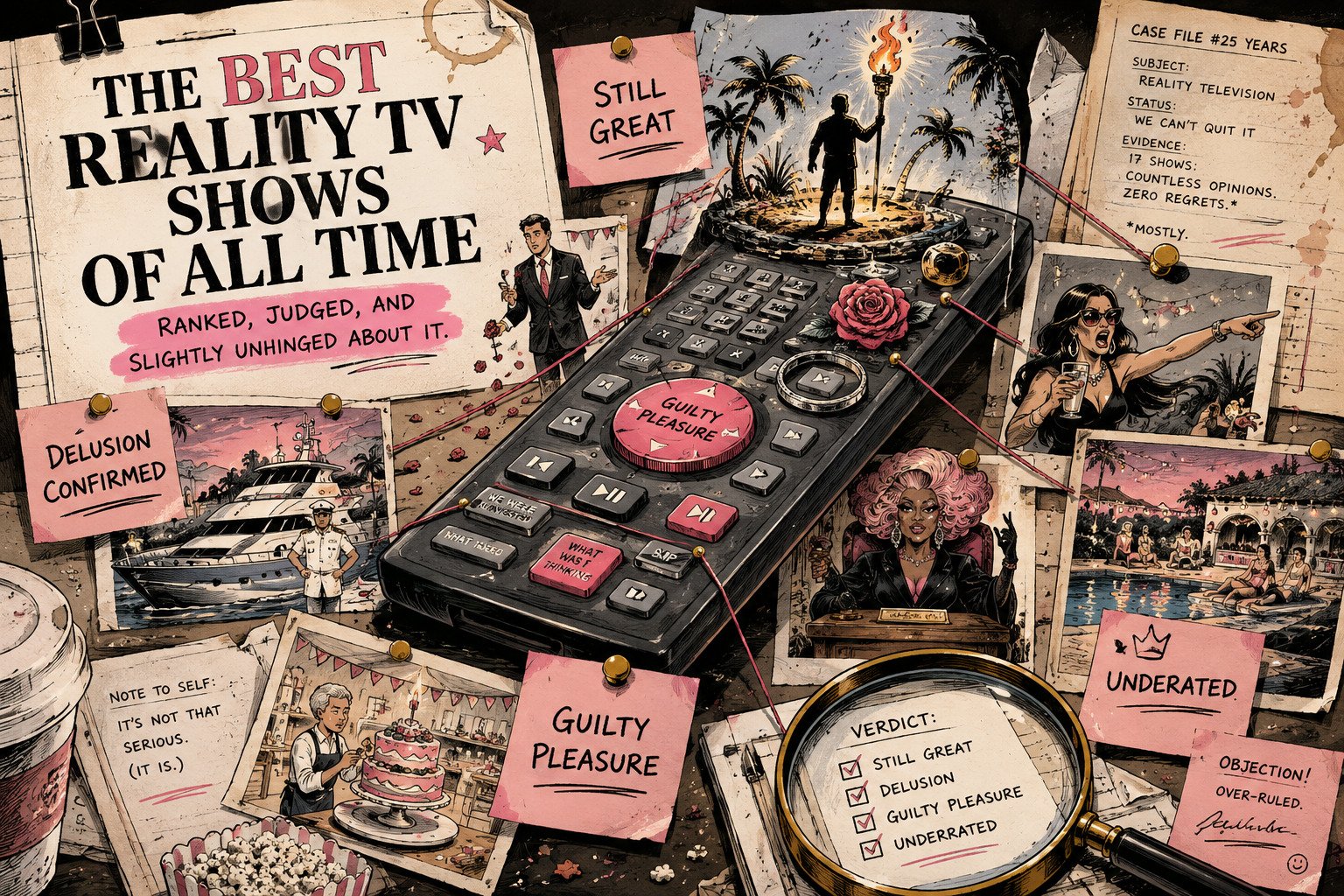
The Best Reality TV
Shows of All Time,
Ranked, Judged, and
Slightly Unhinged
About It.
Seventeen shows. Twenty-five years of evidence. Four verdicts. We watched all of it again, under oath, so you never have to defend your 2010 Monday night TV schedule to anyone, ever, as long as you live.
Tried.
Evidence.
Reached.
Offered.
Every few years, someone publishes a list called "The Best Reality TV Shows of All Time," and what they actually mean is "here are the shows I watched between the ages of fourteen and twenty-six, dressed up as journalism." We are about to do the exact same thing. The difference is we're admitting it up front, and several of the verdicts below are going to get us emails.
Here is the uncomfortable truth about twenty-five years of reality television: some of it was genuinely, structurally good — well-cast, well-built, format innovations other shows are still trying to steal. And some of it was simply on, for so many consecutive years, that an entire generation quietly mistook "I have seen every episode of this" for "this is good television." Those are not the same claim. We have separated them below, under oath, with receipts.
STILL GREAT
These shows would be good television if they premiered next Tuesday. No nostalgia tax. No "you had to be there." Just actual quality, holding up under direct examination.
Twenty-five years in, and Jeff Probst has personally extinguished more torches than most fire departments extinguish actual fires. The format remains: strand strangers on an island, remove their snacks, and watch alliances dissolve faster than a soufflé in an earthquake. It is, somehow, the most honest show on this entire list — everyone is openly trying to ruin everyone else's week, and they will tell you that, to your face, on camera, with a smile.
A competition show where the losing contestant gets a death drop and a farewell speech with better production value than most series finales. "Sashay away" has done more lasting emotional damage to more people than several long-term relationships combined. A judging panel will tell a grown adult, on national television, that their look "isn't reading" — and somehow that remains the kindest thing that happens anywhere on this list.
A tent. Eight strangers. A judge whose face, upon encountering a "soggy bottom," registers a betrayal so personal it borders on generational trauma. "It's a bit dry" has become the single most devastating sentence in the English language — delivered in the tone usually reserved for war crimes, about a Victoria sponge. Nobody on Earth has cried this much over cake, and we have collectively, correctly, decided this is wholesome.
Restaurant Wars is the only war in recorded history where the casualties are egos and the weapons are reduction sauces. Tom Colicchio has tasted several thousand dishes across twenty-plus seasons and his face has registered exactly four emotions, three of which are variations of "no." It remains the only competition show where "I'm not here to make friends" would be a completely reasonable thing to say — and yet nobody says it, because they're professionals, and professionals don't narrate.
Watch grown adults — several with their own Wikipedia pages — completely lose the plot over a wax-sealed letter, like it's a Hunger Games reaping and not a prop from a stationery shop. Alan Cumming wears a cape to a roundtable discussion and everyone simply accepts this as the format. The murders are fake. The paranoia is not. Somehow this is the most psychologically accurate show about group dynamics ever produced, and it's entirely because someone put capes in the budget.
WE ALL AGREED
Important is not the same word as good, even though they are spelled differently and mean different things. These shows mattered. Watching them back is mostly an exercise in working out what, exactly, we thought we were watching.
Over two decades, dozens of seasons, and a success rate so low that if it were a medical procedure it would be under federal review. Every contestant says "I'm not here to make friends" within the first ten minutes and then spends the remaining nine weeks making friends, in a hot tub, on television. The "fantasy suite" gets presented as a shocking twist despite the fact that everyone watching assumed that's what it was for since approximately week one. We gave this twenty-five years. We are not proud. We are also, notably, not stopping.
Fourteen years, twenty seasons, and a combined family net worth that could quietly fund a small nation — deployed primarily toward filming each other walk into rooms and ask "wait, what happened?" Kim once cried, on camera, for several uninterrupted minutes, about losing an earring in the ocean. The earring cost more than most cars. That clip has outlived several actual wars in the cultural memory. Important? Genuinely, yes. Good? We're going to need a moment.
Six seasons, mostly outdoor seating, and an entire emotional arc that rested on whether or not a "tape" existed — a tape nobody ever saw, allegedly made by someone who may not have actually existed, depicting an event that may not have actually happened. Lauren and Heidi didn't speak for over a decade over this. The lighting, to be fair, was extraordinary. The stakes were a vibe. We tuned in every single Monday like it was breaking news, because to us, it was.
"GTL" — gym, tan, laundry — is a phrase that required its own acronym, and that alone should have been the warning sign. Pauly D's hair achieved altitudes that arguably needed FAA clearance. The Smush Room existed, had a name, and everyone on the show and watching the show simply accepted this as a normal feature of a home. Rewatching it in 2026 is less "nostalgic" and more "why was everyone constantly yelling, and why did that used to help us relax after work."
GUILTY PLEASURE
These shows know exactly what they are. The people on them know exactly what they signed up for. There's no pretense left to puncture, which — strange as it sounds — makes them more honest than half of Exhibit B.
Ninety days, a visa, and a camera crew patiently waiting for the precise moment someone's judgment evaporates entirely on schedule. Every cast member, every season, says "I have a bad feeling about this" directly into a confessional camera — and then gets married anyway, while the entire audience yells at their television in real time. We've covered the franchise's worst exit in detail elsewhere. The short version: immigration paperwork has never been this dramatic, and the only ticking clock more stressful than this one is also immigration paperwork, somewhere else, for someone else, right now.
What began as an MTV docu-series about teen pregnancy is now, fifteen-plus years later, a nature documentary about what happens when you put cameras on people during the hardest years of their lives and then simply never, ever turn them off. We've covered where Kail Lowry ended up and where Amber Portwood is now. The reunion specials feature people who are simultaneously more famous and more broke than they were fifteen years ago, which should not be mathematically possible, and yet, every single time, it is.
A show about a West Hollywood restaurant that became, through sheer accumulated runtime, one of the most chaotic ensemble dramas on television — entirely staffed by people whose actual day job is bringing you brunch. "Scandoval" is a grown man getting cancelled by his own band's tour merchandise in real time, a sentence that means nothing to anyone over forty and everything to everyone under it. It earned its mess by committing to it for over a decade. Very few shows can say that and mean it as a compliment. This one can.
A workplace drama where the workplace is a superyacht, the HR department does not exist in any form, and someone has an emotional breakdown about "leadership" roughly every forty minutes. The primaries — guests paying tens of thousands of dollars for this experience — frequently cannot operate a closet door. Somebody always gets fired in international waters with no way home, no flight, and no plan. This is, against every reasonable expectation, relaxing to watch.
Four words — "I've got a text" — now carry more dread than "we need to talk," "the doctor will see you now," and most eviction notices issued in the last decade, combined. Recoupling is a more public and more brutal reshuffling of human affection than most actual breakups, and it happens roughly every third episode, on camera, while a narrator calmly describes the carnage. It is, somehow, romantic. Nobody — including us — fully understands how.
UNDERRATED
Nobody puts these in the same sentence as Exhibit A, and somebody should. Quietly some of the smartest formats the genre has produced in the last decade.
People fall in love with a profile picture and a Midwestern accent that turns out to belong to a forty-five-year-old man named Greg, pretending to be a twenty-four-year-old named Brooke — and somehow this is the most accurate documentary about modern dating ever produced. The "ratings" mechanic means everyone is constantly performing a personality for an audience of people also performing personalities, for a cash prize, which — and we cannot stress this enough — is also just every app on your phone.
The hallway reveal walk is the single most emotionally manipulative piece of architecture currently in use on television, and it works every single time, on everyone, including the people who specifically said beforehand, on camera, that they "don't cry." Jonathan Van Ness operates at an energy level that should, by any reasonable safety standard, require its own dedicated power grid and possibly a permit. You will sob about a bathroom renovation. This is not a flaw in the show. This is the show.
A panel of credentialed "experts" legally marries total strangers to each other, with a success rate that would get a weather forecaster fired, a stockbroker investigated, and a GPS app uninstalled within the week — and the show is still running, season after season, on the raw structural integrity of the chaos alone. Somewhere, one of the actual experts is watching this back and quietly, privately, updating their resume.
THE ONES WE'RE NOT RANKING TODAY
There's a category of show that didn't make it onto this list — and it's not because they weren't successful. Several of them were enormous. They're absent because slotting them into a tier next to The Traitors, as if the only relevant question is "was this entertaining," starts to feel less like criticism and more like a cover story.
Some of these shows were built around children. Some were built around people who were, very visibly, not okay, filmed at the exact moment they were least equipped to consent to any of it.
Some produced cast members who didn't make it to the reunion specials — not because they left the show, but because they didn't survive what came after. The contracts. The production company. The years afterward, when the cameras moved on and nobody else did.
None of that fits in a tier system that tops out at "guilty pleasure." That's a different case file. It's next.