
The Small Treat Economy Was Never Really About the Treats
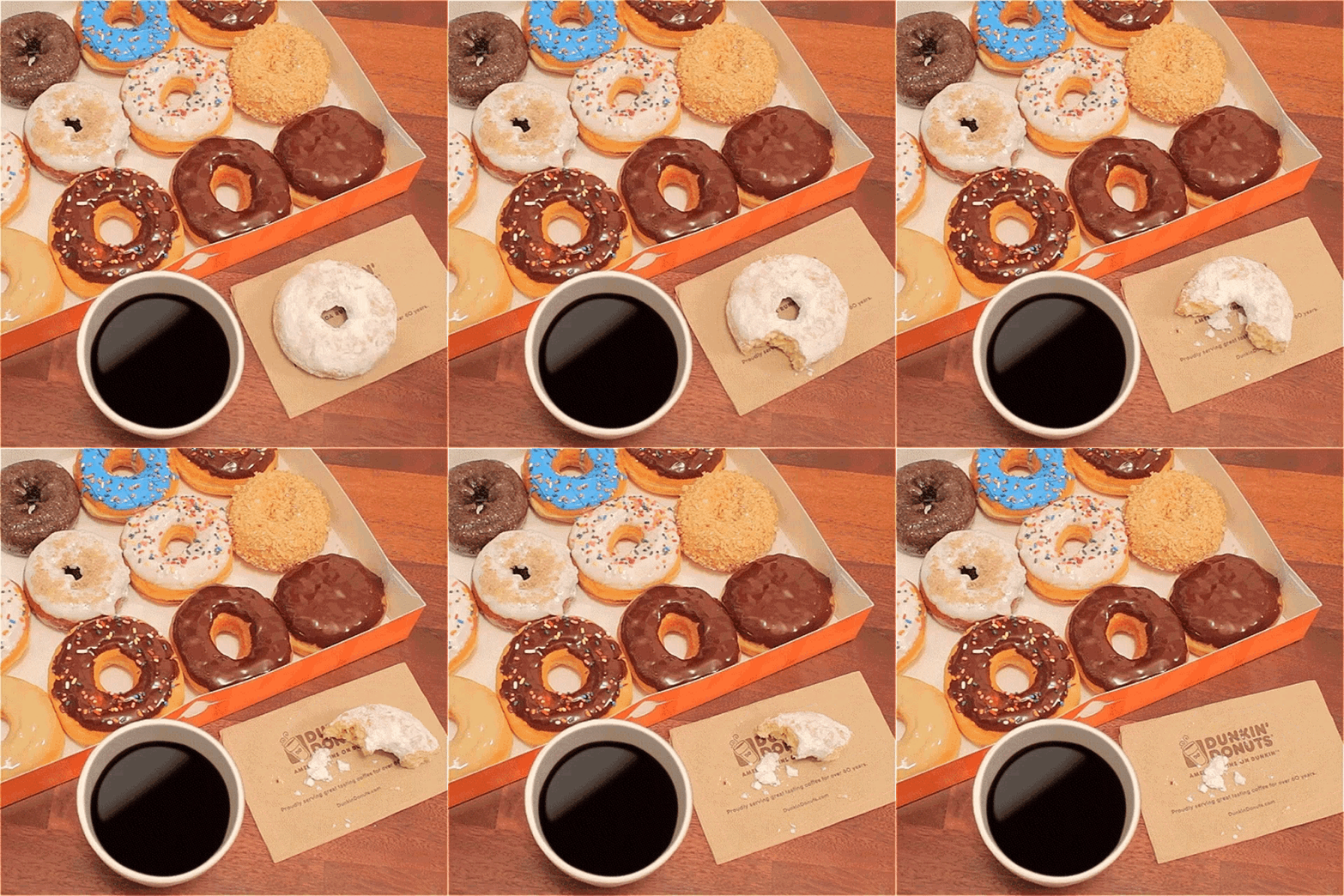
The Small Treat Economy Is Getting Dark.
From doom spending to luxury candles and forty-dollar lip balm, the internet’s little treat culture is revealing something sharper about burnout, anxiety, and modern adulthood.
Let’s Get Everyone Up to Speed Quickly
Editorial note: This is not a “vibes only” piece. The framing is supported by Ahrefs keyword research around “doom spending” and “little treat culture,” plus consumer reporting from CNBC, Bankrate, the Federal Reserve, and Deloitte.
There was a time when buying yourself a little treat felt harmless. A croissant after surviving a humiliating meeting. A lipstick bought during a week that seemed personally committed to making you worse. An overpriced iced coffee consumed less for the caffeine and more for the emotional reassurance that life still contained small, decorative pleasures. The whole thing carried a kind of unserious softness to it, a tiny reward slipped quietly between bills, errands, rent, notifications, responsibilities, and the general administrative horror of being alive.
Now the internet has transformed the little treat into a fully developed coping mechanism, complete with its own vocabulary, aesthetic, financial consequences, and faint smell of doom. Nobody says they are shopping recklessly anymore. They are doom spending. Nobody admits they feel financially cornered by adulthood. They joke about deserving a small reward after answering three emails, surviving a grocery run, or emotionally dissociating through another workday that could have been a single cancelled meeting. The language is funny because the behaviour is recognizable. It is recognizable because the pressure underneath it is real.
The small treat economy is not just about candles, iced coffee, lip balm, bakery boxes, or skincare bought under fluorescent Sephora lighting while pretending the day can still be salvaged. It is about the way consumer culture has learned to absorb modern anxiety and sell it back to us as softness. The treat is rarely only the treat. The treat is a pause. A mood correction. A proof-of-life purchase. A temporary interruption from the growing suspicion that long-term stability has become something other people had, like pensions, starter homes, and attention spans.
A twenty-dollar coffee order feels manageable in ways a future does not.
The Research Is Not Exactly Cheerful
of social media users told Bankrate they had impulsively bought a product they saw on social media.
was the average amount spent over a year by those who made social-media impulse purchases, according to Bankrate.
of shoppers in a Credit Karma report cited by CNBC said they were doom spending.
of U.S. adults said they were doing at least okay financially in the Federal Reserve’s 2024 household economics survey, still below the 2021 high.
Doom Spending Is Becoming Normalized Online
Doom spending sounds dramatic, which is convenient, because the internet prefers its pain with a marketable name. CNBC described doom spending as the habit of mindlessly shopping to self-soothe because of pessimism about the economy and the future, citing Psychology Today and finance experts who connect the behaviour to chronic online exposure, bad news, and a feeling that the future has become harder to plan for. In a separate CNBC report, about 27% of polled shoppers said they were doom spending despite concerns about the economy and world events, with the behaviour reported by 37% of Gen Z and 39% of millennials. Those numbers are not cute. They are a small financial flare going up from the group chat.
It would be easy, and lazy, to frame this as another story about young people being irresponsible with money. That version is satisfying for people who enjoy pretending every economic problem can be solved with meal prep and moral superiority. The more honest version is uglier. Younger consumers are navigating high housing costs, sticky inflation, unstable career pathways, student debt, expensive cities, social media comparison, and the quiet collapse of old milestones that previous generations treated as ordinary. When saving for the future feels increasingly abstract, spending on the present starts to feel less like rebellion and more like emotional triage.
This is where the little treat economy begins to darken. A latte is not financially equivalent to a down payment, no matter how much personal finance scolds enjoy pretending otherwise. But repeated emotional spending still tells a story. It reveals what people reach for when larger forms of security feel inaccessible. If the future looks structurally hostile, the present becomes the only place where pleasure still feels negotiable. That does not make the spending harmless. It makes it legible.
The Clean Girl Era Was Always About Control
The rise and slow decay of the clean girl aesthetic makes more sense when you stop treating it as a beauty trend and start treating it as a public performance of control. Slick buns, neutral interiors, glass jars, beige athleisure, expensive water bottles, barely-there makeup, supplements lined up like tiny soldiers, the whole thing looked calm because the world did not. The clean girl did not merely have nice skin. She appeared organized enough to survive late capitalism without sweating through her linen.
That illusion was expensive to maintain. It required products, routines, lighting, storage systems, wardrobe discipline, and a specific kind of visual restraint that often cost more than maximalism. Even minimalism became another shopping category. Buy fewer things, yes, but make sure the fewer things are beautiful, neutral, photogenic, expensive, and arranged in a way that suggests you have never once eaten cereal out of a mug over the sink.
This is why the cultural turn against polished perfection feels so satisfying. The clean girl aesthetic is not disappearing because people suddenly hate nice skin or organized kitchens. It is losing authority because audiences have become exhausted by the emotional emptiness underneath hyper-curated living. On Brewtiful Living, this same fatigue already shows up in pieces about the clean girl aesthetic collapsing and the politics of beauty trends that pretend to be effortless while quietly requiring money, time, and an Olympic tolerance for self-surveillance.
The luxury lip balm is not just lip balm. It is a tiny, glossy referendum on whether life still gets to feel nice.
The Rise of Financial Dissociation
Financial dissociation is not a formal diagnosis. It is just the most accurate description of what it feels like to open your banking app, stare into the void, close it immediately, and order sushi because dinner still needs to happen and apparently so does your personality. The Federal Reserve’s 2024 Survey of Household Economics and Decisionmaking found that inflation and prices remained the top financial concern for U.S. adults, with many people adjusting their spending in response to higher prices. In the same report, 73% of adults said they were doing okay financially or living comfortably, a figure still below the recent 2021 high. That gap between “technically surviving” and “emotionally comfortable” is where a lot of modern spending behaviour lives.
Deloitte’s 2025 Gen Z and Millennial Survey also places cost of living near the center of younger generations’ concerns, alongside work-life balance, meaning, and well-being. This matters because little treat culture is often discussed as though it exists separately from work culture, housing costs, and economic anxiety. It does not. The treat arrives after the spreadsheet. After the Slack message. After the rent increase. After the news alert. After the realization that even doing everything right may not deliver the stability people were told to expect.
The consumer response to that instability is not always rational, but it is emotionally coherent. A person may panic about grocery prices and still buy a luxury lip balm because those purchases live in different psychological compartments. Groceries represent survival. The lip balm represents identity, softness, aspiration, and the small possibility of feeling like a person rather than a household expense report. Traditional budgeting advice often misses this because it treats spending as purely mathematical when so much modern spending is emotional, social, and aesthetic.
Wellness Culture Made Everything Worse
Wellness culture should have helped, in theory, which is always a dangerous phrase. Instead, the internet’s obsession with wellness often made ordinary existence feel like another underperforming project. Every platform is flooded with content about nervous system regulation, cortisol management, sleep hygiene, supplements, burnout prevention, hydration, manifestation, boundary-setting, somatic healing, cycle syncing, protein goals, and morning routines performed by women who appear to live inside apartments designed by a magnesium brand.
Some of this advice is useful. Much of it is also consumer culture wearing linen pants. Wellness became one of the most effective ways to sell products because it wrapped consumption in moral language. Buying the product was not indulgent. It was healing. It was regulation. It was choosing yourself. It was doing the work, apparently, though the work was suspiciously available in three shades and free shipping over $75.
This is where little treat culture and wellness consumerism begin to merge. A bath soak becomes emotional repair. A smoothie becomes identity maintenance. A candle becomes nervous system support. A skin tint becomes self-respect. The language grows softer as the spending grows more normalized. On the surface, everything looks gentle. Underneath, the message is blunt: if you feel bad, buy something better-looking than the feeling.
Small pleasures are not the enemy. The issue is when consumer rituals become the only affordable emotional support system people feel they have left.
What the Small Treat Economy Actually Reveals
The small treat economy did not emerge because people suddenly became frivolous. It emerged because modern adulthood became psychologically exhausting in ways that are difficult to articulate without sounding either dramatic or underpaid. Tiny purchases became emotional negotiations with ourselves. Proof that softness still exists somewhere. Proof that pleasure still exists somewhere. Proof that adulthood has not fully collapsed into rent, groceries, work messages, algorithmic sameness, and the ambient dread of watching everyone else pretend they are handling it better.
There is nothing morally wrong with buying a coffee, a candle, a lipstick, a perfume sample, a pastry, or a little unnecessary object that makes the day less dead behind the eyes. The problem is not pleasure. The problem is what happens when pleasure becomes one of the only affordable forms of agency left. When people cannot easily buy homes, take meaningful time off, access secure work, or imagine stable futures, they buy smaller symbols of control. Consumer culture did not create that wound, but it has become very skilled at decorating it.
The candle is not just a candle anymore. The luxury lip balm is not just lip balm. The skincare haul is not really skincare. The internet turned consumption into emotional atmosphere because emotional atmosphere increasingly feels easier to purchase than structural security. Underneath every beautifully filmed little treat video sits the same uncomfortable realization: people are trying to create small pockets of softness inside systems that no longer feel reliably stable.
That is why the trend resonates so widely. Not because people are shallow. Because people are tired.
People Also Ask
We document the chaos. With receipts. No scented-candle propaganda.
Culture, internet behaviour, beauty disappointments, and the small humiliations of trying to remain financially and emotionally normal online.
Browse All Culture Coverage →
Social Media Made Spending Feel Like Identity
The internet did not invent emotional spending, but it did make it prettier, faster, more visible, and much easier to confuse with personality. Social media turned every purchase into a potential identity cue. Your apartment is not just your apartment. It is a signal of taste, discipline, softness, desirability, restraint, ambition, emotional regulation, or whatever else the algorithm has decided your throw pillows are supposed to communicate this week. Your skincare shelf suggests whether you are polished. Your groceries suggest whether you are aspirational. Your candle suggests whether you have successfully monetized your loneliness into ambience.
Bankrate’s 2023 social media survey gives useful shape to this behaviour. Nearly half of social media users said they had impulsively purchased a product they saw on social media, and those who made impulse purchases spent an average of $754 over the previous year. Bankrate also reported that 57% of social media users believed people post to appear more successful, while 51% said social media promotes unrealistic lifestyles. This is the part that makes the small treat economy feel less like harmless self-care and more like a feedback loop. People see curated abundance, feel worse about their own lives, buy something to soften the feeling, then potentially turn that purchase into content that feeds the same cycle for someone else.
That loop is especially powerful because modern platforms do not merely advertise products. They advertise emotional states. Calm. Glow. Control. Taste. Recovery. Softness. Discipline. Main character energy, which is just narcissism with better lighting. The product is rarely presented as a product. It is presented as a doorway into a better self. This is why beauty culture, wellness culture, and home aesthetics sit so naturally inside the little treat economy. They all promise small, purchasable upgrades to the emotional atmosphere of daily life.