Why Is My Husband Yelling at Me? Let's Talk About What's Actually Happening
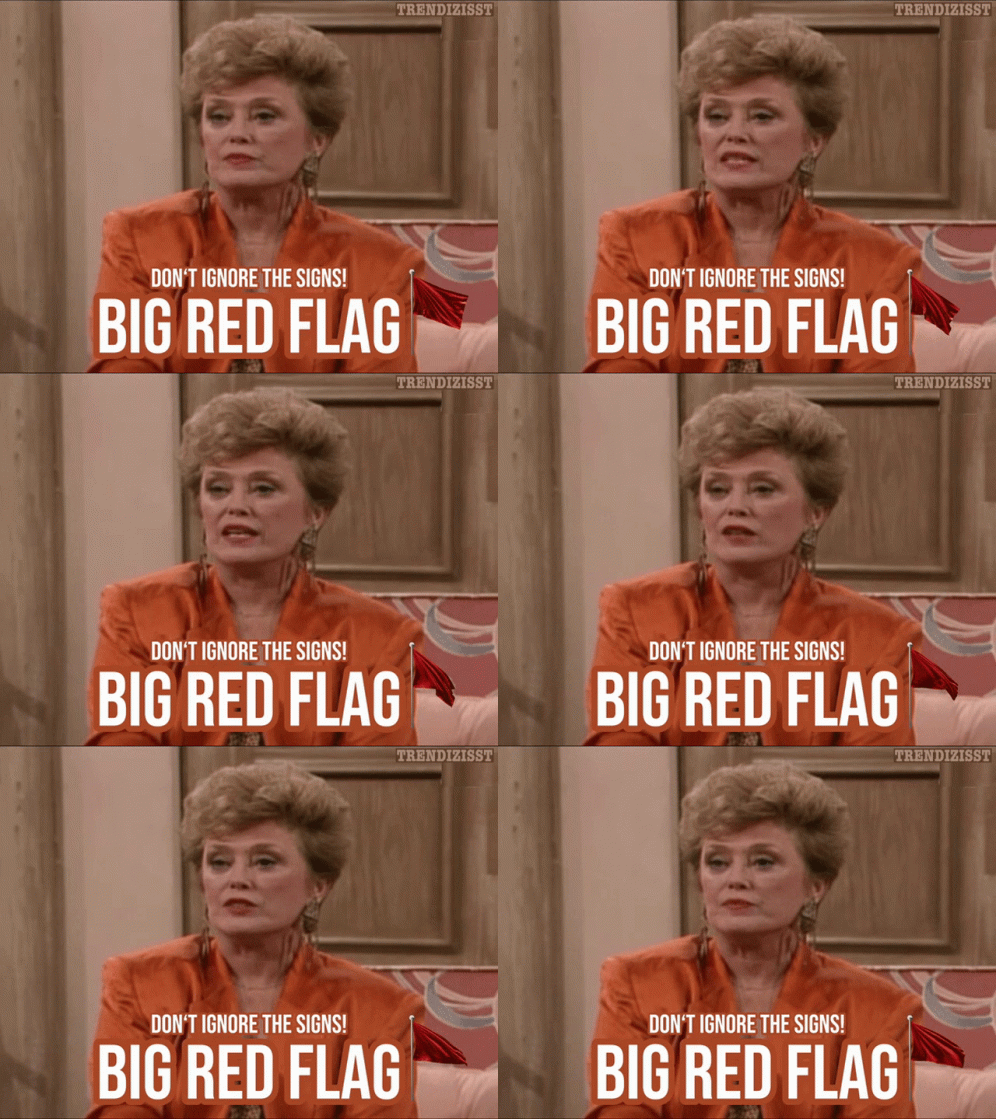
Dear Brewtiful, my husband has been yelling at me a lot lately. Not about anything specific — just general frustration about work, money, the kids, traffic. I know he's stressed. I keep telling myself it's not about me and I try not to react because I don't want to make things worse. My friends say I should just give him space but it's getting to the point where I dread him coming home. Am I overreacting?
— Keeping the Peace in PennsylvaniaWhy Is My Husband Yelling at Me? Let's Talk About What's Actually Happening.
Keeping the Peace in Pennsylvania — you are not overreacting. You are, if anything, under-reacting in a way that has become so habitual you've started calling it patience.
Here is the thing about stress: it is an explanation, not a permission slip. Your husband is stressed — fine, stress is real, the world is genuinely a lot — but he is choosing to express that stress by yelling at you. That is a choice. He is not yelling at his boss, presumably. He is not yelling at the traffic. He is yelling at you, because somewhere along the way he decided that you were the safe place to put it.
The problem with being the safe place for someone's worst moments is that eventually you stop feeling safe yourself. You said you dread him coming home. You are managing your own behaviour to prevent his outbursts. That is not a marriage where you feel at ease — that is a marriage where you are doing emotional surveillance on yourself twenty-four hours a day in order to keep the peace that should not require keeping.
Your friends mean well with the "give him space" advice, but giving someone space when they are routinely yelling at you is not the same as giving them space to cool down after a one-off bad day. Chronic yelling is a pattern, and patterns don't resolve with more accommodation — they expand to fill whatever space you keep giving them.
What I'd recommend is a direct conversation when things are calm — not defensive, not accusatory, just clear. Something like: "When you raise your voice at me, I shut down and pull away. I need this to change." Not a discussion about his stress levels. A statement about your boundary, and what the consequence is if it's crossed. That consequence is yours to decide. But it needs to exist.
If the yelling continues after a direct conversation, that's when couples therapy becomes less optional. Not because you need to be fixed, but because you need a third person in the room who can name the pattern he can't see and you've stopped challenging.
Keeping the Peace in Pennsylvania — the peace is costing you too much. One direct conversation. Then decide what happens next based on how he responds to it — not based on how stressed he currently is.
Dear Brewtiful, I've been seeing someone for about five months. I really like him. But there are some things that bother me that my friends say I'm reading too much into. He cancels plans about once a week, usually last minute. He never posts me on social media even though he's on it every day. He's a bit dismissive when I bring up things that upset me — like, he'll say I'm "too sensitive." He's otherwise really sweet and attentive when things are good. Am I being too sensitive or are these red flags in a relationship?
— Probably Overthinking It in OhioThe Red Flags in Your Relationship Are Not Actually That Hard to Read.
Probably Overthinking It in Ohio — you are not overthinking it. You are, if anything, under-thinking what you are going to do about it.
Let me name what you described in plain language, because I think you already know and are hoping someone will either confirm it or give you permission to dismiss it. He cancels plans weekly. He keeps you off his social media while being active on it daily. And when you bring up something that bothers you, he tells you that you're too sensitive — which is a very efficient way of making your feelings someone else's problem without having to engage with them.
These are not personality quirks. They are a pattern. Individually, any one of them might be explainable. Together, they describe a man who is managing the level of commitment and visibility he's willing to give you — while still enjoying the relationship on his own terms. He is "really sweet and attentive when things are good" because when things are good, he is getting exactly what he wants with no friction. The issue is what happens when you create friction by having a feeling he doesn't find convenient.
"Too sensitive" is a phrase that means: I don't want to do the work of taking your feelings seriously, so I'm going to make your feelings the problem instead. Five months in, this is not a rough patch. This is him showing you how he handles being accountable to someone. Take the information.
Your friends telling you you're reading too much into it might be true — or they might be friends who are uncomfortable with conflict and would rather reassure you than sit with the discomfort of saying what they actually see. Red flags have a way of being obvious to everyone except the person inside them.
Here is the actual test: have a direct, calm conversation about one specific thing — pick the cancellations, since those are concrete and hard to argue with. Watch how he responds. Does he apologise and make a change? Or does he explain, deflect, minimise, and leave you feeling like you were wrong to bring it up? His response to that conversation will tell you more than five more months of waiting to see if it gets better.
Probably Overthinking It in Ohio — you are not overthinking. You are being gaslit into thinking your pattern recognition is a character flaw. It isn't. Trust the pattern. Test the response. Decide accordingly.
Dear Brewtiful, I've been with my boyfriend for two years. I love him and he's a good person but I feel like something is missing and I don't know what it is. We don't fight. He's kind. But I find myself wondering what else is out there and sometimes I feel more relieved when he cancels plans than when we actually get together. I don't want to hurt him. He hasn't done anything wrong. Should I break up with my boyfriend even if there's nothing technically wrong?
— Guilty in GeorgiaShould You Break Up With Your Boyfriend? You Already Know. Here's Why You Won't Act On It Yet.
Guilty in Georgia — the guilt is the tell. You do not feel guilty about things you are genuinely fine with.
I want to sit with one sentence you wrote: "I feel more relieved when he cancels plans than when we actually get together." That is the answer to your question. Everything else you wrote is kind and fair and generous — he's a good person, he hasn't done anything wrong, you don't want to hurt him. All of that is probably true. But relief at his absence is not a small thing to overlook. Relief is your nervous system telling you the truth that your brain is working very hard to reframe as a logistical preference.
Here is what I see: you are in a relationship that is fine. Not painful, not broken — just fine. And you are staying in it partly because it is fine, partly because he is genuinely a good person, and partly because breaking up with someone who has done nothing wrong feels like a crime you are committing against them rather than a choice you are making for yourself.
But here is the part nobody tells you: you do not need a reason to leave a relationship beyond "this is not the relationship I want." That is sufficient. It does not require him to have done something wrong. It does not require you to have found someone else. It does not require a dramatic catalyst or a fight that makes the decision feel justified. Wanting more — even if you can't name exactly what more is — is enough.
Staying because you don't want to hurt him is kind in the short term and unkind in the long one. He deserves to be with someone who is relieved when plans are kept, not cancelled. So do you. Two years is not a loss you have to prevent by staying for a third. Staying in something comfortable because leaving feels cruel is how situationships become five-year relationships that end anyway.
The actual question is not whether to break up. You have already answered that. The question is what is making it feel impossible to act — guilt, fear of being wrong, fear of regret, fear of being alone, or some combination of all four. Sit with those specifically. Because the decision is already made. You are just waiting to feel ready, and ready is not coming. You have to go first.
Guilty in Georgia — you are not guilty of anything yet. You are allowed to leave a good person because it is not the right relationship. That is not a crime. That is just honesty, arriving a little late.
The Questions Everyone Is Actually Googling
that needs a verdict?
Send your letter. The situation you're too embarrassed to bring up in the group chat, the thing your friends keep saying is "probably fine," the question you've been sitting on for six months. We read everything. We answer honestly.
Submit your letter → Letters are lightly edited for clarity · Names are changed · Nothing is soft-pedalled