The Dating App Era Is Officially Dying. Here Are the Receipts
The Dating App Collapse
No One Wants
to Admit
Swipe fatigue is real. The stocks are bleeding. And the industry's solution is artificial intelligence. A totally normal response for a product that promised you love and delivered a dopamine loop.
"At some point it stops being dating fatigue and starts being pattern recognition."
The Financial Decline Is Not Subtle and Not New
Paying users are dropping. Sessions are shorter. Growth is stalling across every major platform in the category. Match Group — which owns Tinder, Hinge, and several others — has seen its stock decline significantly from peak valuations. Bumble has faced similar headwinds. The numbers have been telling this story for a while. The industry has been telling a different one.
This is not a bad quarter. This is a pattern, and patterns are considerably harder to spin than individual data points. The collective user base has been quietly, consistently, doing the thing that users do when a product stops delivering on its core promise. They leave.
Users Are Not Confused. They're Done.
Survey data consistently shows high dissatisfaction rates among dating app users — particularly women, who report safety concerns alongside the more universal complaints about low effort, exhausting communication dynamics, and the specific feeling that the whole exercise has started to feel like a game with unclear rules and no satisfying end state.
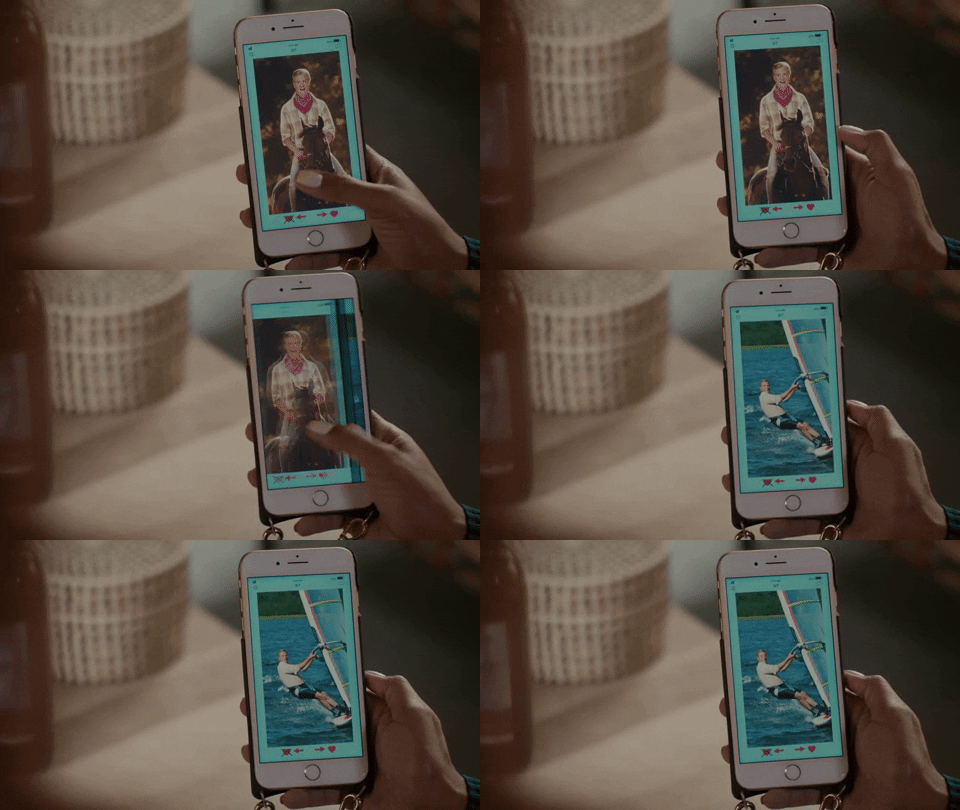
The apps feel like games. Not good ones — the kind where the mechanics are just engaging enough to keep you playing but the gameplay itself stopped being enjoyable about twelve sessions ago. The texture of that experience is documented in full here.
The Apps Were Never Built to End Your Search. That Was Always the Problem.
The goal is engagement, not outcomes. This is not an accusation — it is a structural description of how apps that generate revenue from subscriptions and in-app purchases are necessarily incentivised. An app that efficiently produces a lasting connection loses a customer. An app that keeps users hovering just above satisfaction retains one indefinitely.
Swiping is infinite. Connection is not. The interface was designed for the former and marketed as delivering the latter. The gap between those two things is where a decade of disappointment has been accumulating.
This Wasn't Neutral. It Changed How People Experience Connection.
Years of swipe culture trained a generation to evaluate quickly, detach easily, and perform constantly — and then wonder why nothing feels quite real. The apps didn't just fail to produce connection. They altered the conditions under which connection was being attempted.
Searching became the default mode. Presenting replaced being. The orientation shifted from "I am here, encountering other people" to "I am here, marketing myself to a pool of options while simultaneously evaluating a pool of options presented to me." Those are different states to be in. The second one is exhausting in a way that accumulates.
"You were never meant to experience connection through a slot machine interface. The slot machine was never going to deliver what you were actually looking for."
Now They're Adding AI. Of Course They Are.
AI matches. AI-generated conversation openers. AI "chemistry" scores. The industry has decided that the problem is not the system. The problem is that the humans using the system aren't optimised enough — don't present themselves compellingly enough, don't open conversations effectively enough, don't filter their matches with sufficient algorithmic precision.
The solution being offered to a product that failed to facilitate genuine human connection is: more technology mediating the human connection. The logic is that if the first layer of algorithmic matching didn't work, a second layer of AI assistance will produce the missing ingredient. The missing ingredient is not AI assistance.
People Are Going Back Offline. Eye Contact Is Having a Comeback.
In-person events are rising. Speed dating — which a few years ago felt like a relic — is back and selling out. Social clubs, hobby groups, the kind of low-stakes third-place gathering where you might talk to someone you'd never have matched with on an app because neither of your profile photos conveyed the specific thing that made them interesting: all of it is returning.
This isn't nostalgia. It's correction. It's the collective recognition that the interface wasn't delivering and that the alternative — being physically present among other humans in three dimensions — was always available. The full evidence of the shift is here.
So What Happens Now? Something Slower and More Uncertain and Actually Better.
People are choosing slower. Harder. More uncertain paths to connection than the app interface offered. Not because they've become more patient or more zen or more willing to embrace the romance of the analogue world — but because the faster path with the better interface turned out to produce significantly worse outcomes than advertised.
Real connection was never supposed to be optimised. It was supposed to be felt. The specific friction and uncertainty and occasional awkwardness of encountering another person and not knowing quite what was going to happen next was not a problem to be solved. It was where the interesting part lived. And the apps delayed it indefinitely. Stopping is the whole move.
Romance isn't dead.
The apps just made it
feel like it was.
The collapse of the dating app era is not the end of dating. It is the end of a particular version of it — one that was always more profitable for the platforms than it was useful for the people using them. What comes after is being built right now by people who are going to things, talking to people who are physically present, tolerating the discomfort of not knowing how something is going to turn out before it's started.
That is not a worse version of looking for connection. It is, in fact, the original version. It turns out the original version was fine. It was the optimisation that was the problem.