☕ Mindful-ish · Internet Culture · Oxford Word of the Year 2024
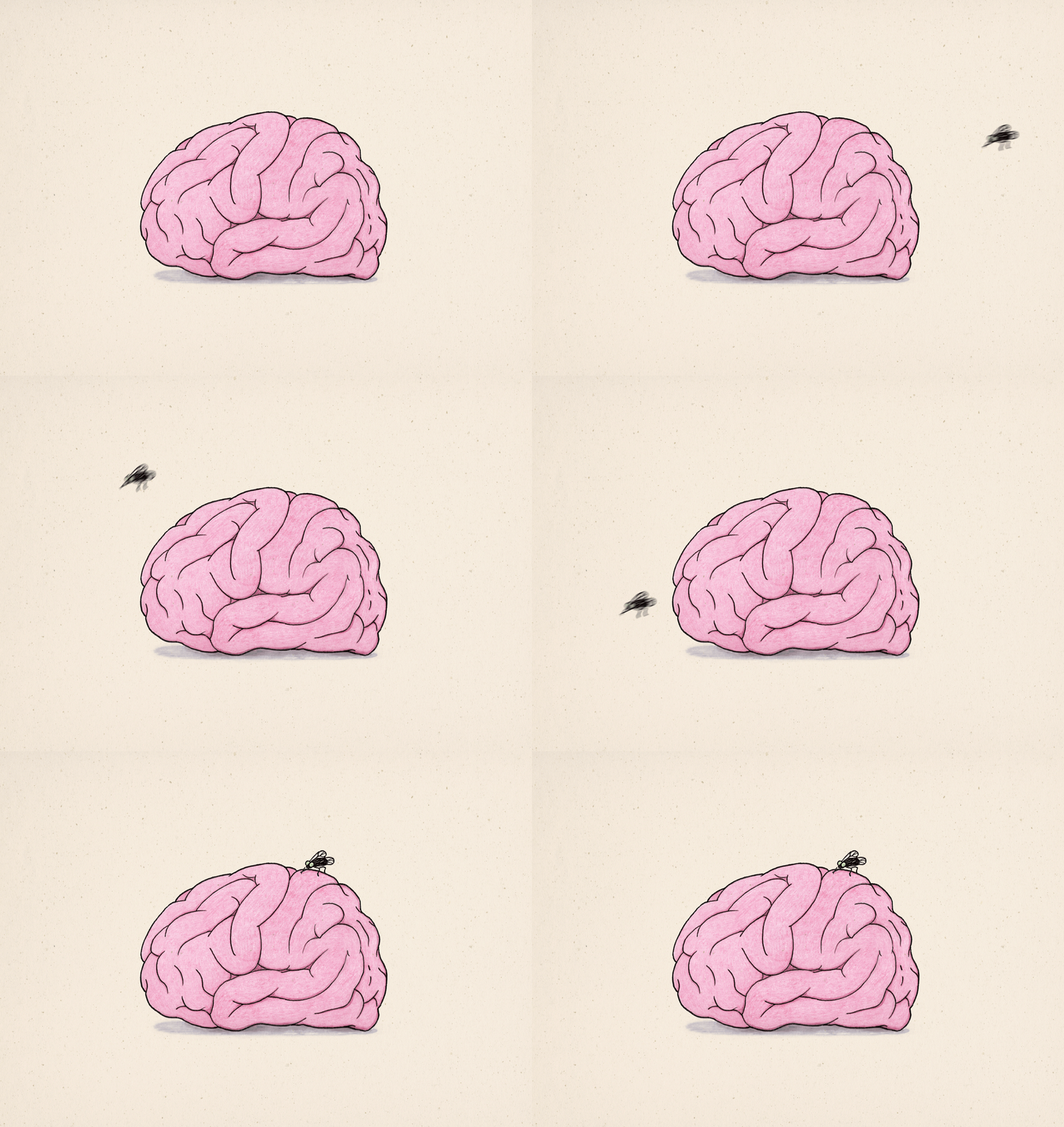
Brain Rot Meaning: What It Is, Why You Have It, and Why You Can't Stop.
The slow, satisfying deterioration of your attention span from too much internet. Oxford named it Word of the Year. You almost certainly have it. We definitely have it. Let's talk about it.
By Sara Alba · Brewtiful Living · April 30, 2026 · Mindful-ish
Brain Rot — Official Definition
The perceived deterioration of mental capacity, attention span, and taste resulting from excessive consumption of low-quality, algorithmically-optimised internet content. Oxford University Press Word of the Year, 2024. Usage up 230% year on year. You already know what it feels like.
The Definition
What Brain Rot Actually Means — Properly Explained
Let's be precise about this, because brain rot is one of those terms that everyone uses and almost nobody defines carefully. It is not, to be clear, a medical diagnosis. Your GP cannot test you for it. There is no scan that shows a brain in active rot. What brain rot describes is something more specific and more experiential than that — and also considerably more relatable.
Brain rot is what happens when you spend so much time consuming fast, algorithmically-optimised, low-effort internet content that your capacity for slower, deeper engagement starts to atrophy. You open a book and find yourself re-reading the same paragraph four times because your brain keeps trying to scroll past it. You start a film and check your phone seventeen minutes in because nothing has exploded yet. You try to read a long article and find yourself skimming for the bullet points that don't exist.
The content hasn't changed. Your tolerance for pace has. That's brain rot. The algorithm trained you to expect constant novelty, constant movement, constant reward — and now anything that doesn't deliver those things in the first thirty seconds feels intolerably slow.
Oxford University Press named it their Word of the Year for 2024. Usage had increased by 230% between 2023 and 2024. Which either means brain rot is getting worse, or that more people are finally admitting they have it, or both. Probably both.
The algorithm trained your brain to expect constant novelty. Now anything that doesn't deliver it in thirty seconds feels intolerably slow. That's not boredom. That's brain rot.
The Symptoms
Signs You Have Brain Rot — A Checklist You Won't Finish Reading
📱
The 30-second attention cliff
You open a video, a podcast, an article — and if nothing has happened by thirty seconds you're already somewhere else.
📚
You can't read anymore
Not literally. But you open a book and re-read the same paragraph six times because your brain keeps trying to scroll.
🧠
Meme fluency, regular fluency down
You can explain the lore of a three-year TikTok beef in detail. You cannot remember what you read this morning.
🎬
Two-speed film watching
You watch films at 1.5x or you scroll through them. A film that "takes too long to get going" means the first twenty minutes had no action.
💬
Internet references in real life
You have referenced an obscure meme in face-to-face conversation and watched someone blink at you slowly.
🌀
Watching nothing while watching everything
You spent forty minutes scrolling, put the phone down, and cannot name a single thing you watched. It was something. Probably several things.
The Honest Metric
If you opened this article on your phone and have already checked another tab, your notifications, or Instagram since you started reading — you have brain rot. That's not a criticism. That's just a data point. Welcome to the club. The club has no meetings because nobody can focus long enough to hold one.
The Content
What Brain Rot Content Actually Looks Like — Examples
Brain rot is not just a description of how you feel — it's also a genre. Brain rot content has specific characteristics that make it both irresistible and slightly corrosive. Here is what it looks like in the wild.
Brain Rot Content — Field Guide
⚡
Extremely fast edits with no narrative. Videos that cut every 0.8 seconds, have four audio tracks layered simultaneously, and end without resolving anything. You watched it three times before realising it had no plot.
🌀
Memes with twenty layers of irony. Content that requires knowing five previous memes to understand this meme. Newcomers see nonsense. Insiders feel a specific warmth of recognition. You are an insider now.
🐸
Things happening for no reason. A man stacking fruit in unusual configurations. A cat sitting in a very specific way. Something falling. These videos have no point and hold your attention completely for ninety seconds.
📢
Talking very fast about something that doesn't matter. A man reorganising his desk at extreme speed while narrating urgently. A woman reacting to a video of a woman reacting to a video. You watched forty minutes of this and felt nothing.
🎭
Absurdist characters with dedicated fanbases. An AI-generated figure doing something inexplicable who has accumulated 2 million followers. You know their name. You don't know why you know their name.
The Progression
The Five Stages of Brain Rot — Which One Are You In?
1
Casual Consumer
You scroll for twenty minutes before bed. You watch a few TikToks. You put the phone down and go to sleep. You are fine. You do not yet know what is coming.
2
The Slide
Forty minutes becomes an hour. You check your phone during films. You find yourself scrolling during conversations. You are aware something has shifted but attribute it to being tired.
3
Active Brain Rot
Books feel slow. Long articles feel like homework. A film without a major incident in the first fifteen minutes feels like it's "not for you." You reference memes in real-life conversations. You have watched a man reorganise his desk for forty minutes and felt it was time well spent.
4
Advanced Brain Rot
You watch content at 2x speed. You multi-screen. You cannot remember what you watched yesterday. You have started and abandoned seventeen long-form things because "nothing was happening." You no longer recognise this as a problem.
5
Terminal Acceptance
You have brain rot and you have decided you are at peace with this. You describe yourself as "chronically online" with the fond tone usually reserved for a lovable character flaw. You are correct that it is lovable. You are also correct that it is a flaw.
Stage five is not the worst place to be. At least the self-awareness is intact. The worst version of brain rot is the one that doesn't know it's brain rot.
The Mechanism
Why Your Brain Keeps Choosing the Rot
The honest answer to why brain rot happens is not a character flaw. It is a design feature — just not your design. It is the design of the platforms.
Every algorithmically-fed feed is optimised for one metric: time on platform. The content that keeps you watching longest wins. And what keeps humans watching longest, consistently, is novelty — new stimulation, new faces, new sounds, before the previous ones have fully processed. The feed is engineered to provide exactly that, at a rate that makes sustained engagement with anything slower feel uncomfortable by comparison.
Your brain is not broken. Your brain adapted correctly to the environment it was given. You asked it to process thousands of short clips per week and it learned to do that efficiently. The side effect is that it also learned to expect that pace — and now resists anything that doesn't match it.
This is also why the dating app era produced the relationship dynamics it did — the same infinite-scroll logic applied to people, with the same attention-span consequences. The ick that arrives faster. The interest that fades sooner. Brain rot and modern dating have the same architecture.
The algorithm is not malicious. It just doesn't care about what's good for you. It cares about what keeps you there. Those two things are different, and the difference is where brain rot lives.
The Recovery
Can You Actually Recover From Brain Rot? Yes. Reluctantly.
Yes — but only if you accept that the first few days of reduced scrolling feel genuinely, uncomfortably boring. That boredom is not a sign that something is wrong. It is your brain recalibrating. It is the attention span equivalent of the first week of a new exercise routine: deeply unpleasant, ultimately worthwhile, highly likely to be abandoned by day three.
1
Stop doomscrolling before bed
The algorithm before sleep is particularly corrosive because your resistance is lowest. Replace it with literally anything — a book, a podcast, staring at the ceiling. The ceiling is boring. That is the point.
2
Reintroduce long-form deliberately
One long article per day. One episode of something without your phone in reach. One chapter of a book before you allow yourself to check anything. Gradual re-exposure, not cold turkey.
3
Stop watching things at 2x speed
1.5x is already a concession. 2x is training your brain to treat everything as something to get through rather than something to experience. The speed is part of the problem.
4
Do one boring thing per day on purpose
Walk without podcasts. Eat without your phone. Sit somewhere and just be there. The discomfort you feel is the brain rot objecting. That discomfort is the recovery.
5
Accept that it takes two weeks minimum
Attention span rebuilds slowly. Most people report noticing a difference after 10–14 days of reduced short-form content. Most people also relapse on day four. This is normal. Try again on day five.
The Honest Caveat
Recovery is possible and also not the only valid option. Some people have brain rot and have decided this is simply who they are now. They are well-informed about extremely niche internet events. They are good at parties. They will never finish War and Peace. These are reasonable trade-offs and only you can decide if they work for you.
The Bottom Line
Brain Rot Is the Word We Needed — Even If We Can't Focus Long Enough to Use It Properly
The reason brain rot went from internet niche to Oxford Word of the Year in the span of a few years is that it named something people already knew was happening but hadn't articulated. The vague sense that you used to be able to focus better. That books used to be easier. That you used to be able to sit in a waiting room without immediately reaching for your phone.
That sense is real. The attention span data backs it up. The platform design confirms it was intentional — or at least foreseeable. Brain rot joins a growing vocabulary for the specific ways internet culture shapes how we feel and think — alongside delulu, girl dinner, chronically online, and the ick. They are all different facets of the same thing: a generation trying to name its own experience with the tools that experience gave it.
The irony that most people will read this article in fragments, on their phone, while also watching something else, is not lost on us. We wrote it in fragments too. We are all in this together. The rot is communal. The attention span is gone. The content continues.
At least we named it.
People Also Ask
Brain rot refers to the perceived deterioration of mental capacity, attention span, and taste caused by excessive consumption of low-quality, algorithmically-optimised internet content. A person with brain rot typically struggles to focus on longer-form material, finds themselves referencing obscure internet memes in real life, and experiences difficulty engaging with anything that requires sustained attention. Oxford University Press named it Word of the Year for 2024, with usage up 230% year on year.
Brain rot content is fast, algorithmically optimised, low-effort internet content that is highly compelling in the moment but offers little lasting value. Examples include very short TikTok videos with no coherent narrative, absurdist memes requiring layers of ironic context, videos of things happening for no reason, and extremely fast-paced edits. The defining quality is that it is simultaneously not worth your time and very hard to stop consuming.
No — brain rot is not a recognised medical diagnosis. It is a colloquial internet term describing the subjective experience of attention and focus deteriorating from excessive internet use. That said, the underlying experience it describes is real and documented by researchers studying internet use and attention. Brain rot is the informal name for something genuinely happening, even if the clinical picture is more nuanced.
Oxford University Press named brain rot Word of the Year 2024 because the term saw a 230% increase in usage between 2023 and 2024, reflecting a broad cultural conversation about the effects of excessive social media and short-form video on attention. The selection acknowledged that brain rot had moved from niche internet slang into mainstream cultural vocabulary used to describe both individual mental fatigue and wider concerns about digital culture's effect on how we think.
Yes — but it requires deliberate effort and tolerance for boredom. Recovery involves reducing short-form content consumption, reintroducing longer-form material gradually, doing activities that require sustained focus, and accepting that the first days of reduced scrolling feel uncomfortable. Most people notice a difference in attention span after 10–14 days of reduced algorithmically-fed content. The harder part is not relapsing on day four.
Wellness without the performance. Culture with receipts. Brewtiful Living — for people who are doing their best and would like to complain about it first.