MINDFUL
ISH.
Wellness without the toxic positivity. Roughly, sort of, more or less.
The Dating App Era Is Officially Dying. Here Are the Receipts
Swipe fatigue is real, the stocks are bleeding, and the industry's solution is artificial intelligence. A totally normal outcome for a product that promised you love and delivered a dopamine loop.
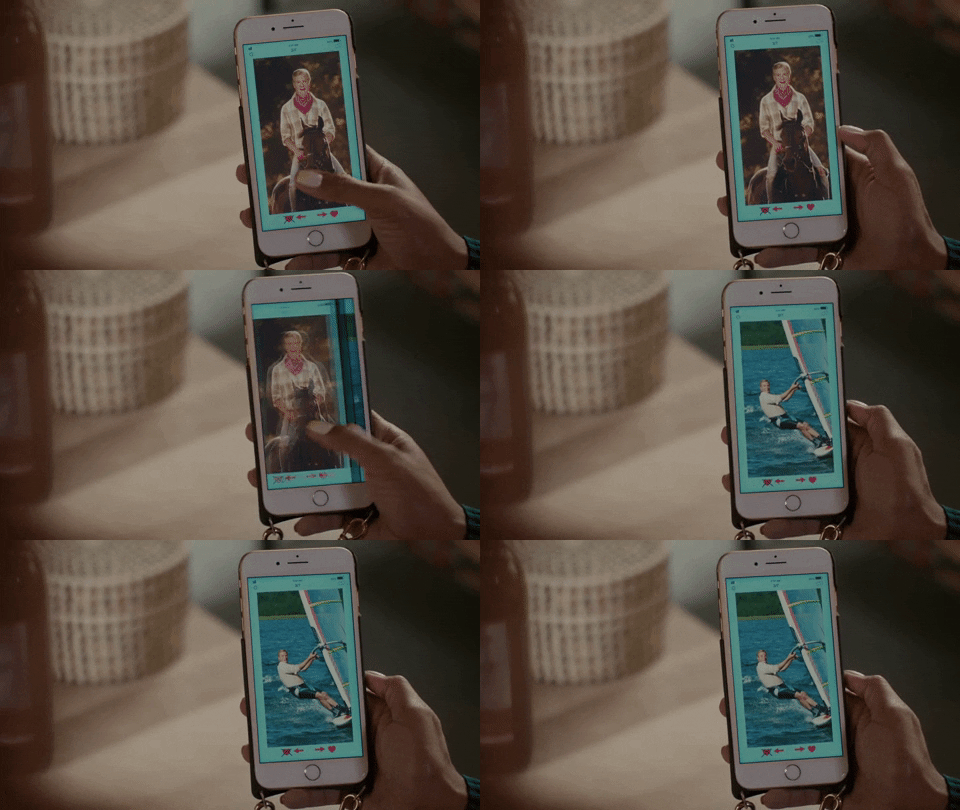
For over a decade, swiping was the answer. Lonely? There's an app for that. Single? Download three. Emotionally available and looking for something real? Here are ten thousand strangers sorted by proximity, each one represented by four photos and a bio that says either nothing or too much. Good luck. That'll be $29.99 a month.
The promise was always connection. The product, as it turns out, was something else entirely.
And now the numbers are in.
The Financial Collapse Nobody Wants to Admit Is a Collapse
Let's start with the money, because the money does not lie even when the marketing does.
Match Group, which owns Tinder, reported that its paying users fell 5% year over year to 13.8 million in Q4 2025. Tinder, its flagship product, saw an even steeper 8% drop in subscribers over the same period. Homes and Gardens That is not a blip. That is a trend that has been running for over seven consecutive quarters without reversing.
Bumble's shares plunged nearly 30% after the company dramatically lowered its annual revenue growth outlook, posting its first decline in quarterly sales since going public in 2021. Living Spaces Bumble lost 16% of its paying users by Q3 2025, landing at 3.6 million. Homes and Gardens These are not small platforms quietly struggling. These are the dominant names in an industry that once seemed invincible, and they are shrinking in ways that are becoming very hard to explain away.
Global dating app installs and sessions declined in both 2024 and 2025, with growth slowing even further in the latter year. The average session length dropped from 13.21 minutes in 2024 to 11.49 minutes in 2025. Who What Wear People are opening the apps less, staying shorter, and leaving in larger numbers. The product is losing the most fundamental argument it has: that it is worth your time.
What the Users Are Actually Saying
The financial decline would mean less if users were leaving satisfied. They are not.
A Pew Research survey found that nearly half of dating app users are unhappy with the apps. Women especially report feeling unsafe and frustrated, often citing scams and harassment. Many say the apps feel like games, not real ways to meet someone. Users are complaining about shallow matches, endless swiping, and pricey subscriptions that don't guarantee anything. Living Spaces
There is also the specific exhaustion that comes from a format that was designed, structurally, to never resolve. Most dating apps don't go much beyond a couple of pictures and a short bio — yet the goal people actually have is long-term partnership, not casual browsing. This contradiction is baked into the product: the apps were built for engagement, not outcomes, and users eventually notice the gap. Parade
The gap, it turns out, costs you more than time. The research on what sustained app use does to a person is not flattering to the industry. Studies found that dating app users experience increased emotional exhaustion over time, and that people who already struggled with loneliness or anxiety were made more vulnerable, not less, by prolonged app use. The machine that was supposed to solve loneliness had a documented tendency to make it worse. That's not a bug. That's a business model that was never oriented toward your happiness in the first place.
If any of this is bringing to mind a pattern you recognise from elsewhere — the charm, the cycle, the feeling that something is wrong but you can't quite prove it — the markers of emotional manipulation are worth revisiting. The apps and the people on them can both run the same playbook.
The Industry's Response: More Artificial Intelligence, Somehow
Faced with an exodus of paying users, shrinking session times, and a user base that is visibly, vocally exhausted, the dating app industry has landed on its solution: artificial intelligence.
Match Group committed $60 million toward AI and product development at Tinder, centred on a matching tool called Chemistry that tries to pair users based on deeper behavioural signals rather than surface-level profile information. Bumble is building an entirely new AI-first, cloud-native platform set to launch by mid-2026. Hinge introduced an AI recommendation feature that drove a 15% increase in matches, and its AI Convo Starters tool builds on the finding that 72% of daters are more likely to consider a match when it includes a message. Homes and Gardens
Let's sit with that last point for a moment. The platform is now generating your opening line for you, because users are more likely to respond when someone says something. The industry has identified that humans prefer to be spoken to as if by a human, and the solution is to automate the humanity. This is presented as innovation.
The deeper question — whether people left because the product was broken, or because the entire premise was flawed — is not one the AI rollout answers. Technology can refine how people meet on an app. It cannot resolve the fundamental tension between an industry that profits from your continued searching and a user who wants to stop searching entirely. Those two things are not compatible, and no amount of machine learning changes the underlying incentive structure.
Where Everyone Is Going Instead
There is finally a trend that can replace the apps, and it's being called "intentional dating" — singles events, speed dating, and in-person gatherings are seeing a surge in attendance as people crave real-life experiences that foster organic chemistry rather than algorithmic matching.
"A few photos and a snappy bio can't tell you whether someone has good chemistry with you, how their energy feels in a room, or even something as basic as if they make eye contact or laugh at your jokes," Emily Henderson as one dating expert put it. This observation is being treated as a revelation in 2026. It was, of course, always true. The apps just made it easy to forget for long enough that an entire industry could be built around the forgetting.
The return to in-person connection is not nostalgia. It is correction. It is people remembering that chemistry is a physical experience, that reading someone takes more than four curated photographs, and that the person who makes them laugh in a room cannot be replicated by a behavioural algorithm — however well-funded.
The Actual Problem Nobody Is Solving
Here is what the earnings reports and the think pieces and the AI roadmaps tend to dance around: the dating app era produced a specific kind of emotional damage that has not been fully accounted for. A decade of swipe culture trained an entire generation to evaluate people at speed, to treat romantic potential as a volume game, and to interpret silence as rejection so routine it barely registers.
It taught people to perform rather than present themselves. To optimise for the match rather than the relationship. To stay in a perpetual state of searching, because the alternative — closing the app and accepting the uncertainty of real life — felt like giving up.
After years of screen fatigue and impersonal interactions, people are not only craving real-life experiences, but are actually willing to take the steps to achieve it. Emily Henderson That willingness is the most interesting data point in any of this. It suggests that the exhaustion has finally crossed a threshold — that enough people have had enough that they are choosing the harder, slower, less convenient option of being present in a room with another human being.
Whether that constitutes a genuine cultural shift or just this year's wellness trend remains to be seen. What is certain is that cutting through the noise to find something real has never required a subscription, a premium tier, or an AI-generated opening line. It just requires the one thing the apps were structurally designed to delay: actually stopping.
— BrewtifulLiving.com | Brutal truths, Brewtifully packaged.
Why Online Dating Feels Like Digging Through Trash in Heels
Disclaimer: This is a highly opinionated piece dipped in satire, sprayed with expired cologne, and set on fire with a box of unused Bumble Boosts. If you’re in a loving relationship that started online, congratulations. The rest of us are just trying to survive the wasteland.
The Dating App Glow-Up Is Officially Over
It’s not just your delusion. It’s actually happening. The romance with dating apps is crumbling like a soft boy’s promises. Bumble recently cut 30 percent of its workforce. Match Group, which owns Tinder, Hinge, OKCupid, and every other digital disappointment machine, let go of 8 percent of its employees. The CEO of Bumble literally said the layoffs were part of a “reset moment” to revive user engagement and revenue. Translation: people are tired, bored, and not buying the fantasy anymore.
The numbers say everything. Match Group’s market value plummeted from $45 billion in 2021 to just under $10 billion this year. That’s not a dip. That’s a free fall into a sea of “u up?” messages and permanently single people too afraid to delete the app in case their soulmate downloads it on the same day.
They Called It Empowerment. We Got Exhaustion
When Bumble launched in 2014 with a “women message first” model, it was billed as a feminist revolution. What we got was the emotional labor of initiating every awkward conversation with men who answer with three words or an emoji and then vanish. Somehow the power shift didn’t lead to better dating. It just led to more burnout.
Whitney Wolfe Herd, Bumble’s founder and former CEO, stepped down last year and admitted she wants to “reset” her own relationship with the company. It’s hard not to read that as a metaphor. The woman who gave us this platform for modern love got exhausted by it too. Same, Whitney.
Online Dating Is Not Just Broken. It’s Dangerous
Let’s skip the romance and go straight to the red flags. Because dating apps aren’t just boring and disappointing. They can be seriously unsafe.
According to a 2023 Pew Research study, nearly half of women under 35 say they’ve received sexually explicit messages they didn’t ask for. Another one in ten say they’ve felt physically threatened. And that’s just the stuff they reported. Most of us just delete, block, move on, and tell ourselves it’s normal.
The illusion of safety online is paper-thin. Bumble’s own safety features, like photo verification and message prompts, are helpful, but they’re not foolproof. The same man who uses the “feminist” badge on his profile can still scream at you in a parking lot when you don’t want to go to his apartment on date one.
The Apps Know They’re Losing Us
Bumble's new CEO, Lidiane Jones, came straight from Slack. That’s right. A workplace messaging platform. Which is fitting, because app dating now feels like scheduling a meeting with someone who doesn’t show up and then tells you they’re “not really looking for anything serious.”
Jones is promising to revamp Bumble into something more meaningful. But we’ve heard that song before. Every app promises it’s different. Every app gets worse. At this point, Hinge should just rebrand as a therapy simulator for people with attachment issues and a Ring camera.
Real Talk: Dating Apps Don’t Want You to Find Love
If dating apps really worked, we’d all be off them. But love doesn’t scale well. Frustration does. Loneliness does. Confusion, ghosting, second-guessing, slow fades, and emotionally vacant convos about music taste do. The business model doesn’t thrive on connection. It thrives on churn.
The average Bumble user opens the app more than 10 times a day. Not to talk. Just to see. To check. To hope. We’re addicted to the possibility of connection, even though it rarely delivers anything but confusion, disappointment, or a man named Jordan who says he’s “between jobs.”
It’s a Trash Fire and You’re Not Crazy for Feeling Burned Out
App fatigue is real. According to the Wall Street Journal, usage across major dating apps has steadily declined. People are logging in less. Swiping less. Engaging less. And yet the same apps are raising prices, slapping on new “AI matchmaker” features, and pretending it’s innovation instead of desperation.
We’re not jaded. We’re traumatized. And we’re tired of digging through digital garbage bins hoping for a ring box.
Swipe Culture Isn’t Just Broken. It’s Dehumanizing
When you treat people like options, you stop treating them like people. Dating apps have turned connection into consumption. Swipe left, swipe right, forget their name. The faster you move, the less you feel. It’s not that love has died. It’s that it’s being suffocated by UX design.
No wonder nobody calls anymore. We’ve trained ourselves to fear real-time conversation. To delay vulnerability. To withhold effort. Because the next best thing is always one swipe away. Except it never is.
So What Now?
Delete the app. Not forever, just for long enough to remember what it feels like to make eye contact with someone who doesn’t want to text for three weeks before scheduling a drink.
Romance isn’t dead. It’s just been buried under a pile of bad algorithms, predatory business models, and blurry selfies. Real connection is still possible. It’s just not something you can download.
So maybe the answer isn’t more swiping. Maybe it’s more walking up to someone and saying hi. The old-fashioned way. The terrifying way. The human way.
How to Spot an Emotional Predator
Just as you savor the nuances of a well-crafted brew, it's essential to navigate relationships with care and discernment.
Ever felt like your emotions are being manipulated by someone else's agenda? That's the world of emotional predators, and it's not a place you want to linger. These individuals are skilled at pulling the strings, using their charm and cunning to control and exploit others.
But fear not, dear readers, for we have the tools to spot these predators in their tracks and protect ourselves from their grasp.
Over-the-Top Charm
Just like a shot of espresso, excessive charm and flattery can give you an immediate rush. But beware, it's often a facade masking darker intentions. Emotional predators use charm as a tool to gain your trust and manipulate your emotions.
Social Isolation
Much like enjoying a quiet moment with your favorite brew, emotional predators want you all to themselves. They'll use tactics like guilt-tripping or jealousy to keep you away from friends and family, leaving you isolated and vulnerable.
Jealousy
Just as coffee beans need to be roasted just right, a healthy dose of jealousy can spice up a relationship. But when it becomes excessive and controlling, it's a bitter brew to swallow.
Emotional predators can't stand the thought of you having a life outside of them, and they'll do whatever it takes to keep you under their thumb.
Lack of Empathy
Like a cold cup of coffee on a winter's day, emotional predators leave you feeling empty and alone. They'll dismiss your feelings and needs, leaving you feeling invalidated and unheard.
Constant Criticism
Instead of lifting you up, emotional predators tear you down with constant criticism and nitpicking. They'll make you feel like you're never good enough, keeping you dependent on their approval like a caffeine addiction.
Mood Swings
Emotional predators are notorious for their unpredictable behavior, much like the changing seasons. One moment they're sweet and affectionate, the next they're cold and distant. This rollercoaster of emotions leaves you feeling confused and on edge.
Gaslighting
Gaslighting is a manipulative tactic used by emotional predators to make you doubt your own reality. They'll twist the truth, deny facts, and make you feel like you're losing your mind, leaving you feeling confused and powerless.
Love Bombing
Just like indulging in a decadent dessert, love bombing feels good in the moment but leaves you feeling empty and unsatisfied. Emotional predators overwhelm you with affection and attention in the early stages of a relationship, only to pull back once they've gained your trust.
Unpredictable Behavior
Emotional predators thrive on keeping you off balance with their erratic behavior. One day they're your biggest supporter, the next they're tearing you down. This constant instability leaves you feeling anxious and insecure.
Guilt-Tripping
Emotional predators are experts at making you feel guilty for things that aren't your fault. They'll manipulate your emotions to keep you under their control, making you feel responsible for their happiness and well-being.
So, how can you protect yourself from these emotional predators?
Trust Your Instincts
Just like brewing the perfect cup of coffee, trust your instincts to guide you. If something feels off, don't ignore it.
Seek Support
Surround yourself with friends and family who have your best interests at heart. They can provide valuable perspective and support during difficult times.
Set Boundaries
Establish clear boundaries in your relationships and don't be afraid to enforce them. Remember, it's okay to say no and prioritize your own well-being.
Cut Off Contact
If a relationship becomes toxic and unhealthy, don't hesitate to cut ties and move on. Your mental and emotional health should always come first.
By staying true to yourself and honoring your own needs, you can navigate the complex world of relationships with confidence and grace. Remember, you deserve to be treated with kindness and respect - just like the perfect cup of coffee, you are brewtiful in every way.