Meghan Markle Keeps Showing Up Like a Global Icon. The Crowd No Longer Agrees
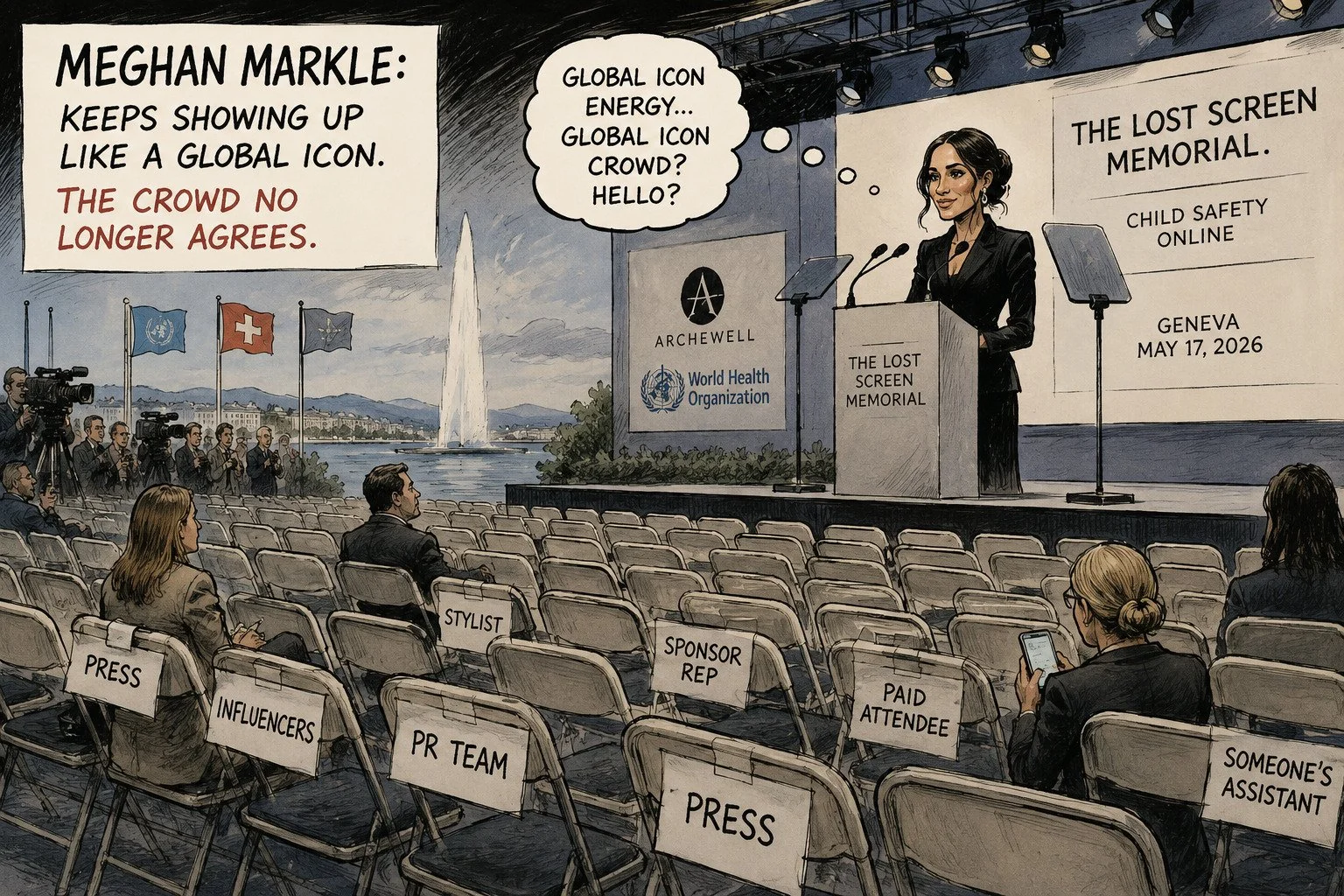
MEGHAN MARKLE KEEPS SHOWING UP LIKE A GLOBAL ICON.
THE CROWD NO LONGER AGREES.
She arrived in Geneva for a serious online safety memorial with perfect tailoring and a very composed expression. The internet, performing its highest civic duty, immediately counted the chairs.
Meghan Markle went to Geneva. She wore something black. She stood near signage. She attended a serious installation about online child safety — a genuine cause, a real issue, the kind of thing that deserves sober coverage and serious people lending their platform to it. None of that is in dispute. What is in dispute, or rather what became the entire conversation within approximately eleven minutes, was the size of the room and the enthusiasm of the people in it. Not enthusiasm for the cause. Enthusiasm for Meghan. Those, it turns out, are not the same thing anymore.
Children and teenagers are growing up inside digital environments that can do real and lasting damage. The U.S. Surgeon General has said so. Researchers have said so. Parents with rapidly depleting patience have said so while attempting to explain why a twelve-year-old should not be on TikTok at midnight. This is a serious issue. It deserved a serious appearance. What it got was a serious appearance that immediately became a case study in whether Meghan Markle's presence still moves rooms or merely occupies them.
Meghan currently exists in a very specific cultural location. Not obscurity — she would probably prefer that, and also hate it. Not universal love — that ship has sailed, reorganised its brand, relaunched as something artisanal, and quietly run out of inventory. She lives in the territory of: extremely well-known, extremely discussed, and increasingly regarded the way people regard a prestige drama that has gone on three seasons too long. You know all the characters. You understand the plot. You have simply lost the energy to be surprised by what happens next. Another speech. Another cause. Another carefully selected Swiss backdrop. Another headline. The audience, at some point, just nods.
:max_bytes(150000):strip_icc():focal(999x0:1001x2)/meghan-markle-051726-6-5c15b22c45fd48729f134afc472fec18.jpg)
THE GENEVA APPEARANCE WAS BUILT FOR GRAVITAS
Switzerland. A podium. Black tailoring. Seriousness with good bones.Geneva was not a random setting and nobody should pretend it was. Geneva is where public life goes when it wants to sound like it has moved beyond personal branding and into something weightier — international, institutional, properly serious, faintly allergic to the word "curated." You go to Geneva when you want the setting to do some of the moral heavy lifting. The World Health Assembly is nearby. The United Nations is practically next door. The air itself smells vaguely of global responsibility and chocolate. For Meghan, who has been trying to pivot back toward the humanitarian lane every time the jam shelf empties, Switzerland was a good call on paper.
On paper. The visual language was immaculate. Black tailoring that communicated seriousness without trying too hard, which is a fine line and she walked it. A podium. Solemn signage. The kind of backdrop that says "this is not a brand activation" while being, in the view of approximately half the internet, entirely a brand activation. The problem is not that Meghan attended a serious event. The problem is that Meghan's image now walks into every serious event approximately fifteen seconds before she does, rearranges the furniture, and redirects the conversation toward itself. The cause becomes the backdrop. Meghan becomes the story. This is not a press conspiracy. It is physics.
She has spent the post-royal years building a brand with more identities than a streaming password shared across four households: humanitarian platform, lifestyle founder, media producer, royal survivor, domestic goddess, global advocate, Montecito resident of intentional serenity. The brand is not insincere. It is overpopulated. When you try to be twelve things simultaneously, the audience stops trusting any of them — not because you are lying but because the number of things is exhausting to keep track of, and people have podcasts to get back to.
THE CROWD BECAME THE STORY BECAUSE THE CROWD IS THE SYMBOL
Celebrity needs witnesses. When the witnesses look uncertain, the frame cracks.Nobody normal counts chairs at an event. This is a truism. Normal people are watching the speeches, reading the signage, thinking about whether they had time to eat before this. The chair-counters are a specific subspecies of internet user who have decided that attendance figures are a moral data point, and they are not wrong that they are irritating, and they are also not wrong about what they found. The discussion was not about arithmetic. It was about what arithmetic reveals. Celebrity, in its purest form, is social proof with better lighting. When the lighting is excellent and the proof is thin, people notice the gap between the two.
Meghan has always been framed as a figure of global significance. Not just famous — significant. Important. The kind of person whose presence in a room should alter the atmosphere of the room. That is the pitch. That is the brand premise embedded in every Geneva backdrop and every carefully angled podium. When the room does not appear to be altered — when the atmosphere murmurs "Reserved Seating for Partners and Press" rather than screaming anything — the gap between the premise and the evidence becomes visible. And once something is visible to the internet, it becomes the only thing the internet can see for approximately three to five business days.
"The crowd looked sparse." Three words. Devastating. Very Geneva. There is something almost poetic about the most controlled image operation in modern celebrity producing a visual that the internet immediately used against it. Meghan's team presumably had the seating arrangement approved. Presumably reviewed the sightlines. Presumably considered the optics. And still: chairs. Visible ones. With space between them. In Switzerland. The efficiency of it is almost admirable.
A celebrity can survive criticism. It has a much harder time surviving the suspicion that the audience is only watching to see what goes wrong.
— Sara Alba · Brewtiful LivingTHE CAUSE WAS SERIOUS. THE MEGHAN DISCOURSE WAS LOUDER.
The uncomfortable part nobody wants to sit with.Here is the uncomfortable part, which we will address briefly and then everyone will immediately skip to the snark because that is how reading works. The Lost Screen Memorial is connected to real harms. Online child safety is not a decorative cause. The U.S. Surgeon General has issued formal advisories about social media and youth mental health. Researchers have documented serious risks. The families of children who have been genuinely damaged by digital environments are real people who deserve serious advocacy, not a celebrity press tour that gets hijacked by discourse about who showed up.
The cause deserves better. That is precisely why Meghan's image problem matters here rather than being merely gossipy. When the public figure carrying the message has become so narratively enormous that she arrives before the message does, the message gets buried under her. The memorial becomes set dressing. The discourse becomes: Meghan. Again. Always Meghan. She is the chandelier in every studio apartment she enters, including the important ones.
Is she sincere? Probably some of it. Sincerity is not the problem. The problem is that sincerity, when it has been run through six documentaries, a memoir, a Spotify deal that produced one podcast, a Netflix lifestyle series that ranked 1,217th, an artisanal jam line, and five Instagram outfit changes in a single reel, starts to sound like a very well-produced version of sincerity. Which is different from sincerity. The audience can hear the difference. They have been trained, by Meghan specifically, to hear the difference.
Online Harm Is Real. Which Makes The Optics More Awkward.
The U.S. Surgeon General's 2023 advisory on social media and youth mental health warned that young people can be exposed to harmful content online, including content related to self-harm, eating disorders, hate-based content, bullying, and predatory behaviour. Pew Research has found that many teens report being online almost constantly. This is a serious public health conversation that deserves better than becoming another episode of "What Is Meghan Doing Now?"
THE INTERNET HAS DEVELOPED SEVERE PR ALLERGIES
Everyone is now a suspicious communications director with unresolved issues and a notes app.The modern audience has become an extremely small, extremely suspicious communications director who works for free and has absolutely nothing to lose by saying it. They inspect the timing. They inspect the outfit. They inspect the organisation, its funding sources, its past associations, whether its CEO tweeted something questionable in 2016, and what shade the floral arrangements are, because the floral arrangements are also content now. They inspect the ratio of altruism to brand repair with the precision of someone who has been lied to before and has a notes app. They assume strategy. They expect manipulation. They often find both.
This is not a healthy cultural development. It is also not an unreasonable one given the evidence. The public has watched too many celebrities discover compassion twelve to eighteen months after a bad press cycle. Too many solemn speeches have coincided with product launches. Too many "I need to be honest with you" moments have preceded interview promotions. Too many vulnerable moments have arrived in the same week as something for sale. People are tired. Cynicism keeps showing up with receipts and the receipts keep being correct.
Meghan entered this exact era as the most heavily narrated public figure in modern celebrity history. Every chapter has been explained, contextualised, documented, counter-documented, re-released in a different format, and then used as evidence by someone. To fans, she is a survivor of institutional racism and media cruelty. To critics, she is a person who has turned institutional racism and media cruelty into a content strategy. Both groups are watching every single thing she does. Neither group is going to be satisfied by one appearance in Geneva, however Swiss the backdrop is.
THE CAUSE WAS REAL. THE MEMORIAL WAS SERIOUS. THE CHAIRS WERE COUNTED. ALL THREE THINGS ARE TRUE AND ONLY ONE OF THEM IS MEGHAN'S FAULT, WHICH IS THE ONE THING NOBODY WANTS TO HEAR.
THE WIMBLEDON INCIDENT STILL HAUNTS THE ROOM LIKE A BAD SEATING CHART
The fossil that never fully decomposes.In 2019, Meghan appeared at Wimbledon — a place where famous people go specifically to be publicly watched, in a sport where being watched is the entire point — and somehow made it weird. Reports circulated that spectators nearby were asked not to take photographs. At Wimbledon. Where photographs are taken. Of the famous people. Who came to Wimbledon to be famous people at Wimbledon. The optics, to put it gently, did not land. You wanted public visibility without public access, at a public event, among the public, who had paid to be there. Devastating. Extremely specific type of own goal.
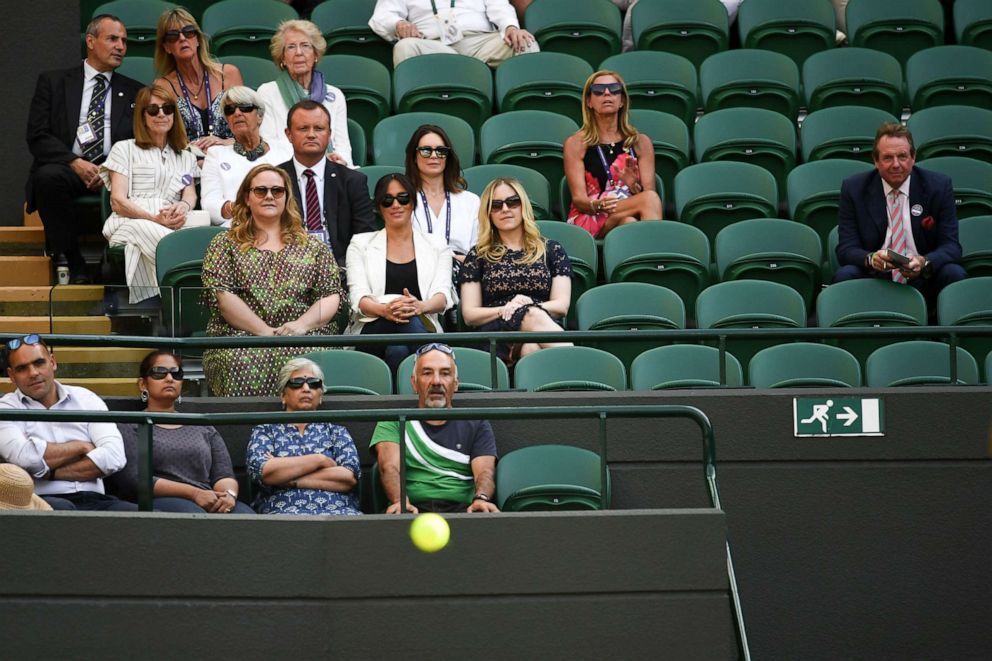
Wimbledon became one of those images that sticks because it feels like it reveals something true. Meghan wanted public reverence served to her quietly, at a safe distance, without the inconvenience of an actual public. Geneva, at least in the framing of everyone who had already bookmarked the Wimbledon story, became the punchline. The joke writes itself so smoothly it is almost rude: at Wimbledon she wanted the crowd to back up. In Geneva the crowd apparently had somewhere else to be. Whether or not this is fair — and much of it is not — it is the story that the internet found and it fits a narrative that Meghan has, through years of extremely visible choices, helped build herself.
MEGHAN'S REAL PROBLEM IS NOT HATRED. IT IS FATIGUE.
Hatred has energy. Fatigue just scrolls past while making a face.Hatred, at least, is energetic. Hatred writes things. Hatred clicks things. Hatred sends emails. Hatred keeps entire media ecosystems financially viable. Fatigue is more dangerous because fatigue just exhales, scrolls, and goes to make a snack. Fatigue does not need evidence or arguments. It says "this again?" and moves on, and the brand gets left standing at the podium with excellent lighting and nowhere to direct the energy it has spent years cultivating.
Every single Meghan appearance now arrives carrying the accumulated weight of the previous ones. The royal wedding. The Thomas Markle situation, which we have discussed at length elsewhere and will not fully re-litigate here but the receipts remain accessible. The Oprah interview. The Netflix documentary. The Spotify deal that produced one podcast. Harry's memoir containing details about a frostbitten body part that nobody asked for. The As Ever jam launch. The cumulative accounting of the Sussex era reads like a very long guest list for a party that kept promising to start and never quite did. By the time Geneva arrived, the audience had been briefed on Meghan's personal mythology so thoroughly that a speech about online child safety had to fight through six years of narrative baggage just to be heard.
This is not one bad event. It is cumulative. It is the thing that happens when a brand tries to do too much narrating and not enough being. The public eventually stops listening to the story and starts watching whether the story matches the life. When it does not — and with Meghan, it often does not — the fatigue compounds. Sympathy has a bandwidth limit. Even the most generous observers have a finite capacity for "and then came the rebrand."
The most damaging thing for a celebrity is not being disliked. It is becoming so narratively loud that even serious work starts sounding like brand maintenance.
— Sara Alba · Brewtiful LivingTHE LILIBET TIMING DID NOT HELP
Modern parenting is contradiction in athleisure. Meghan does not get the benefit of ordinary contradiction.The timing issue, which arrived before Geneva and followed her to Geneva like a very organised shadow, involved content featuring Lilibet Diana posted to Instagram shortly before an event dedicated to protecting children from the harms of social media exposure. Now, to be fair — and we are going to be briefly fair before we stop being fair — posting a photograph of your child online does not make you a hypocrite about online child safety. Most parents do both. Most parents Google "is TikTok ruining my child" while simultaneously uploading forty-three photos of said child to an app. Modern parenting is contradiction in athleisure. This is established.
Meghan, however, has forfeited the benefit of ordinary contradiction. She used it up. The account is empty. When you have spent six years building a brand around authenticity, privacy, compassion, and emotional intelligence, while simultaneously running one of the most controlled and commercially driven celebrity image operations in the world, your contradictions do not get filed under "normal human inconsistency." They get filed under evidence. If she talks about privacy, someone produces the Netflix deal. If she talks about children and online harm, someone produces the Instagram post. If she talks about healing, someone produces the podcast. The public has become a very motivated paralegal, and the financial filing cabinet is enormous.
This is the price of narrative-first branding. When your personal story is the product, every new story you tell gets cross-referenced against the existing inventory. The audience is not being cruel. It is being a very attentive reader of a very long book that keeps promising a satisfying ending.
ROYALTY NEEDS MYSTERY. INFLUENCE NEEDS INTIMACY. MEGHAN KEEPS TRYING TO USE BOTH.
The brand has more identities than a streaming password shared across divorced households.Here is the fundamental structural problem with the Sussex brand, which has now been running for six years and still cannot decide what it is. Royalty requires distance. You do not explain yourself. You do not have a podcast. You wave, you open things, you smile at a corgi, and the mystique does the rest. Influence culture requires the opposite: constant access, confessional intimacy, the suggestion that you are letting the audience behind the curtain while actually maintaining a very sturdy curtain with a small camera installed in it. These two systems are not compatible. You cannot simultaneously be a mysterious former royal who deserves institutional respect and a relatable lifestyle founder who posts dancing videos credited to your four-year-old.
Meghan wants all of it. The moral weight of the royal title without the duty that came with it. The founder narrative without the commercial accountability. The privacy rhetoric without the privacy. The humanitarian credibility without the long, boring, uncovered years of unglamorous work that typically precede humanitarian credibility. The intimacy of a creator without the vulnerability that makes creators trustworthy. She has built a brand that is trying to do the work of eight brands at once, which is why the mosaic looks increasingly like a jigsaw puzzle assembled by someone who lost the box.
The result: a speech about online safety in Geneva cannot just be a speech about online safety in Geneva. It has to carry the weight of the Sussex brand, the humanitarian pivot, the post-jam credibility-building, the Harry situation, the Lilibet timing, the Wimbledon memory, and six years of accumulated public opinion. The woman cannot stand near a poster without becoming a thesis. That is exhausting for everyone, including, presumably, Meghan.
THE CROWD NO LONGER AGREES
The final accounting.Meghan Markle keeps arriving like a global icon. She has the wardrobe — impeccable, always. She has the title — technically. She has the platform — very much still running. She has the international settings, the serious causes, the press machine, the team, the communications strategy, and the very expensive backdrop. What she increasingly does not have is the crowd going along with it. The public, literal and symbolic, has started treating the global icon framing like a dress code it did not agree to. It watches. It counts chairs. It screenshots things. It compares the statement to the Instagram post. It asks, with the energy of someone who has been following this story for six years and is starting to feel like they deserve some kind of loyalty points, why every appearance feels like the pilot episode of a show that keeps getting renewed but never quite delivers the promised season finale.
The lesson is not that Meghan should disappear, which would frankly be a loss for the content economy and for this website specifically. The lesson is that the old playbook — prestige setting, polished tailoring, serious cause, controlled visuals, press release, cycle — is worn through. You can see the stitching. The audience has memorised the sequence. What would actually work is the one thing the communications plan seems constitutionally unable to produce: a genuine moment that nobody choreographed. Something unplanned. A recipe that fails on camera. A real conversation. A messy admission. Something that does not look like it was approved by three people before it reached the public. Something that costs something.
Meghan Markle does not have a fame problem. She has a stillness problem. Everything around her is announced, pre-framed, optimised, defended, and repackaged so thoroughly that even sincere things start to sound like they arrived with a caption strategy. The crowd in Geneva was not the problem. The crowd is the symptom. The disease is six years of treating every public moment like a brand deliverable and then being surprised when the public starts treating it the same way. Lightly. Sceptically. From a slight distance. With their phones out. And very good notes.
MEGHAN MARKLE DOES NOT HAVE A FAME PROBLEM. SHE HAS A STILLNESS PROBLEM. THESE ARE VERY DIFFERENT THINGS AND FIXING ONE WITH MORE OF THE OTHER IS HOW YOU END UP IN GENEVA COUNTING CHAIRS.
THE CROWD HAS THOUGHTS.
LET'S HEAR THEM.
1,237 of you read this today. Some of you agree. Some of you have a very different read on the empty chairs situation. Some of you watched the Geneva clip and arrived at a completely different conclusion. We want to hear it.
Is this celebrity fatigue, genuine criticism, or just the internet finding a new bone? Where do you actually land?
Do you think Meghan's presence still carries weight — or has the brand officially outrun the goodwill?
The Wimbledon comparison: fair, unfair, or the one that stings most because it fits a pattern?
What would Meghan actually have to do differently for the public read to shift? Or is it too late?