Dopamine Decor Is the Design Trend That's Actually About Joy
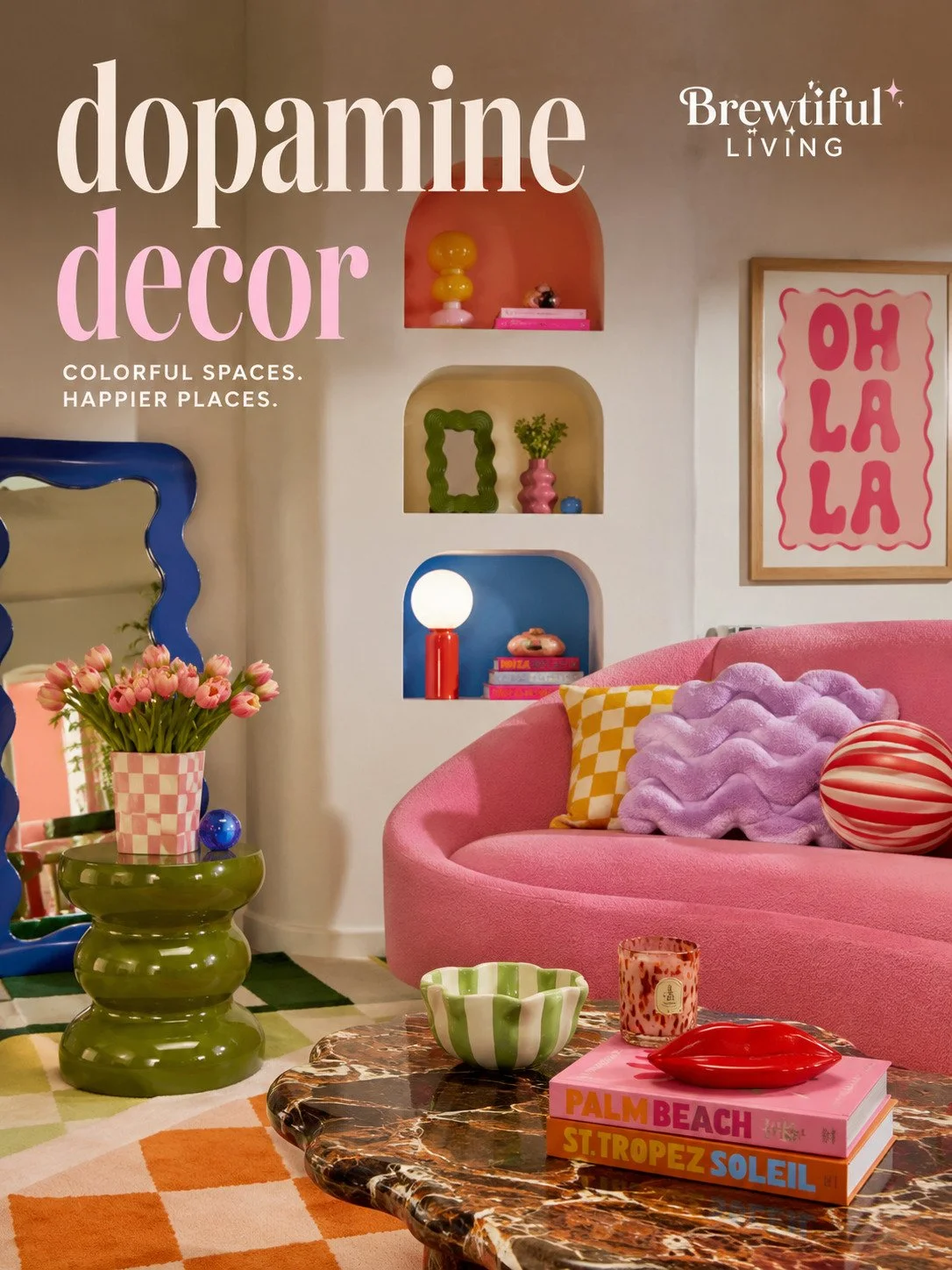
Dopamine Decor
Is the Design Trend
That's Actually About Joy
Not buying more stuff. Not staging your home for Instagram. Actually feeling something when you walk into a room. Radical concept, apparently.
The trend has a name now. Dopamine decor — the design philosophy that your home should make you feel something, specifically joy, specifically on purpose. It is the deliberate, slightly triumphant rejection of the all-white, nothing-on-the-walls, "light and airy" minimalism that has controlled every mood board since approximately 2014 and made a significant portion of the population feel like they were living in a staged property that was always about to be sold.
The aesthetic is exactly what it sounds like. Warm colours. Bold choices. Displayed collections. Objects that mean something. Lamps that have a personality. Rooms that look like a real human being made a decision about them — and that decision was yes.
We already took the temperature on where home design is heading this year, and the results were not ambiguous — cozy, lived-in, and full of story won by a landslide. Dopamine decor is not just a trend that fits that direction. It is that direction, taken to its logical, colourful, slightly emotionally demanding conclusion.
What Dopamine Decor Actually Is
The name borrows from colour psychology and neuroscience, both of which have known for years that warm, saturated, visually rich environments produce a mild but real mood response. Your brain notices colour. It responds to it. Not dramatically — we're not talking about a full serotonin reset because you bought a terracotta pot — but meaningfully enough that walking into a room that makes you feel something is genuinely different from walking into one that doesn't.
Dopamine decor is not maximalism for its own sake. It is not "I threw everything at a wall and called it eclectic." It is intentional vibrancy. It is choosing colour, warmth, and personal objects not because a staging guide tells you to, but because they reflect something true about who you actually are. Which, it turns out, is what most people have wanted from their homes the entire time.
If you've been living with wabi-sabi's quiet permission to stop optimising, dopamine decor is its louder, more opinionated sibling. Same underlying energy — your home should feel like yours — entirely different volume setting.
Why Is Everyone Suddenly Doing This
Because the world is a lot, and minimalism was always a well-intentioned lie. The theory was that blank space would create mental clarity. What actually happened is that everyone's homes looked like they were being prepared for an open house and nobody felt better.
The mob wife aesthetic understood this before dopamine decor had a name — that maximalism isn't chaos, it's confidence. That displaying what you own isn't clutter, it's personality. Dopamine decor picks up that same thread and pulls it into the home. It is the interior design equivalent of finally dressing like yourself.
It also arrives at a moment when people are genuinely thinking about what their homes are for. Post-pandemic, people spent more time at home than any generation since before the industrial revolution. They noticed whether their spaces made them feel anything. A lot of people noticed the answer was no. Dopamine decor is the active response to that realisation.
Dopamine Decor vs. Everything Else
Because people keep asking, and the distinctions are actually useful:
| Aesthetic | What It Prioritises | How Dopamine Decor Differs |
|---|---|---|
| Minimalism | Less of everything. Negative space as design. | More of the right things. Positive space as intention. |
| Maximalism | Volume. More is more, always. | Not about amount. About how each thing makes you feel. |
| Wabi-Sabi | Imperfection, impermanence, restraint. | Similar values, louder execution. Both accept mess. One celebrates colour. |
| Mob Wife | Maximalism with status and texture. | Shares the anti-minimalism DNA. Dopamine decor is warmer, less about power. |
| Hygge | Cosiness, togetherness, candlelight. | Hygge is the mood. Dopamine decor is the method. They work well together. |
How to Actually Do It Without Losing Your Deposit
Start with one room. Not the living room where every guest will have an opinion — start somewhere you spend time alone. The bathroom. Your home office. The bedroom. One dopamine upgrade, two weeks to live with it, then decide whether to go further.
Your bathroom is already a candidate. The full spa-bathroom transformation guide covers exactly this — peel-and-stick wallpaper, brushed gold accents, a warm lamp replacing the overhead punishment. Add one saturated colour element and you've crossed into dopamine decor territory without a single permanent decision.
Paint is your fastest lever everywhere else. One interior door in a deep, deliberate colour costs almost nothing and changes the entire feeling of a hallway. One bookshelf styled by colour rather than subject. One gallery wall that includes something genuinely weird that you actually like.
The self-care overlap is worth naming. Dopamine decor is the physical manifestation of the same impulse behind the soft life movement. Your Sunday reset works better when the space you're resetting in doesn't feel like a waiting room.
The Bottom Line
Dopamine decor will outlast the name. The name is already a little embarrassing — it sounds like something a wellness brand invented to sell you a $48 candle, which several wellness brands have absolutely done. The principle underneath it is just: make your home feel like something. That is a permanently good idea.
The all-white, staged-for-a-photoshoot era had a decade-long run and produced an enormous amount of content that all looked identical. It also produced an enormous amount of people who didn't feel anything when they came home. Dopamine decor is the correction.
Pick a colour. Mean it. See how you feel in two weeks. And if you need a quiz to figure out which version of this is yours, we have one of those too.