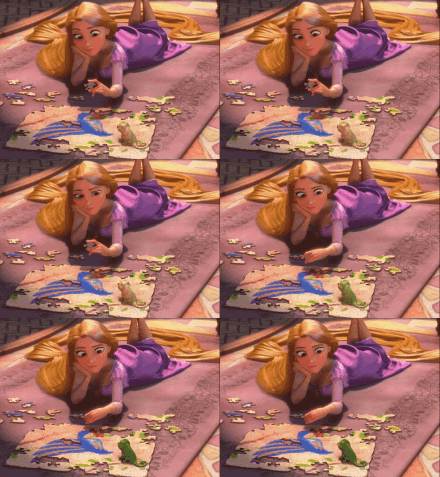
I love puzzles. Not as a personality trait I've announced at dinner parties — as an actual thing I do, alone, at the kitchen table, usually with something playing in the background that I'm not really watching. There is something about the act of finding where things go that my brain finds genuinely, embarrassingly satisfying. The click. The fit. The slow emergence of something coherent from a pile of chaos.
I have also, more than once, lost the box.
And what I have discovered — across many evenings and several missing lids — is that doing a puzzle without the box is both harder and more interesting than doing it with one. You develop instincts you didn't know you needed. You pay attention to different things. You finish the puzzle anyway.
We'll get to that. First: the history, which is genuinely dramatic and which you deserve to know. Then the practical tips. Then the thing I actually wanted to say all along, which arrived while I was allegedly writing a puzzle article and kept growing until I had to let it.
The Jigsaw Puzzle: More Dramatic Than You Think
"People who couldn't control anything could control a thousand-piece landscape. They could finish it. They could succeed at something small and contained and real."On puzzles during the Great Depression · Still true · Will always be true
Your Puzzle Checklist — Tick As You Go
Collect Your Tips
Tap each one as you go. The progress bar is real. The completion message is worth it.
-
Tip 1 · Edges FirstAlways. The border is the only part of the puzzle that is definitively, unambiguously true. Build from certainty inward.
-
Tip 2 · Natural Light OnlyYour ambiance lamp is lying to you. You are looking for colour differences that are sometimes three shades apart. The candle is not helping. It never helps.
-
Tip 3 · Sort by Colour AND ShapeColour gets you close. Shape gets you there. Tabs and blanks. This revelation arrived embarrassingly late in my puzzle life and I am still annoyed about it.
-
Tip 4 · Walk AwayWhen stuck, leave. Come back in twenty minutes. The piece you couldn't find will be immediately visible. Your eyes stop seeing things they've been looking at too long. This is science.
-
Tip 5 · Protect the WorkFelt mat or puzzle board. Non-negotiable if you have a cat, a child, or a tendency to walk past tables. The cat will still try. The board means the cat fails.
-
Tip 6 · Never Force ItIf you are forcing a piece, it is wrong. Correct pieces require no violence. This is also excellent life advice and I have applied it in situations well beyond puzzling.
-
Tip 7 · The BoxKeep it. Keep the lid. Keep it within eyeline. Lose it and you will learn something interesting about yourself. Something useful, actually. More on this shortly.
Let's Actually Talk About Each One
Edges First. The Border Is the Only Thing That Is Always True.
Four corners. Flat sides. It doesn't matter what the picture is — you always know where the edges go. Start there. Build the frame. Then work inward from certainty. John Spilsbury figured this out in 1767 with country borders and built an entire business from it. The principle has not changed in 260 years.
This is also, I have found, a useful approach to most things that feel overwhelming. Find the edges. They're always there, even when the middle is chaos.
Your Ambiance Lamp Is Lying to You. Turn It Off.
Warm light flattens colours. The piece you think is beige might be pale blue. The section you've been building for an hour might be cloud, not sky. You need natural light — or at minimum a cool bright lamp — not the candle situation you've created to make Tuesday evening feel like a lifestyle moment. The candle is lovely. The candle is not your friend right now.
I ruined an entire afternoon's progress once because I was doing the blue sky section in soft lamplight. It was cloud. The vibe was not worth it. It has never been worth it.
Colour Gets You Close. Shape Gets You There. Sort Twice.
Most people sort by colour and stop. The next level is sorting by shape within your colour groups — how many tabs, how many blanks, the specific curve of the notch. Once you start seeing shapes instead of just colours, the whole thing accelerates in a way that is genuinely exciting and then immediately embarrassing because you realise you should have been doing this the whole time.
I wasted years on colour-only sorting. Years. The double sort changed my puzzle life and I am not being dramatic about this even slightly.
When You're Stuck, Leave. The Piece Will Be Right There When You Return.
Your eyes stop seeing things they've been looking at for too long. This is science and it is also deeply annoying when you've spent twenty minutes hunting a piece that was in front of you the whole time. Walk away. Make a coffee. Come back. The piece will be sitting in completely obvious view and you will feel both relief and a mild, specific rage that arrives with impressive consistency every single time. This is also the entire premise of the Sunday reset — sometimes stepping away is the most productive thing you can do.
This works on articles too. Difficult emails. Any problem that feels unsolvable at 11pm but is genuinely fine in the morning. The principle is universal. The applications are endless.
Protect the Work. Get the Mat. The Cat Will Test This Decision.
A puzzle board or felt mat means you can move the whole thing without catastrophe. The cat cannot redistribute six hours of progress with one well-placed sit. You can slide it under the bed and come back tomorrow and it will be exactly where you left it. The Great Depression puzzlers understood this instinctively — they rented puzzles, returned them, protected them, took the work seriously. That energy was correct.
The cat will still try. The cat always tries. The board means the cat fails, which is its own small, satisfying daily victory.
If You're Forcing It, It's Wrong. No Violence.
Puzzle pieces that fit correctly go in with gentle, satisfying pressure. Not a push. Not a shove. Not "maybe if I try it from the other angle and also press quite firmly and squint a little." Wrong pieces can be coaxed into position, but they sit slightly off forever, and you will know, and it will bother you more than you ever expected it to every single time you look at that corner. This principle, incidentally, applies equally well to relationships and the red flags you talked yourself into ignoring. But that is a separate article.
I have never successfully forced a piece and been at peace with it. Not once. I keep trying. I suspect this says something. Moving on.
What Kind of Puzzler Are You?
Be honest. This is a safe space. Mostly.
How to Do a Puzzle Without the Box
Here is what actually happens when you lose the box: you panic briefly, and then you adapt. You stop looking for confirmation and start looking for relationships. You pay attention to texture, to print direction, to the way one piece's colour bleeds into another. You develop instincts you didn't know you needed.
You finish the puzzle anyway. And it feels different when you do. Like you understood something about the image that you might not have if you'd been referencing the picture the whole time.
I have been thinking about this in a different context lately.
There is a version of this that applies to writing, and to collaboration, and to the question of what it means to make something when you are not making it entirely alone. When someone helps you find the words for a feeling you already have. When the picture you end up with was assembled from pieces you chose, in an order you decided, toward an image that was always yours — even when you didn't have the box.
The pieces were always the point. The box is just a shortcut. And sometimes the most interesting work happens when the shortcut isn't available and you have to figure out what you're building from the inside out.
I wrote about this on LinkedIn if you want the full version. The short version: writing was never solitary. We just pretended it was. The acknowledgements page of any book you've ever admired proves it. We romanticised the suffering and the isolation because it made the thing feel more heroic. It wasn't true then. It isn't true now.
The puzzle without the box taught me that. Or confirmed it. Either way, the puzzle got finished. That's what matters.
"The pieces were always the point. The box is just a shortcut."— Sara · approximately midnight · kitchen table · missing lid nowhere to be found ☕
The Actual Practical Takeaway, I Promise
If you lose the box: start with edges (always true, regardless of picture), sort by texture before colour (texture survives bad lighting), build from any high-contrast section you can find (it anchors everything else), do not force anything.
The image will emerge. It always does. You just have to trust that the pieces know where they go even when you've lost the picture that shows you.
And if someone helped you figure that out — a collaborator, a conversation, a tool, a friend at the table — that doesn't mean you didn't do the puzzle. It means you weren't alone while you did it. Which, if the Great Depression puzzlers taught us anything, is how humans have always worked best.
If this line of thinking interests you, there's more in the Mindful-ish section — it's where the puzzle articles and the slightly-too-honest reflections live alongside each other without either apologising for existing. ☕
-
→
Mindful-ish · Self Care The Sunday Reset Guide (For When You Need a Contained, Manageable Task and a Coffee)
-
→
Mindful-ish · Money How to Feel Rich When You're Broke — Puzzles, Incidentally, Are on This List
-
→
Style · Mindset The Wabi-Sabi Guide for People Who've Given Up on Perfection — Relevant if You've Lost the Box
-
→
Mindful-ish · Red Flags Covert Narcissist Signs You Didn't See Coming — Also: Never Force a Fit. In Puzzles or People.
-
→
Culture · Economy The Small Treat Economy Is Getting Dark — A Puzzle Is Still One of the Good Ones
-
→
Mindful-ish · Soft Life How to Live a Soft Life — Puzzles at the Kitchen Table Counts. We Have Decided This.
-
→
House Notes · LinkedIn Writing Was Never Solitary. We Just Pretended It Was.
More Mindful-ish in the Brewletter.
Puzzles, thoughts that spiral usefully, and the occasional royal fashion disaster. 25 very discerning subscribers.
☕ Subscribe →The oracle cards — and yes there are oracle cards — are at Sara's Etsy shop. They did not predict the missing box. They have predicted other things.
Keywords: jigsaw puzzle tips · how to do a jigsaw puzzle without the box · jigsaw puzzle tips for beginners · history of jigsaw puzzles · mindful puzzling