The Solar Plexus and Vagus Nerve Connection: Why Your Stomach Keeps Punching Back
Vagus Nerve Dysregulation:
What It Is, How To Know
If You Have It, And
What Actually Helps.
(Also: You Don't Have To Hum.)
Your acid reflux, your anxiety, your tight solar plexus, your inability to do a proper belly laugh — it might all be the same nerve. Here's what the vagus nerve actually is, what happens when it's wrecked, and what two years of working on mine did to my body and my collected, absorbed, very enthusiastically hoarded trauma.
For the first thirty-odd years of my life, I thought my body was just badly built. Acid reflux so persistent I could tell you the pH of any meal within an hour. A solar plexus — that region right above the belly button, the pit of the stomach, the place people punch you in action movies to drop you — that felt like someone had installed a fist there and forgotten to remove it. Shallow breathing that meant I thought I was "breathing normally" when I was actually just constantly, quietly, barely. And a complete inability to do a real belly laugh — the kind that comes from somewhere south of the sternum and shakes the whole room — without it feeling like pulling at something that had been knotted up for years.
I was also, to put it lightly, a walking anxiety event. I had absorbed approximately one lifetime's worth of other people's nervous systems, collected a generous amount of my own trauma, and stored all of it helpfully in the region between my ribcage and my navel. My body had become a very expensive storage unit for feelings I had not processed. Nobody had sent me an invoice but the acid reflux was basically the bill arriving.
The vagus nerve is not a wellness trend. It is not something TikTok invented. It is the longest nerve in your autonomic nervous system, it has been doing its job since before you were born, and there is a very reasonable chance that if your nervous system feels off — chronically, persistently, in a way that no amount of chamomile tea has resolved — this nerve is involved. Let me explain what it actually is before I tell you what happened when I started taking it seriously.
Two years ago I started massaging my solar plexus. I want to be very clear that this sounds unhinged and I know it sounds unhinged and I did it anyway because I had run out of dignified options. Every other solution had been tried. The antacids. The elevating the head of the bed. The dietary changes. The "have you tried just stressing less" advice that I received from multiple people who did not survive the interaction. Nothing shifted the concrete feeling in my upper gut. So I started going deep, slow, circular, daily. The kind of massage that initially feels like you're pressing a bruise. Because you kind of are.
Two years later I can breathe into my belly. I can do a full, genuine, floor-shaking belly laugh. The acid reflux is dramatically better. The anxiety — which I now understand was not just "in my head" but very much also in my gut, talking directly to my brain via one long nerve — is lighter. Not gone. Lighter. The trauma I was storing like a hoarder stores magazines feels less like a weight and more like a thing that happened that I am still processing. The fist above my belly button has unclenched. Mostly. And I think the vagus nerve is a significant part of why.
What Is The Vagus Nerve, Actually
The vagus nerve — from the Latin vagus, meaning wandering, which is either poetic or just descriptive depending on your mood — is the longest nerve in your autonomic nervous system. It originates in your brainstem, at the base of your skull, and then wanders downward through your neck, past your vocal cords, through your chest, around your heart, through your lungs, past your diaphragm, and all the way into your gut, where it innervates your stomach, your small intestine, your large intestine, your liver, your kidneys, and your spleen.
It is, essentially, the motorway between your brain and every organ that keeps you alive and feeling things. And here is the part that changes the picture for most people: approximately 80% of the vagus nerve's fibres run upward — from body to brain, not brain to body. Your gut is not passively receiving instructions. It is constantly, actively, reporting back. The "gut feeling" is a neurological reality. Your stomach has opinions and a direct line to your brain to express them.
The vagus nerve contains approximately 100,000 neurons. It is the primary component of the parasympathetic nervous system — the "rest and digest" side of your autonomic nervous system, the counterweight to the sympathetic "fight or flight" response. When your vagus nerve is functioning well, you recover from stress. You digest food properly. Your heart rate variability is healthy. You feel calm without effort.
When it is not functioning well — low "vagal tone," in the research language — you get stuck. Stuck in anxiety. Stuck in freeze. Stuck in a body that cannot seem to shift out of threat-detection mode even when the threat is over. Research published in Frontiers in Psychiatry links low vagal tone to depression, anxiety, inflammation, gut disorders including IBS and GERD, and impaired recovery from trauma. High vagal tone correlates with better emotional regulation, resilience, and — interestingly — social connection.
Note on polyvagal theory: In early 2026, 39 researchers published a paper calling aspects of the theory "untenable" — specifically challenging its neurophysiological and evolutionary claims. This is a legitimate scientific debate about the mechanism of the theory. It does not change the clinical reality that the vagus nerve regulates your stress response, your digestion, and your mood. The debate is about the exact architecture of how. Not about whether.
The Solar Plexus Connection —
Or: Why Your Stomach Keeps Punching Back
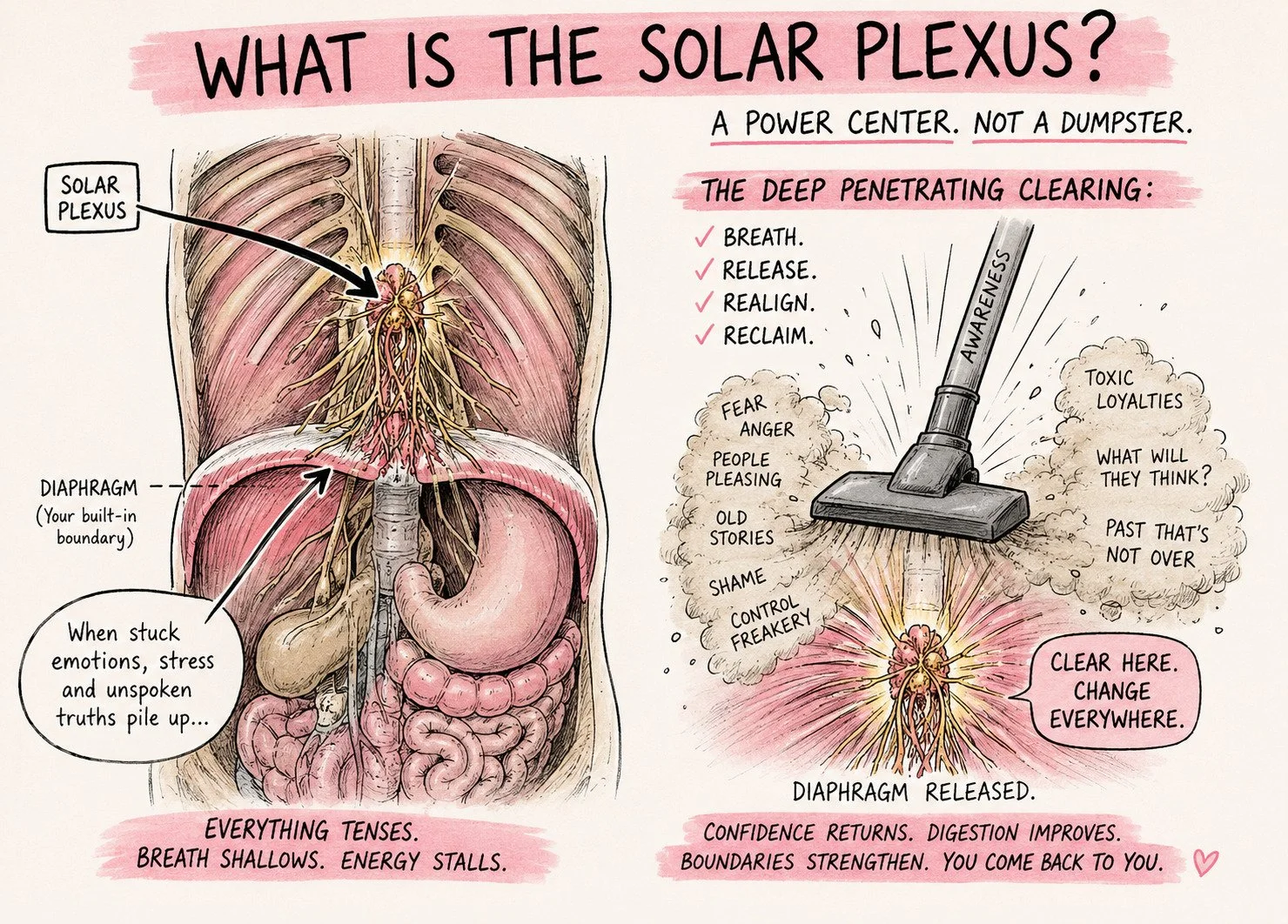
The solar plexus is not a chakra concept invented by wellness influencers, though wellness influencers have certainly adopted it with enthusiasm. It is a real anatomical structure — the celiac plexus — a dense network of nerves and ganglia sitting in the pit of your stomach, roughly behind your navel and in front of your aorta. It is part of your sympathetic nervous system, and it plays a direct role in regulating your stomach, kidneys, liver, and adrenal glands.
The vagus nerve approaches the abdominal organs from the front of the body, creating what researchers describe as a "complementary innervation pattern" with the solar plexus. These two systems are talking to each other constantly. When your nervous system perceives threat — real or remembered, present or past, acute or chronic — the solar plexus region tightens. The diaphragm shallows. Breathing gets restricted. And because the vagus nerve runs right through this area, a chronically tight solar plexus is essentially squeezing the wire that's supposed to be sending your "you're safe now, relax" signals back to your brain.
The "knot in the stomach" is not a metaphor. It is a neurological event. When I was at peak anxiety and peak "storing everything I've ever experienced in my upper abdomen," I had what I can only describe as a permanent fist sitting above my belly button. Not painful in the acute sense. Just there. Dense. Immovable. Like I was braced for impact at all times, including during activities that genuinely did not require bracing, like making coffee or watching television or existing in a Tuesday.
The acid reflux, I now understand, was directly connected. When the vagus nerve isn't functioning properly, it doesn't correctly signal the stomach to regulate acid production. When the solar plexus is chronically tight and the diaphragm is restricted, the lower esophageal sphincter — which the vagus nerve also controls — doesn't close properly. The acid goes where it shouldn't. I spent years treating the acid reflux as a digestive problem and a completely separate anxiety problem when they were the same problem wearing two different hats. I also wrote about the other things that were not helping the situation.
Signs of Vagus Nerve Dysregulation —
How To Know If Yours Is Struggling
Low vagal tone does not announce itself with a formal diagnosis. It shows up as a collection of symptoms that don't obviously belong together — until you understand what the vagus nerve is doing. Here is the list. Read it and see how many you're quietly nodding at.
"Your gut is not passively receiving instructions. It is constantly, actively, reporting back. Your stomach has opinions and a direct line to your brain to express them."
— Brewtiful Living · Mindful-ish☕ The Self-Assessment —
How Is Your Vagus Nerve Actually Doing?
Rate yourself honestly. This is not a clinical tool — it is a starting point for understanding what your nervous system might be dealing with. Answer based on how you've felt over the past few weeks, not on a good day.
Trauma, The Body,
And Why Your Gut Remembers
Here is the part that the wellness industry oversimplifies and the medical establishment sometimes undersells: trauma is not just psychological. It is physiological. It lives in the body. Specifically, it tends to live in the nervous system — in the patterns of activation and shutdown that a nervous system learns when it has been in sustained threat, absorbed someone else's chaos, or simply never had the conditions to fully settle.
The vagus nerve is central to this. Research published in Frontiers in Psychiatry describes how chronic stress and unresolved trauma reduce vagal tone, impairing the nerve's ability to regulate the stress response. The body gets stuck in low-grade fight-or-flight. Digestion suffers — because your body, quite sensibly, deprioritises digestion when it thinks you're being chased by something. The diaphragm stays restricted. The solar plexus stays braced. The acid comes up. The belly laugh stays inaccessible. The anxiety never fully shifts because the off-switch is stuck in the half-pressed position.
I want to be specific about what "stored trauma in the solar plexus" felt like for me because I think the language around this gets very vague very quickly and I have limited patience for vague. It was not emotional. It was physical. It was a density. A tightness that I had so thoroughly normalised that I thought it was just what my body was like. I thought I was a tense person by nature. I thought the acid reflux was a hereditary digestive quirk. I thought the inability to breathe deeply was just my lungs being slightly inadequate.
It took someone asking me to press my fingers into my solar plexus and breathe into it for me to realise: I could not breathe into it. I could not make it move. It was like pressing against a wall. And when I held the pressure and kept breathing — the first time this happened — I cried for about fifteen minutes without knowing why. That is not a metaphor. That is the vagus nerve doing its job when you finally give it enough space and safety to do it.
Vagus Nerve Massage,
Nervous System Regulation,
And What the Research Actually Says
Let's talk about what the evidence actually says improves vagal tone, because the wellness internet has taken a genuinely interesting neurological concept and surrounded it with cold plunges, expensive gadgets, and the word "activate" deployed with the confidence of someone who has not read the methodology section of a single study. Here is what the research supports, and here is what I have actually done for two years.
My actual practice, for what it's worth: ten minutes every morning before coffee. Lying down. Two hands on my solar plexus. Slow circular pressure, alternating clockwise and anticlockwise. Breathing into my belly against the pressure, which initially felt impossible and now feels like coming home. I make involuntary noises sometimes. I have cried into my own hands more times than I can count. I have also, incrementally and unmistakably over two years, become someone who can breathe into the bottom of my lungs. Who can do a real belly laugh. Whose acid reflux has downgraded from a daily personality trait to an occasional inconvenience. Whose anxiety — the anxiety that was living in my solar plexus, talking directly to my brain, keeping the alarm running 24/7 — has become something I can work with rather than something I simply am.
It is not fast. It is not dramatic. It does not make a good video. But two years later I can tell the difference between a body that was braced and a body that is settling. And the settling is, in the most understated possible way, everything.
The Part Where I Have To Say
This Is Not Medical Advice
I am a writer with a long-term relationship with my own solar plexus and a genuine interest in the research. I am not a somatic therapist, a gastroenterologist, a neurologist, or any other kind of person with a medical degree. If you have chronic acid reflux, please see a doctor — there are conditions including Barrett's esophagus that need proper medical attention and do not respond to abdominal massage alone. If you have serious trauma, please consider working with a professional who is trained in somatic or body-based approaches. If your anxiety is at a clinical level, please access the support that exists for that.
What I am offering here is: the research exists, the nerve is real, the connection between your gut and your mental state is neurological not metaphorical, and the practices that support vagal tone are accessible, free or cheap, and genuinely supported by evidence. Start with the breathing. Add the abdominal massage if you're curious. See what shifts over time — not over a week. Over time.
Your acid reflux and your anxiety might be the same nerve having the same bad time. Your tight solar plexus and your inability to belly laugh might be the same stuck signal in the same long wire running from your brainstem to your gut. The trauma you absorbed, the nervous systems you co-regulated badly, the feelings you stored in your upper abdomen because there was nowhere else to put them — they have a physical address. The vagus nerve runs through it. Two years of pressing that address gently, breathing into it daily, and giving it permission to release has changed more than I expected. Start with the breathing. Go slow. The fist above your belly button has been there a while. It will take a while to unclench. That's fine. You have time.
SEO: vagus nerve dysregulation · vagus nerve massage · nervous system regulation · vagal tone · acid reflux anxiety · polyvagal theory · trauma stored in body. Slug: /mindful-ish/vagus-nerve-dysregulation-explained · May 31, 2026.