Meghan Markle’s Brand: What Went Wrong and Why We’re Not Surprised
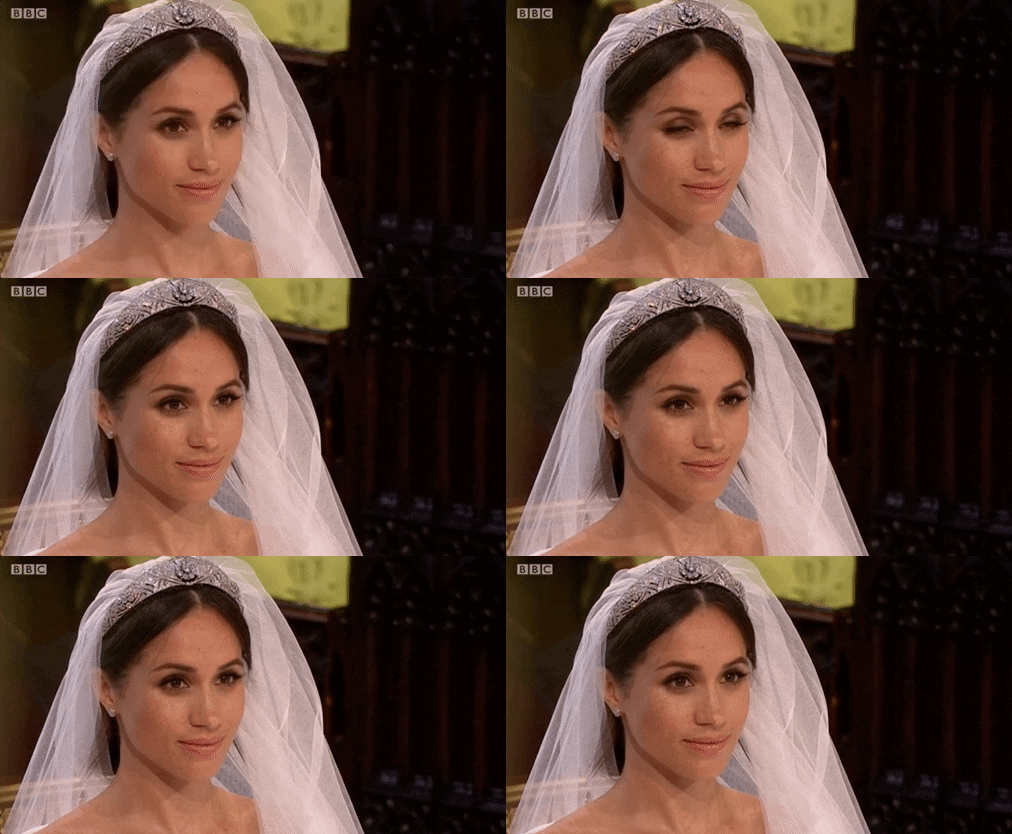
THE ROYAL WEDDING.
THE BRAND
UNRAVELING.
She got the prince, the title, the platform, and the fairy-tale optics. A reported $100 million streaming deal. The kind of global attention most brands spend decades trying to manufacture. Then somehow the brand still lost the room. A programme edition with all six unfortunate readings.
2018 wedding The starting point
that followed Now a first-look arrangement
H2 2025 The ending point
than her 2025 show Off air since 2019
When Meghan Markle married Prince Harry in May 2018, the whole thing arrived packaged as a modern fairy tale. Hollywood actress meets prince. Outsider enters institution. New blood, new era, global fascination, cathedral-level spectacle, and the kind of audience sympathy that most public figures spend entire careers trying to manufacture and never quite achieve.
She had the title. The glamour. The visibility. A reported $100 million streaming deal. The rare kind of platform that lets someone become not just famous but symbolic — a woman who could stand for something larger than herself and carry that weight with grace. The goodwill was genuine. The opportunity was real. The audience was enormous and, for a moment, entirely on her side.
And yet somehow, the brand still unraveled. This programme edition covers how. Six readings. Full receipts. The ceremony, the vows, the toast, and the moment the reception went strange.
What Followed.
What Was Given (2018)
- A global wedding with half a billion viewers
- The Duchess of Sussex title
- Near-universal public goodwill
- A $100M Netflix deal and Spotify partnership
- Institutional platform and royal proximity
- A genuinely compelling personal narrative
- The sympathy that followed the 2021 Oprah interview
What Was Built (2020–2026)
- Privacy claimed. Content produced simultaneously.
- Spotify: one season, terminated
- Netflix: $100M → first-look → unfollow
- With Love, Meghan Season 2: ranked #1,217
- Suits — off air six years — ranked higher
- As Ever launched. Netflix exited eleven months later.
- The Sydney retreat, the refund demands, the $4.50 Funday sweets
Readings.
THE SIX READINGS NOBODY PLANNED FOR
Every ceremony has readings. These are the ones that aged badly.Reading I: The Megxit Mess — Brave or Chaotic?
The royal exit was framed as brave, liberating, and self-defined. A principled refusal to continue inside an institution that had failed to protect them. The case for that framing was real and documented — the inadequate mental health support was not invented, and the racial dynamics in press coverage were not imagined.
But the execution immediately introduced contradictions that never fully closed. Privacy was the stated rationale. Netflix was the immediate commercial outcome. "We are leaving for privacy" and "we are leaving for a $100 million deal" occupy the same sentence in a way that required a great deal of goodwill to ignore — and that goodwill was finite. We wrote about this in the Dear Harry letter. The argument itself became the product. That was the first unraveling.
Reading II: Archewell and the Ambition Gap
Archewell Productions was introduced with the language usually reserved for world-changing institutions. Compassion. Impact. Healing. Transformation. A production company whose stated mission was to "drive systemic cultural change across all of our work." This is a significant claim. The public took note of it. The public kept taking note of it.
Six years later, the company's commercial output includes the Harry and Meghan documentary (which worked), Polo (which did not), With Love, Meghan (which was cancelled after two seasons ranked #1,217), and zero scripted projects in six years despite the scale of the original investment. The $100 million Netflix relationship has contracted to a first-look arrangement that nobody appears to be discussing with enthusiasm. The problem is not that Archewell failed to change systems. The problem is that brands built on moral aspiration require visible proof. When announcements consistently outrun outcomes, enthusiasm cools into something more damaging than hostility: indifference.
Reading III: The Privacy Contradiction That Never Resolved
Privacy was the stated goal — the reason for the exit, the security arrangements, the lawsuits against the tabloid press, the move to California. "We want to live privately" was the founding document of the post-royal era.
The same period produced the Oprah interview, the Netflix documentary, the Harry memoir Spare, the Archetypes podcast, With Love, Meghan, the Australia tour commercial appearances, the Sydney wellness retreat, the delivery room twerking video, and a social media presence that generates tens of millions of views per post. Each individual decision had a rationale. Together they formed a pattern that made "privacy" mean "the right to control what is public" rather than "the right to be left alone." People can forgive ambition. What they struggle to forgive is being told one thing while consistently being shown another. The privacy contradiction was not a one-time mistake. It was the operating principle of the whole era.
Reading IV: Overexposure Overload — When the Mystery Evaporated
Meghan's most commercially powerful period operated on scarcity. The 2018 wedding, the 2020 exit, the 2021 Oprah interview — each one was singular. Each arrived before the previous one had been processed. That scarcity created value. The audience leaned in.
What followed was years of sustained, managed visibility that removed the scarcity entirely. Constant presence, constant commentary, constant reappearance under new narratives. A little mystery keeps an audience leaning forward. Saturation teaches them to scroll past. With Love, Meghan Season 2's position at #1,217 on Netflix is the data point that documents this most precisely. The audience did not object to the show. They simply could not be motivated to watch it. That is what overexposure produces in its terminal stage: not dislike but indifference. For a brand built on personal magnetism, indifference is the only truly terminal condition.
Reading V: The Identity Crisis — A Glamorous Blur Where a Brand Should Be
Actress. Royal. Advocate. Producer. Podcaster. Philanthropist. Founder. Tastemaker. Public victim. Private power player. AI fashion investor. Lifestyle oracle. Wellness retreat host. Jam entrepreneur. Each of these identities arrived with its own aesthetic, its own vocabulary, and its own commercial architecture.
The problem was never a lack of options. It was the total absence of a stable centre. A brand cannot stand upright if it changes its costume every quarter and calls the wardrobe changes evolution. At some point, the audience stops evaluating each new chapter and starts evaluating the pattern of chapters. The pattern says: nothing stays. Which means: nothing can be trusted. Which means: nothing is worth fully investing in. The six-year catalogue reads not as a second act but as a search for one. That search is still ongoing. The audience has largely stopped joining it.
Reading VI: The Gap Between Image and Edge
The specific controversies — the bullying allegations, the Oprah credibility questions, the Thomas Markle situation, the Sydney retreat refund demands — did not just create noise. Each one exposed the same gap: the distance between the compassionate, empathetic, warm public image and the harder, more controlled, more strategically managed edges that kept becoming visible behind it.
Once that gap becomes the story, the elegance of the surface stops helping. People who were previously willing to extend the benefit of the doubt begin to re-evaluate earlier moments through the new lens. The credibility problem is not additive — it is multiplicative. Each new exposure reframes everything that came before it. The Thomas Markle situation is the clearest expression of this. The brand says empathy. The pattern says something more complicated. That complication, repeated across enough contexts, becomes the brand.
Actually Requires.
THE VOWS — WHAT ACTUALLY BUILDS A LASTING BRAND
Not opinions. Structural requirements. Documented by six years of counterexamples.Trust is built when the message stops shape-shifting every quarter. The audience needs to be able to predict what you stand for without reading a press release first.
Authenticity cannot survive if it always arrives fully styled, professionally lit, legally reviewed, and positioned as a chapter in an ongoing narrative about healing.
Visibility works best when it leaves some oxygen in the room. Every interview, every documentary, every managed overshare spends down the reserve of public curiosity.
One lane, executed with consistency over years, will always outperform a glamorous blur of identities executed in sequence. Kate chose kindergartens. The crowd said Bellissima.
The public can forgive conflict. It rarely forgives chaos dressed as principle, or principle deployed so selectively that it starts looking like a strategy with a moral surface.
The narration of the work, at scale, for years, without the work being undeniably good enough to justify the narration — that is the specific failure mode of this era.
KATE WENT TO ITALY AND 3,000 NUNS AND PRESCHOOLERS SCREAMED HER NAME BECAUSE SHE SPENT FIVE YEARS ON KINDERGARTENS. THE CROWD ALWAYS KNOWS THE DIFFERENCE BETWEEN THE WORK AND THE NARRATION OF THE WORK.
"A fairy tale can survive scandal. What it cannot survive is the slow discovery that the story it was telling about itself was not quite the story that was actually happening."
Went Strange.
THE RECEPTION WENT STRANGE
The distance between 500 million wedding viewers and #1,217 on Netflix is the story.Meghan Markle's brand journey is a case study in expectations outrunning execution — and in the specific way that a very strong beginning can create a very large problem if it is not followed with equal substance. The original hype was genuine and enormous. The symbolism was once-in-a-generation. The audience wanted to believe. Many of them still do, in a diminished and exhausted way, which is perhaps the most poignant aspect of the whole story. The goodwill has not entirely gone. It has just been spent faster than it has been replenished.
Titles fade. Novelty fades. Spectacle fades. Once those things have faded, what remains is the structure underneath. The structure underneath has been the problem since at least 2022. The subsequent years have not resolved it. They have documented it, one cancellation and one retreat refund demand at a time.
The wedding was the most watched event of its kind in a generation. Season 2 of With Love, Meghan ranked #1,217 on Netflix. The distance between those two data points is the entire story of the brand. Nothing more needs to be added. The numbers said it already.
There Is Still Time for a Turnaround. But Not for Another Relaunch.
The next chapter — whatever it is — cannot arrive the way every previous chapter has arrived: with an announcement, a press statement, a new aesthetic, and the implicit promise that this time the substance will match the scale of the claim. The audience has seen that pattern enough times to recognise it before it completes. They are very good at recognising it now. She trained them to be.
What could work is what has never been tried: something finished, something undeniable, something that operates on its own merits without the royal backstory doing the structural work. One thing. Completed. Real. Not a trailer for itself. Kate spent five years on kindergartens and 3,000 Italians screamed her name. The work preceded the reception. That is the lesson. It is not a complicated lesson. It is just a difficult one when the content machine requires a different kind of fuel.
At some point, the brand has to offer more than the wedding photo. The wedding was extraordinary. But it was eight years ago. And the audience has been sitting in the reception hall ever since, waiting for the speeches to end and the dancing to begin, and slowly realising that the programme does not have a page for that part.