Prince Harry Does Not Look Okay
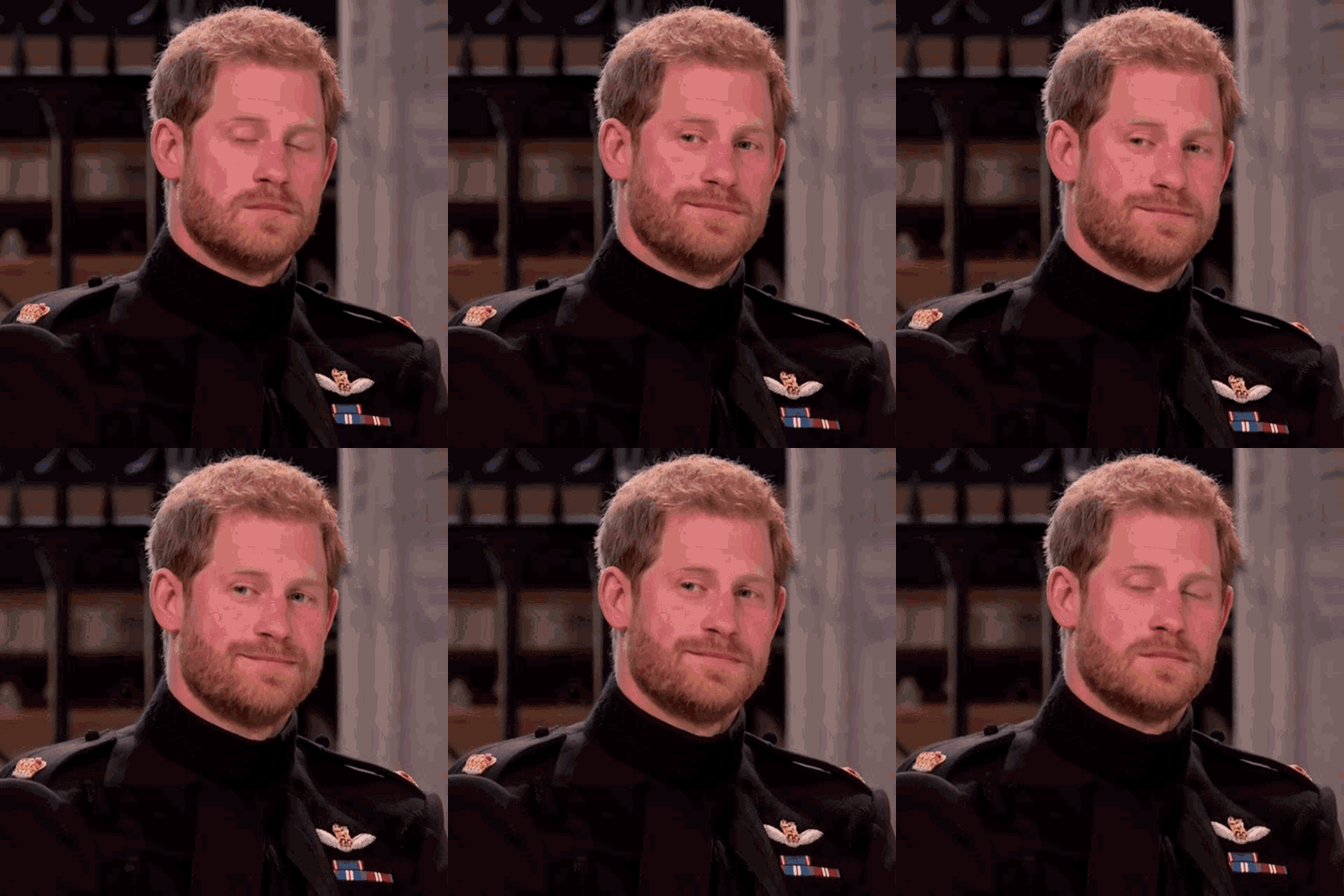
Photo credit
I Know I'm Not Supposed to Say This,
But Prince Harry Does Not Look Okay
Maybe this is parasocial. Maybe it is none of my business. Maybe the internet has rotted all of our instincts into performance. Still, every time he appears in public lately, I have the same thought: something feels off, and pretending not to notice feels just as dishonest as pretending I know exactly why.
Let me say the responsible thing first. I do not know Prince Harry. I do not know his marriage. I do not know what happens behind closed doors, inside private conversations, after the cameras leave, after the interview ends, after the official statement is polished into something clean enough for public consumption.
But public life has a way of forcing private pain into weird shapes, and sometimes what people call "speculation" is just the uneasy human instinct of recognizing distress when it keeps flashing across a familiar face.
So no, this is not a diagnosis. It is not a declaration. It is not one of those smug internet dissections where a slowed-down video clip and a body-language thread suddenly become a courtroom exhibit. It is simpler than that, and maybe more uncomfortable: he does not look well, and I think many people can feel that without claiming to know the whole story.
The public concern about Harry is often dismissed as tabloid intrusion or fan projection. Some of it is. The specific thing this piece is trying to articulate is something different — the accumulated, uneasy recognition that a person who once looked like someone who loved his life now consistently looks like someone managing it. Those are different registers. Most people know them when they see them.
What People Keep Noticing, Even If They're Afraid to Say It Out Loud
The problem with public concern is that it gets dismissed the second it sounds too emotional. But concern rarely arrives in a neat academic tone. It arrives as a pattern. A repeated tension. A face that looks harder each time. A person who seems less like himself and more like someone carrying an invisible weight badly.
None of the points below prove anything with certainty. That matters enormously. But pretending there is nothing to notice at all also feels dishonest. There are reasons people keep circling back to the same uneasy questions — and those reasons are worth sitting with rather than dismissing.
1. The isolation is hard to ignore
His rupture with family has been public, bitter, and ongoing. Of course families can be toxic. Of course estrangement can be necessary and even protective. Estrangement is a complicated subject and does not automatically indicate control or harm.
But when someone becomes more cut off from nearly every old structure in their life — friends, family, institution, country, the army he served in, the causes he championed independently of his marriage — people notice. The pattern is wide enough that "protective boundaries" and "managed isolation" have become genuinely difficult to distinguish from the outside. That difficulty is the point. It should make people thoughtful, not dismissive.
2. He seems radically different from the man people remember
Yes, people change. Grief changes people. Public warfare changes people. Marriage, fatherhood, exile, humiliation — all of it changes people. That is not what this is about.
What many viewers seem to be reacting to is not that he is older or more serious. It is that he often appears diminished. Flattened. Overwound. Like a person moving through his own life with the brakes half on. The man who walked the Invictus stage in 2024 and the man who charmed crowds at polo matches and laughed with veterans does not consistently appear in the same frame as the man giving managed interviews with pre-agreed talking points. These feel like different people rather than one person at different stages.
3. The financial and commercial narrative feels murky
Financial dependency and financial pressure change the emotional temperature of any relationship. The commercial operation has always been primarily positioned around Meghan's identity — her name, her brand, her narrative, her products. Harry appears in it as a supporting presence in a story that is primarily about her.
That does not constitute evidence of anything specific. It is simply the kind of structural arrangement that people who have thought about autonomy and dependency in relationships recognise as worth noticing. The person whose commercial identity is secondary in a joint enterprise has less obvious leverage. That is not proof of harm. It is worth acknowledging.
4. The tension in public appearances does not feel imagined
I do not need a certified interpreter of eyebrow angles to tell me when an interaction looks strained. Most people don't. You can be entirely skeptical of pseudo-scientific body language analysis and still register visible discomfort when it accumulates across enough documented appearances.
Sometimes the most unsettling thing is not one dramatic moment. It is the cumulative effect of many small ones — the slight delay before the smile, the quality of attention in a shared frame, the specific way a person's energy changes depending on who is in the room. None of these things prove anything. All of them are observable.
5. He often sounds like he is defending a script, not speaking freely
Public figures repeat talking points. That is normal and means nothing on its own. But there is a meaningful difference between being media-trained and sounding spiritually cornered by your own narrative.
When someone keeps defending choices that visibly do not seem to be making them happier — when the conviction sounds more effortful each time, when the same phrases recur across years of interviews like lines that have been rehearsed rather than believed — people start to ask whether conviction is really what they are hearing. Sometimes it is. Sometimes it is the refusal to admit something to yourself.
6. Everything gets blamed on outside enemies
Some of those outside forces are real and documented. The British press's treatment of Meghan has genuine racial dimensions that are not invented. The palace's institutional failures were real. Harry's grief about his mother's death and its relationship to the press is real and documented.
What becomes notable is when external blame is the answer to every question, including questions where the external forces don't obviously apply. When every decision, every commercial outcome, every relationship failure is routed outward without remainder, observers begin to wonder whether the inner life of the situation is being carefully managed — and whether Harry has been encouraged to see it that way too.
7. He looks tired in a way that feels deeper than exhaustion
Public commentary on appearance is often cruel, shallow, and predatory. That is true. It is also true that chronic stress has a look, and people who have lived through it — through sustained anxiety, through long-term pressure, through the particular toll of maintaining a public face over a private difficulty — tend to know that look when they see it.
Not every worn face tells a dramatic story. People age, have difficult years, carry ordinary weight. But persistent depletion across a sustained period has a different quality than ordinary tiredness. The specific quality of how Harry has appeared in recent public appearances is something many observers have independently noted without coordination. That pattern of independent noticing is worth taking seriously rather than dismissing as projection.
8. His autonomy is genuinely hard to read
Relationships involve compromise. Public partnerships involve strategy. None of that is automatically problematic. The question being asked is not whether Harry has compromised or strategized. It is whether there is a version of Harry that operates independently of the partnership's requirements — that makes decisions for reasons other than the operation's needs, that speaks in his own voice rather than the brand's voice, that would be recognisably himself in a room where the cameras weren't running.
Those are unanswerable questions from the outside. They are also the right questions. The discomfort that many observers experience watching Harry in public is often precisely located there: not in anything specific he says or does, but in the difficulty of finding him inside what he says and does.
9. The loyalty can look less like love and more like entrapment
People defend the people they love. They also defend situations they cannot emotionally afford to question. Those two realities can look very similar from the outside, and the person inside them often cannot tell the difference themselves — not while they are in it.
That is what makes public concern about Harry so difficult to articulate cleanly. Sometimes steadfast defense is devotion. Sometimes it is survival. Sometimes it is pride — the specific pride of a person who has burned every bridge, sacrificed every relationship, paid every cost, and cannot admit even to themselves that something about the exchange no longer feels right. Not because they are weak. Because being honest about it would require confronting everything they gave up to get here.
10. The emotional volatility reads as pressure leaking through
People under immense, sustained pressure do not always collapse neatly. Sometimes they become reactive. Raw. Easily triggered. Overexposed at moments when management would ordinarily keep them contained. Sometimes the strain leaks through in interviews as something between defensiveness and exhaustion.
That does not tell us the source of the pressure with certainty. It does tell us something about the level of internal strain being managed. And for many viewers, that is the thing they cannot quite shake. Not a specific incident. Just the accumulating sense that a person is under more load than the official narrative allows for, and that the load is not what they said it would be when they left.
What this piece is not saying
It is not claiming facts it cannot know. It is not diagnosing a marriage from photographs. It is not performing concern as content. It is not pretending a headline can replace real information or that observation constitutes proof.
What this piece is saying
Public concern does not become invalid simply because it cannot be fully proven. Sometimes people look unwell. Sometimes those watching can feel it. Sometimes that instinct matters, even when it cannot be neatly resolved or acted on from the outside.
That is where I land. Not in certainty. Not in spectacle. Not in those grotesque online verdicts dressed up as concern where the conclusion was always going to be the same and the evidence was assembled afterward. Just in that stubborn human place where alarm lives before proof, where instinct speaks before evidence catches up — if it ever does.
Maybe the internet has trained us to distrust our own discomfort unless it can be backed by documents, leaked texts, or some cinematic reveal. But real worry rarely arrives with a legal brief. Sometimes it is just the repeated feeling that someone is vanishing in plain sight, and that the people best positioned to notice have every incentive not to.
So is Prince Harry in danger? I cannot say that responsibly. I do not know. Nobody outside the situation knows. And that unknowing is genuinely important — it should keep this piece from claiming conclusions it hasn't earned.
But I can say this: people are not crazy for noticing that something about him feels strained, reduced, or wrong. The observation does not require a conspiracy theory or a villain. It requires only the honest acknowledgment that a person who once looked like he was living can now consistently look like he is enduring.
Maybe that is all concern really is. Not certainty. Not gossip. Just the refusal to look at a person who seems to be fraying and call it normal because the cameras are expensive and the statements are polished and everyone around them has a professional interest in nothing being wrong.
Sometimes the most decent thing is simply to stop pretending the discomfort is imaginary.