Meghan Markle's Latest (Manic) Public Appearance
The Royal Ledger
One Woman Let a Child Twirl.
One Woman Found the Cameras.
On March 17 and March 19, 2026, two women attended two events on opposite sides of the world. A tale of two appearances, two instincts, and the eternal difference between attending an event and becoming one.
On March 17, 2026, at Mons Barracks in Aldershot, Catherine, Princess of Wales, crouched down on a parade ground in her Alexander McQueen forest green coat dress and asked a three-year-old named Vienna if she was excited. Vienna was. Vienna jumped up and down. Vienna twirled in her blue dress when Catherine told her she had beautiful hair. Catherine laughed, took her hands, swung her gently toward the floor, and let the moment belong entirely to a small girl having the best day of her young life.
No atmospheric lighting. No bump-cradling. No sense that the day's meaning required her face to be at the centre of its best photograph. Lance Sergeant Mills — who led the drums and pipes, whose daughter Vienna this was — said meeting the princess was "such a great opportunity" and something his daughter had been looking forward to "all week." His wife Jessica said Catherine was "just so easy to talk to, and really down to earth. I wasn't actually expecting that."
That last sentence is the whole story. She was not expecting that.
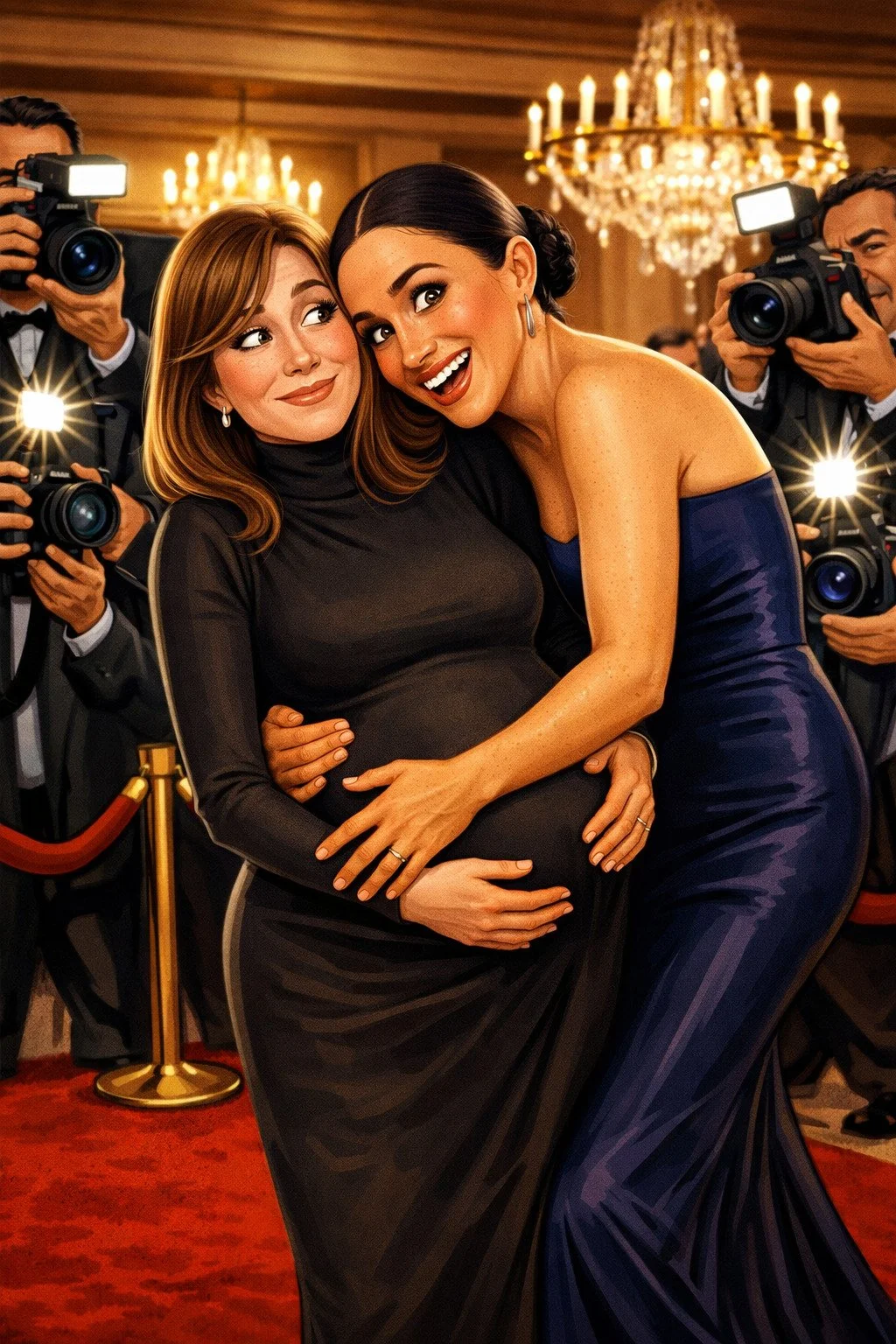
On March 19, 2026, at the Beverly Wilshire Hotel in Beverly Hills — because it could not possibly have been anywhere more on the nose — Meghan Markle, Duchess of Sussex, attended the Alliance for Children's Rights 34th Annual Champions for Children Gala. She was there to present the Francis M. Wheat Community Service Award to her close friend Kelly McKee Zajfen, co-founder of Alliance of Moms, who is expecting a rainbow baby boy following the devastating loss of her nine-year-old son George to COVID and viral meningitis in 2022.
Let us be precise about something before we continue: Kelly McKee Zajfen is a genuinely remarkable woman doing genuinely important work. The gala raised $1.4 million for children in foster care. These are not small things. They are the point — the real point, the actual point — and they deserve to be stated clearly before the analysis begins.
The friendship between Meghan and Kelly is also real. They have known each other for nearly twenty years, since being introduced through Meghan's ex-husband Trevor Engelson. Kelly was with Meghan through the loss of her son, and Meghan and Harry have attended the George Zajfen Tennis Tournament for the past two consecutive years in his memory. When Kelly says "she hasn't left my side since" — that is not a publicity quote. That is a woman describing what her friend actually did during the worst period of her life.
All of this is true. All of this matters. And all of this coexists with something else that is also true and also documented.
"The evening prior to the gala, Ted Sarandos — Netflix CEO — unfollowed Meghan on Instagram. Which in 2026 is the digital equivalent of having your name quietly removed from a guest list."
March 18, 2026: Ted Sarandos, Netflix CEO, unfollowed Meghan Markle on Instagram. This happened. It was noted. The digital gesture of a powerful media executive quietly removing a business partner from his social media feed does not technically mean anything formal or official. It means something cultural. It means something legible.
March 19, 2026, the following evening: Meghan appeared at a high-profile Beverly Hills charity gala. Strapless navy Ralph Lauren. Photographs everywhere. Warm speech about her friend. Award presentation. Good press. Twenty-five photos in the Just Jared gallery.
We are not saying these things are connected. We are noting, with the precision of people who have been documenting this operating model for six years, that they exist in the same 48-hour window, involving the same person, and that the sequencing is — as it so often is — immaculate.
The issue with Meghan has never been that she attends charitable events. She does. The issue is proportion. Every event enters orbit around her eventually, as though gravity itself signed a personal services contract.
Her speech at the Beverly Wilshire was generous and heartfelt. It was also structured, by its end, around enough references to her own emotional experience to ensure no one left having forgotten who held the microphone. This is not malice. It is habit. It is the same instinct that put her in olive green at Prince Louis' christening when everyone else understood the palette. Not cruelty. A very consistent orientation toward centrality.
Catherine, at Mons Barracks, operated from a completely different set of assumptions. She wore the regimental brooch of the Irish Guards — one originally given to the late Queen Elizabeth II in the 1960s — because the day was about the regiment, not about what she chose to wear to it. She crouched on a parade ground and held hands with a three-year-old because the moment was Vienna's moment and there was no version of that calculus that required her to own it.
She also presented shamrock to an Irish Wolfhound named Seamus. His handler noted that Catherine "always loves" greeting Seamus, that she asked after his health, that she remembered the handler from the previous year. The detail of Seamus is not incidental. It is evidence of a woman who has attended this parade enough times that she has a relationship with the dog. That is not performance. That is presence, accumulated across years.
"Disciplined status does not beg to be noticed because it already knows it will be. Undisciplined branding begs because it is no longer certain."
The comparison is not entirely fair, and we should say so plainly. Catherine was born into a system that has spent centuries perfecting the art of visible service with invisible ego. She had decades of training in institutional comportment before a single camera was pointed at her. Meghan came to public life from a different tradition entirely — one where visibility is the product and attention is the metric of success.
These are structurally different starting points and they produce structurally different results. Criticising Meghan for not having the instincts of someone who grew up inside an institution is not entirely fair. She was not shaped by that institution. She was, for a brief period, deployed by it.
What is fair to observe is what six years of freedom from that institution has produced. If the argument was always that the royal system constrained her authentic self — that the real Meghan, free of palace protocols and institutional demands, would finally be able to express who she genuinely is — then the Beverly Wilshire gala is a data point in the ongoing assessment of what that authentic self actually looks like when it operates without constraint.
Six years out, the pattern has not changed. The rebrand is always underway. The pivot is always one event away. The next chapter is always being photographed into existence.
The Alliance for Children's Rights raised $1.4 million. The children in the LA foster care system for whom that money was raised will be materially helped by it. Kelly McKee Zajfen, who has spent years building the infrastructure that makes this work possible, deserved every moment of the evening in her honour.
Vienna Mills, three years old, had the best St. Patrick's Day of her life. She jumped up and down. She twirled. A princess told her she had beautiful hair and held her hands and laughed with her, and then Lance Sergeant Mills led the drums and pipes and said it was one of the big moments of his career.
Both of these things happened in the same week. Both of them were attended by women who showed up because they were supposed to show up. The difference — the only difference that matters, in the end — is whose name you remember when the event is over.
At Mons Barracks, you remember Vienna. You remember Seamus. You remember Lance Sergeant Mills and his moment.
At the Beverly Wilshire, you remember who wore navy Ralph Lauren.
Audiences can forgive ambition. They can forgive vanity. They can even forgive relentless self-mythology if it is entertaining enough. What they do not forgive indefinitely is the sensation of being managed. The Thomas Markle story endures for precisely this reason. Not because people need a villain. Because something about the management is visible now, the way the Lilibet branding made the machinery visible, the way the Sydney retreat made it visible, the way the Melbourne hospital visit made it visible. The stage wiring shows once you know where to look.
Kelly McKee Zajfen still deserved the night. The children still deserve the funds. The cause is real and the friendship is real and the good that was done that evening at the Beverly Wilshire is also real.
But whenever Meghan enters a room, there is always a second event occurring simultaneously: the production of Meghan Markle attending a room. And the question — the one that six years of watching has not yet resolved — is whether those two events can ever occupy the same space without the second one quietly absorbing the first.