The Oprah-tunity Cost
The Oprah-tunity Cost
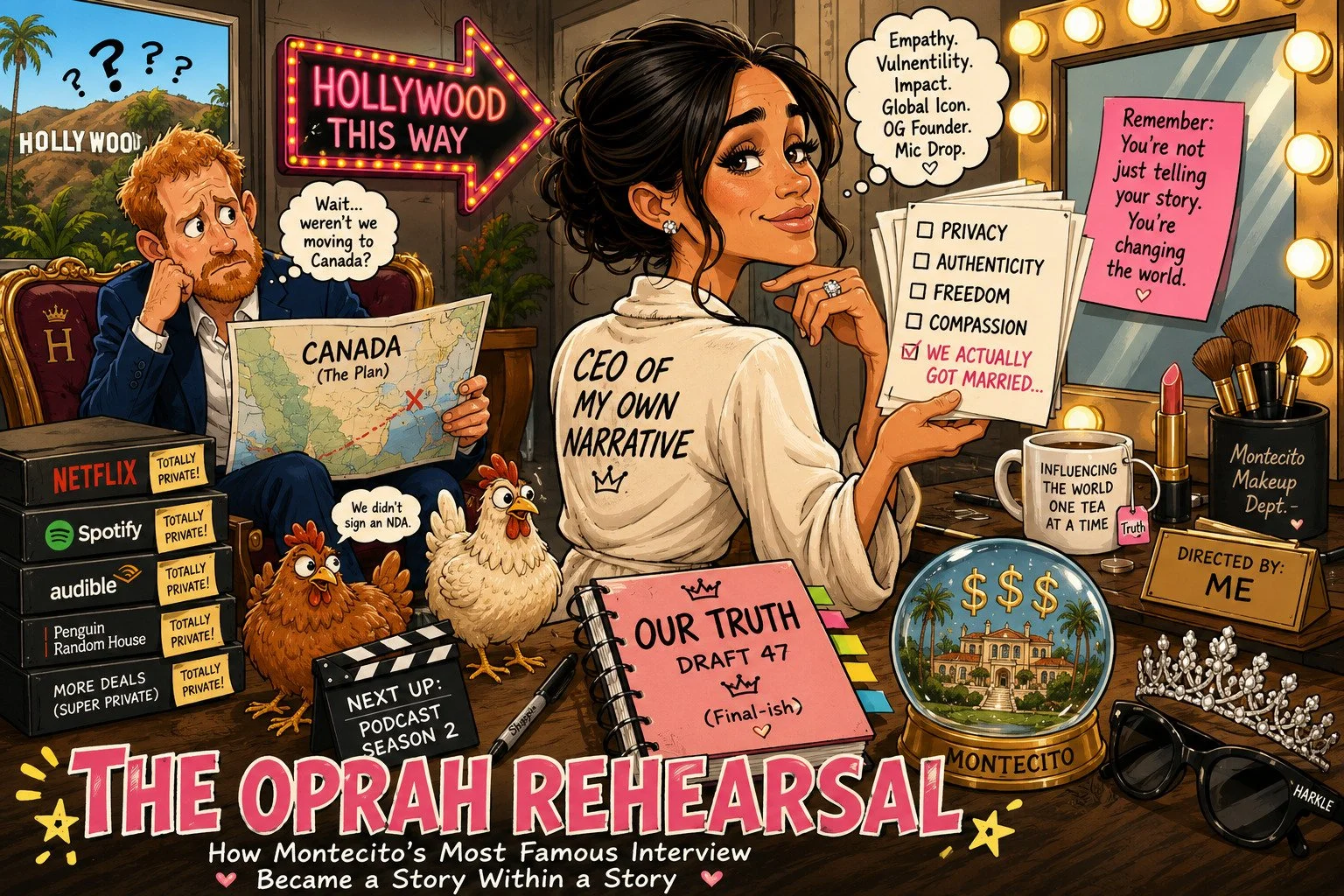
A satirical retelling of the night before the interview, the story that followed, the chickens who refused media training, and the one question Harry's face seemed to keep asking: wait, weren't we moving to Canada?
The Montecito chickens had long gone to bed. This, in hindsight, may have made them the only residents of the property operating with a healthy sense of boundaries.
Inside the mansion, however, the lights were still on.
Not in a cozy, newly-free couple whispering about their future sort of way. More in the way campaign headquarters probably look the night before an election, when the coffee has gone cold, the slogans have gone feral, and someone has written authenticity on a whiteboard so many times it has become a threat.
Meghan paced the room with the focused energy of a woman preparing for either a life-changing interview or a particularly aggressive PTA coup.
Harry sat on the sofa, blinking at cue cards.
- Freedom
- Compassion
- Authenticity
- Privacy
- Exclusive sit-down with Oprah Winfrey
Harry picked up the last one and frowned.
"Should privacy and Oprah maybe not be on the same card?"
The room went quiet.
Meghan slowly lowered her herbal tea.
"Harry."
"Right," he said. "Sorry."
He placed the card back exactly where he found it, as if disturbing the narrative might set off an alarm.
"Remember," Meghan said, resuming her pacing, "this isn't just about what happened."
Harry nodded.
"It's about how it felt."
He nodded again.
"And how it looked."
Another nod.
"And how it will be clipped on social media."
Harry stopped nodding.
There are moments in every marriage when one person realizes they may have missed several meetings. Harry appeared to be living inside one of those moments permanently.
The Difference Between an Interview and a Narrative
"What's the difference?" Harry asked.
Meghan looked at him with patience. Not warm patience. Executive patience.
"An interview is when someone asks questions," she said.
"Right."
"A narrative is when we answer the questions people should have asked."
Harry stared.
"And if Oprah asks something else?"
"Then we pivot."
"To what?"
"Pain."
He absorbed this. Somewhere in the distance, a chicken made a noise that suggested it had understood more than he had.
Do not think of this as television.
Think of it as a controlled burn.
The palace has marble. I have Oprah.
Everyone must play to their strengths.
The rehearsal continued.
If Oprah asked a difficult question, Harry was instructed to look thoughtful. If he did not know the answer, he was to look wounded. If he disagreed, he was to look down. This last instruction came naturally. By then, he had become exceptionally good at looking down.
It was not cowardice exactly. It was more like emotional buffering. The royal browser had too many tabs open.
The Wedding Before the Wedding
Then came the line.
"We actually got married three days before the wedding."
Somewhere in Britain, an archbishop dropped his pen.
Harry shifted in his chair.
Not enough to derail anything. Just enough for everyone with functioning peripheral vision to notice.
His face did not say scandal. It said administration.
It said: Did we file that?
It said: Was I at that one?
It said: I remember a garden, but I also remember a nationally televised ceremony, several choirs, and my grandmother sitting in a hat.
Details are decorative.
Think of facts as throw pillows.
They are there to support the aesthetic, not the structural integrity.
In a purely legal sense, the statement quickly became one of those little royal footnotes that lawyers, clergy, and people on Twitter could fight over until the heat death of the internet. Was it a legal wedding? A private vow exchange? A spiritual ceremony? A backyard soft launch?
But as television, it was perfect.
A secret wedding is irresistible. It implies romance, intimacy, rebellion, and stationery nobody else received. It makes the public wedding feel almost beside the point. A small thing, really. Just the Archbishop of Canterbury, the Queen, the choir, the cameras, the global broadcast, and several million people who apparently had not been invited to the real thing.
Justin Welby — the Archbishop allegedly present at this clandestine garden ceremony — publicly contradicted the claim weeks after broadcast. "The legal wedding was on the Saturday," he told La Repubblica. "I signed the wedding certificate, which is a legal document, and I would have committed a serious criminal offense if I signed it knowing it was false."
The couple's own spokesperson later confirmed to The Daily Beast that the backyard moment was not a legal marriage. English law also requires at least two witnesses beyond the officiant. There were, by Harry's own account on camera, three people present.
What happened was almost certainly a private vow exchange. Which is lovely. Intimate. But not the same sentence as "we got married — no one knows that." Recollections, as the palace once observed about a different matter, may vary. The Archbishop's, in this case, are backed by a signed legal document and the threat of criminal liability.
Harry glanced sideways — the glance lasted less than a second, but it was enough. Royal conditioning then arrived like a butler carrying a tray: smile politely, do not interrupt, do not make a scene, let the duchess cook, even if she appears to be flambéing the calendar.
Nobody Asked If I Was Okay
Then the emotional architecture went up. The palace was cold, the institution was cruel, nobody helped, nobody listened, nobody cared. It was clean television — brutal, effective, designed to land in the chest and bypass the filing cabinet where dates, protocols, and contradictory interviews usually live. Millions watched from their sofas. Some cried. Others stared at the screen while remembering the last time they were not okay and received a single text that said "u good?" followed by a thumbs-up emoji six hours later.
Vulnerability score: rising.
Sympathy index: stable.
Oprah is leaning forward.
Continue deployment.
During the general period Meghan described as institutional silencing, she guest-edited the September 2019 issue of British Vogue — one of fashion's most coveted annual platforms, requiring months of active correspondence, commissions, and the public expression of her views. She also made approximately 73 public appearances in the same window, many with speeches. "Silenced" may well have referred to something specific and real about palace press restrictions. As a full account of her output during this period, it needed the word to carry considerably more than it usually does while wearing considerably better clothes.
Separately, her claim that palace HR refused mental health support because it "wouldn't be good for the institution" landed with devastating effect. It also went undocumented. No named individuals. No follow-up evidence. At the time, Harry was publicly co-founding the Heads Together mental health charity. The couple had given speeches about the importance of asking for help. The idea that this same institution simultaneously told a family member help was unavailable is not impossible. It is just the kind of claim that normally comes with a source.
Harry looked downward — not angry, not defensive, just tired. Like a man mentally replaying every decision since Las Vegas and wondering whether at any point he could have taken up beekeeping instead. The tragedy of Harry in that interview was not that he looked shocked by every statement. It was that he often looked like someone hearing the polished version of his own life for the first time. There is a difference between living through something and watching it become content, and he looked like he was discovering that difference in real time.
The Canada Plot Twist
This may be the part Brewtiful readers keep circling back to, because it is where the whole dream starts to look less like a rescue mission and more like a relocation package with hidden fees.
Harry's version of freedom always sounded Canadian. Not Hollywood. Canada — Commonwealth, quiet, rain, trees, dogs, a comfortable distance from palace life without launching directly into celebrity orbit. You can almost see it: Vancouver Island, morning walks, muddy boots, a fleece jacket, security that looked bored, a rescue dog named something sincere, Harry learning to split logs while insisting it was "actually quite therapeutic," the occasional Tim Hortons run where nobody pretended not to recognise him but everyone remained too polite to say anything. It had a shape. It made sense. It was escape without performance.
Then, somewhere along the way, the destination acquired palm trees, then Netflix, then Spotify, then production meetings, then brand decks, then Montecito, then a lifestyle vocabulary so expensive it began making ordinary jam sound like a founding document.
We can absolutely be private.
Privately famous.
There is a difference.
One involves better distribution.
Harry may have thought they were escaping. California looked suspiciously like arriving.
If Canada was the quiet exit, California was the grand entrance through the gift shop.
Brewtiful TranslationAnd maybe that is the heart of the entire thing. Meghan seemed to understand California instinctively — California loves reinvention, does not ask who you were born as, asks instead what your launch strategy is, and can turn trauma into a docuseries, privacy into a press release, and jam into a soft-power campaign. Harry, meanwhile, appeared to understand escape. Those are not the same skill set.
The Chicken Strategy
Then came the chickens — rescue chickens, specifically, because regular chickens apparently would not have carried the emotional symbolism. The interview cut to gardens, sunlight, rustic fencing, fresh eggs, and domestic calm: the visual equivalent of whispering "we're just like you" from a property most people could only afford if they discovered oil under their sectional sofa. Still, the chickens worked. Of course they worked. Never underestimate poultry in a soft-focus crisis.
Martha Stewart walked so I could emotionally support livestock.
Gwyneth had candles.
I have hens.
We all find our lane.
Harry smiled at the chickens, and it may have been the happiest he appeared all evening. The chickens, to their credit, declined to comment on palace racism, title protocols, security funding, or whether a private vow exchange counts as a wedding. They pecked at the ground, maintained brand neutrality, and gave nothing away. There is dignity in that.
Privacy, Sponsored by Global Distribution
The word privacy has had a difficult few years. It used to mean privacy. Then it became something closer to the right to tell your story publicly while asking everyone else to stop telling theirs. This is not unique to Harry and Meghan — celebrity privacy has always been less about disappearing and more about controlling the angles. The difference is that most celebrities do not frame the control room as a monastery. By the time the Oprah interview aired, privacy had already become one of the central contradictions of the Sussex project. They wanted peace but not invisibility, freedom but not irrelevance, distance but not silence, a life beyond the palace but also the ability to monetise the palace-shaped hole in the room.
Harry looked like a man who wanted the noise to stop. Meghan looked like someone who had realised the noise could be arranged. These are not the same dream.
Leaving royal life did not end the scrutiny. It changed the venue. The palace press pack became streaming deals, tabloid cycles, brand coverage, legal updates, and public commentary from every person with a ring light and a grievance. The machine did not stop. It simply moved to California and discovered better lighting.
The Title Problem
Then there was Archie — the titles, the security, the implication, the palace machinery, the rules that somehow always sound simple until a duchess explains them to Oprah and suddenly everyone is Googling King George V like they have a constitutional law exam in the morning. This part of the interview was emotionally powerful because it linked status, safety, race, and belonging into one impossible knot. The institution had rules, the public had feelings, the media had headlines, and Harry had a face that suggested he wished someone had brought a flowchart.
Under long-standing royal convention, Archie did not automatically qualify as prince while Queen Elizabeth II was monarch. After Charles became King, Archie and Lilibet became eligible to use Prince and Princess titles.
So the claim was not cleanly wrong, but it was also not as simple as the emotional packaging made it feel in the moment. Royal protocol: somehow both archaic and aggressively boring.
This is where the Oprah interview worked best and worst simultaneously. Best, because it took complicated institutional machinery and made people feel the human cost of it. Worst, because it sometimes turned that same machinery into a villain monologue wearing a crown. Good television hates nuance — nuance sits badly under studio lighting.
The Part Where Reality Filed a Complaint
Here is the thing about a very good narrative: it does not need every individual fact inside it to be accurate. The emotional logic carries the rest — you feel the wrongness, and the details stop mattering quite as much. That is not a design flaw in the Oprah interview. That is the design. But several of the interview's most headline-generating claims did not simply fade into the general fog of royal dispute. They were contradicted by named people, on the record, and in some cases by the couple themselves. Most viewers never heard about the contradictions because they arrived quietly, in follow-up articles, with no Oprah, no garden lighting, and absolutely no chickens. Corrections are not good television. This is a structural problem with truth.
The Archbishop's Objection
The secret wedding claim was the interview's most romantically irresistible moment. Just the two of them. The garden. The Archbishop. No spectacle. No camera. No one watching.
Except, as it turned out: an Archbishop who had some thoughts about being cast in this story.
Within weeks of the broadcast, Justin Welby — the man allegedly present at this clandestine backyard ceremony — gave an interview to Italian newspaper La Repubblica. "The legal wedding was on the Saturday," he said. "I signed the wedding certificate, which is a legal document, and I would have committed a serious criminal offense if I signed it knowing it was false."
Which is the ecclesiastical equivalent of clearing your throat very loudly in a library.
The couple's own spokesperson subsequently confirmed to The Daily Beast that the backyard moment was not a legal marriage. English law also requires at least two witnesses beyond the officiant. By Harry's own on-camera account, there were three people present.
So: a private vow exchange. Meaningful. Intimate. Genuinely romantic. But not "we got married three days before — no one knows that." Those are different sentences. One is a blessing. The other is a claim an Archbishop has explicitly said he would face criminal charges for enabling.
I have married future monarchs.
I have baptised royal children.
I have never, in the course of my ministry, been used as a plot device.
Until now.
The correction received a fraction of the coverage the original claim did. It arrived without fanfare, without a primetime slot, without Oprah leaning forward on a garden chair. This is the fundamental asymmetry of the attention economy. Claims travel at the speed of television. Corrections travel at the speed of a press office statement most people missed.
The walk-back was quiet, brief, and received approximately the cultural impact of a footnote in a document nobody printed.
Brewtiful TranslationThe Silencing of the Woman Who Edited British Vogue
The interview's second great claim was silence — enforced, institutional, the kind that descends when a very large, very old, very marble institution decides a voice is inconvenient. Which may well have been Meghan's genuine experience of certain palace protocols. The institution was not warm, not flexible, and communicated through courtiers who communicated through other courtiers in a language apparently designed to prevent anyone from saying anything directly. All of that can be true.
And also: in September 2019, Meghan Markle guest-edited the most-read annual issue of British Vogue.
She commissioned the interviews. She chose the cover. She wrote the framing. She corresponded publicly about her vision. She made approximately 73 public appearances during the period she described as her silencing, many of which involved speeches, remarks, and the active deployment of her voice.
There are many kinds of silence.
There is the silence of not being allowed to speak.
And there is the silence of not being heard.
I was editing a magazine during the second kind.
This distinction requires a longer interview.
"Silenced" may have meant something specific: the inability to respond to press stories, to defend herself publicly against palace leaks, to push back on the narrative being built around her. That is a real and documented frustration many royals have described.
But as a complete account of the period, the word was doing the work of a much longer sentence while wearing much simpler clothes.
Then there was the claim about mental health support. Meghan described going to the palace's human resources department, explaining she was not okay, and being told there was nothing they could do because she was not a paid employee of the institution. The emotional impact landed exactly as intended — millions of people understood, viscerally, the experience of reaching for help and finding a form to fill in instead. The contextual detail the interview did not dwell on: at the time, Harry was co-founder of Heads Together, a high-profile mental health charity he had helped launch specifically to destigmatise seeking psychological support, was publicly in therapy, and had given speeches about the importance of asking for help. That an institution publicly championing mental health simultaneously told a family member help was unavailable is not impossible — institutional hypocrisy is one of the most well-documented phenomena in human history — but no named individual was cited and no documentation was produced. The claim created powerful feeling in advance of any evidence, which is the interview's consistent structural method.
There is also the matter of the only child. Meghan told Oprah she grew up as one. She has a half-sister, Samantha Markle, and a half-brother, Thomas Markle Jr. Samantha Markle filed a defamation lawsuit. Meghan's legal team responded with what may be the most philosophically ambitious sentence produced by the Sussex communications apparatus to date: the statement, they said, "was obviously not meant to be a statement of objective fact" but rather "a textbook example of a subjective statement about how a person feels about her childhood." Which is a defense — and one that would technically work for a great number of other things people say, if applied consistently, though whether it should is a question Meghan's lawyers did not address, possibly because they were busy.
None of these corrections received anything like the airtime of the original claims. They arrived in follow-up articles, press statements, and court filings. They had no Oprah. They had no garden. They had no chickens to maintain the emotional register.
This is not a conspiracy. It is just how the attention economy works. A claim made on primetime television to an audience of millions carries more weight than a correction filed in a court document or given to an Italian newspaper. The asymmetry is structural. Meghan understood it. The palace did not.
Understanding which direction information travels is not the same as lying. But it does shape what people remember. And what people remember is mostly the interview, not the footnotes that followed.
Oprah Asks. Harry Sinks.
As the interview continued, viewers became amateur detectives — a pause here, a glance there, a subtle tightening around Harry's eyes. The body-language industry probably paid for several vacations afterward. He did not look triumphant or relieved. He looked like a man realising, in real time, that the roller coaster he had boarded was not the scenic railway he had been promised, and the safety bar had already locked.
I thought this was about mental health.
And maybe Canada.
Why are we discussing the Archbishop?
Why is everything suddenly a brand pillar?
There is a specific expression people wear when they realise they agreed to the terms and conditions without scrolling. Harry wore it repeatedly. To be fair, he had his own reasons for speaking. His life inside the institution had clearly left marks. His anger at the press was not invented, his grief was not a strategy, his need to protect his family was not fake. But somewhere inside the Oprah interview, those real wounds became part of a larger presentation. The problem was not that Harry had pain. The problem was that pain had entered a partnership with production value.
The California Dream, Itemized
The California dream must have sounded beautiful at first: no more grey palace corridors, no more hierarchy, no more courtiers whispering through the wallpaper, no more tabloids waiting outside like raccoons with press credentials. Just sunshine, freedom, family, work that mattered, and enough distance to breathe. Even the most cynical person can understand the appeal. California has a way of making reinvention feel morally superior — you are not just moving, you are healing; not just buying a house, you are choosing peace; not just signing a media deal, you are reclaiming your voice, with backend participation.
The trouble is that California also has receipts. It loves a launch and is less sentimental about maintenance. Netflix wants results, Spotify wants inventory, lifestyle brands want conversion, public sympathy wants fresh chapters, and the audience wants more story then resents you for having one. Harry may have expected freedom to feel quiet. Instead, it came with deliverables.
Freedom is one thing. Freedom with quarterly content obligations is quite another.
The Montecito SpreadsheetThe Woman Who Thought She Understood The Assignment
Meghan Markle's greatest talent may not be strategy.
It may be confidence.
The kind of confidence that allows a person to walk into a room, announce she has reinvented storytelling itself, and somehow convince everyone to ignore the smoke coming from the previous five projects.
Because truly strategic people tend to build. They sustain. They adapt. They do not burn through Spotify, cool relations with Netflix, alienate half of Hollywood, launch a lifestyle brand with the consistency of airport Wi-Fi, and then call it misunderstood genius.
The Oprah interview worked because it tapped into something real: pain, isolation, anger, and the universal desire to be believed. But believing you won the moment is not the same as winning the war.
And that is where Meghan's pattern becomes fascinating.
Every setback has an assigned villain.
The Palace. The British press. Racism. Spotify. Netflix. The public. The timing. The algorithm. Mercury, possibly, if the brand deck needs another slide.
At some point, if every room is full of idiots, perhaps the common denominator deserves a follow-up question.
None of this means she is not ambitious. She clearly is. It does not mean she is unintelligent. It means confidence without self-awareness can become its own liability. Eventually hubris starts introducing itself as brilliance, usually right before the cliff edge.
The Oprah interview was not messy in the way raw confession is messy. It was polished, arranged, and built: hurt, escape, love story, institutional villain, backyard wedding, chickens, hope, roll credits. It was not subtle, but subtlety has never trended well. And the narrative was built so cleanly that it did not require every claim inside it to survive contact with the footnotes.
That was not genius. That was a very expensive first impression with a terrible warranty.
The Man Who Looked Like He Missed a Memo
Harry, meanwhile, looked like a man trapped between two operating systems. The old one: duty, silence, family, don't explain, don't complain, pretend everything is fine while a portrait of an ancestor watches from the wall. The new one: explain everything, complain strategically, package the pain, own the story, make sure the lighting is good. He wanted to defend his wife, condemn the system, make people understand — but he also appeared, at times, to be hearing the full marketing version of their life at the same moment as the rest of us.
That is what made his face so compelling. Not guilt, not betrayal — recognition. The slow dawning horror of a man realising the quiet life may have been a brochure image, and he was already inside the campaign.
Was there a meeting about this?
Was I invited?
Did I decline?
Is this what freedom looks like?
The Ariel Problem
And then there was Ariel.
Because naturally, in the middle of this adult constitutional fever dream, Meghan reached for The Little Mermaid. Not Diana. Not Grace Kelly. Not even Wallis Simpson, who at least understood the burden of becoming a royal problem with good tailoring. Ariel.
Meghan said she identified with Ariel because Ariel fell in love with a prince and lost her voice. It was meant to be poignant. It was supposed to glide into the room like a Disney metaphor wearing pearls.
Unfortunately, metaphors have a way of opening the wrong door when left unattended.
She fell in love with a prince.
She lost her voice.
The symbolism is perfect.
Please do not examine the contract.
Because Ariel did not simply lose her voice. Ariel ignored everyone who knew her, abandoned her entire family system, changed species for a man she had mostly observed from a distance, and signed a legally suspicious agreement with a woman whose entire aesthetic screamed litigation pending.
She traded her voice for proximity to a prince. She believed a dream sold at the height of emotion. She entered a deal without fully understanding the clauses. She then spent the rest of the story discovering that transformation is expensive and paperwork is rarely your friend.
Which, as royal metaphors go, is not nothing.
In The Little Mermaid, Ursula at least had the decency to announce herself through song.
Brewtiful TranslationHarry, meanwhile, increasingly resembled Prince Eric: pleasant, handsome, a little damp, and apparently unaware that several major plot developments were occurring around him. Eric spent much of the film being saved by a woman whose life he did not fully understand. Harry spent much of the Oprah interview looking like he had discovered the sequel had been greenlit without his notes.
The Ariel comparison was supposed to prove Meghan had been silenced. Instead, it accidentally reminded everyone that fairy tales are mostly stories about people making enormous decisions while emotionally undercooked.
As Brewtiful already noted in our dive into The Little Mermaid, Ariel's entire storyline is basically: I met a man, ignored everyone who knew better, signed paperwork without reading it, and hoped love would fix logistics.
Depending on your feelings about Oprah, that is either an inspiring fairy tale or an alarmingly familiar relocation strategy.
The Ariel comparison works only if we stop at the surface: prince, love, lost voice. The second anyone remembers the actual plot, the metaphor begins chewing through the furniture.
Ariel's story is not just about being silenced. It is about bargaining away her own voice to chase a dream, trusting the wrong broker, and learning that fantasy comes with terms and conditions. Meghan offered the symbol. The symbol then behaved badly in public.
The Recollections Needed GPS
By the end of the Oprah interview, viewers were expected to hold several ideas in their heads at once without asking them to make eye contact.
Meghan was silenced while guest-editing British Vogue. She grew up as an only child despite having half-siblings. She had secretly married three days earlier, despite the Archbishop later clarifying the legal wedding was the public one. Privacy required a global television special. California represented escape from publicity. Ariel was the right comparison, provided nobody remembered Ursula, contracts, or the part where the heroine gives up her voice voluntarily.
At some point, my truth stopped meaning perspective and started applying for diplomatic immunity from basic chronology.
And Harry, poor Harry, kept looking like the man in the passenger seat who had agreed to a weekend getaway and slowly realised the car was headed to a media empire with a chicken coop.
The Brutal Brewtiful Read
Harry was not sold a marriage.
He was sold a pitch deck.
Freedom. Privacy. Canada. Children growing up normal. Rescue dogs. Muddy boots. Maybe the occasional Tim Hortons run where Canadians politely pretended not to recognise him because national etiquette is sometimes stronger than celebrity culture.
Then somewhere between Vancouver Island and Montecito, the presentation changed.
The privacy became Netflix. The healing became Spotify. The quiet life became Oprah. The escape became content. The trauma became intellectual property with better lighting.
Harry looked less like the co-author of the plan and more like a man discovering Version 2.0 during the quarterly earnings call.
And maybe that is why people remain fascinated by him. Because everyone knows that feeling: the job that was not the job, the relationship that was not what it said on the tin, the temporary move that somehow ended with a lifestyle brand and artisan jam.
The difference is that most people do not realise it while Oprah Winfrey is staring into their soul from across a garden patio.
Meghan understood something Harry never fully grasped: the story was not the escape. The story was always the destination.
The palace brought a press office to a branding war.
And Lost On ContactThe cruel twist is that the exit was not empty. It had a production crew, contracts, talking points, an Ariel metaphor that aged like seafood in a hot car, and chickens. And it had Oprah, sitting calmly in the garden asking questions while Harry's face quietly attempted to resign from the narrative.
Final Thoughts From Montecito
That is why the interview remains fascinating years later — not because everyone agreed, far from it. Some people saw courage, others saw calculation. Some saw liberation, others saw reinvention disguised as victimhood. Some watched Meghan and believed every word. Others watched Harry and wondered if he believed all of them at quite the same speed. The interview did what great television does: it flattened complexity into feeling, gave audiences a story simple enough to argue about forever, and turned institutional dysfunction, family pain, celebrity ambition, racial tension, marriage, branding, trauma, monarchy, and poultry into a two-hour cultural grenade.
And sitting in the middle of it was Harry — looking down, looking sideways, smiling late, processing. Maybe he was protecting his wife. Maybe he was backing the plan. Maybe he was realising the plan had more departments than he remembered. Because if his face had subtitles that evening, one suspects they might have read:
Wait.
We were moving to Canada, weren't we?
Why are there chickens?
And why is Oprah here?
End SceneThe trouble with dreams is that eventually they run into real life. And real life does not care about the narrative. It just keeps rolling the cameras.
Be honest: did Harry know he was signing up for California, or did he think this was a quiet Canada situation?
Cast your vote — results update live, just for you. The chickens remain undecided.